

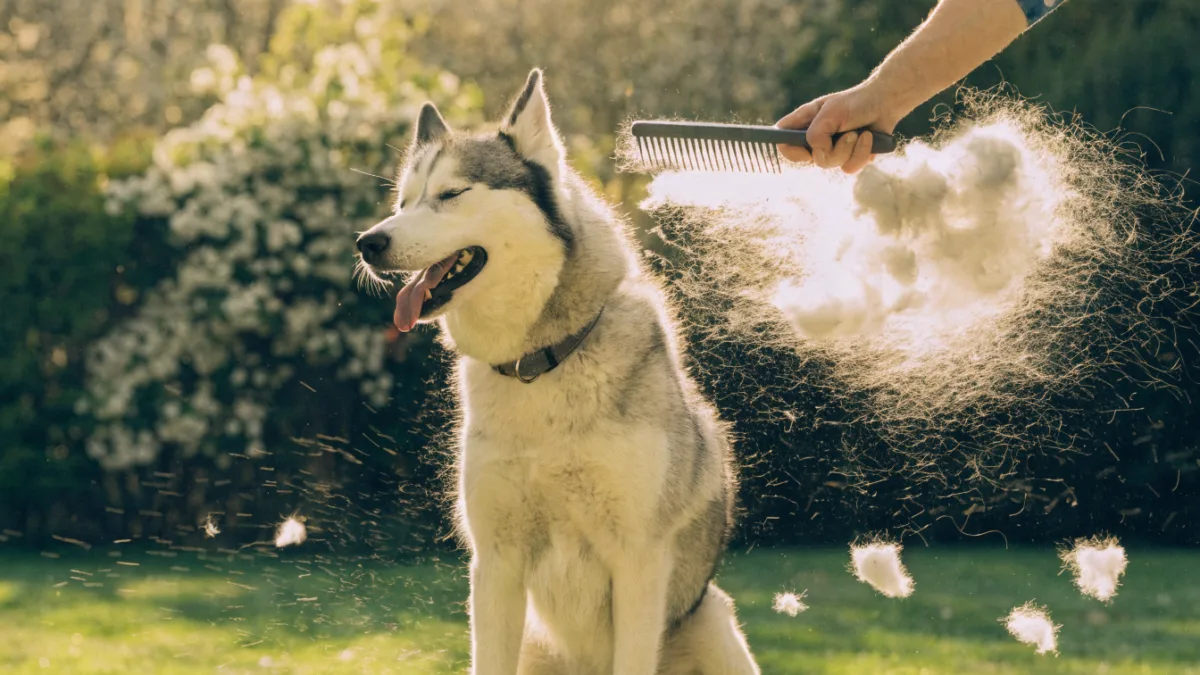
I watched a Husky named Koda get a high-velocity blowout at a grooming shop in Portland last April. The groomer turned on the dryer, and within thirty seconds the room looked like someone had stuffed a pillowcase full of winter coat and detonated it. Fur swirled in eddies across the tile floor. Koda sat there grinning, fifty percent smaller than when he walked in. His owner filmed the whole thing for TikTok. That’s the “Fur-nado” — and if you live with a double-coated dog or cat, it’s coming for your furniture twice a year whether you’re ready or not.
What’s Actually Coming Off Your Dog
The spring blow-out is a biological event, not a malfunction. Dogs and cats with double coats grow a dense layer of soft, fluffy undercoat insulation beneath their longer, coarser guard hairs — the topcoat that repels water and dirt. When daylight hours shift in spring, hormonal changes trigger the undercoat to release in massive quantities so a lighter summer coat can replace it. A second, smaller blow happens in fall, when the winter undercoat grows back in.
Single-coated breeds — Poodles, Dobermans, Boxers — shed a little all year. You’ll find hair on your clothes, but never enough to knit a second dog. Double-coated breeds shed moderately year-round and then lose what looks like an entire second animal over the course of two to four weeks each spring. The volume is genuinely hard to understand until you’ve lived through it. A blowing Husky can produce enough loose fur in one brushing session to fill a kitchen trash bag. I’ve held clumps of shed undercoat from a friend’s Bernese Mountain Dog that were larger than the dog’s head.
Who’s at Ground Zero
Nordic and herding breeds dominate the Fur-nado roster. Huskies, Alaskan Malamutes, Samoyeds, and American Eskimo Dogs blow coat with a ferocity that borders on performance art. German Shepherds are notorious — working-line GSDs with correct coat texture seem to produce fur from a pocket dimension. Golden Retrievers, Bernese Mountain Dogs, Newfoundlands, Great Pyrenees, and Shiba Inus all blow twice a year. Even some cats get in on it: Maine Coons and Norwegian Forest Cats carry genuine double coats and will shed accordingly.
Professional groomers see their de-shedding bookings spike every April and May. Many offer tiered treatments — basic undercoat removal runs around $40 to $60 for a medium dog, while the deep-conditioning “super de-shed” services with enzyme shampoos and extended blow-dry time can hit $100 to $150 for heavily coated breeds. Worth every cent if you value your vacuum cleaner.
Surviving the Storm at Home
You can’t stop a coat blow, but you can dramatically reduce the fur circulating through your house. The goal is removing loose undercoat before it migrates onto your couch, your bed, and your work clothes. Different tools do different jobs, and using the wrong one — or the right one incorrectly — wastes time and can hurt your dog.
Tools That Actually Work
- Undercoat rake: The single most important tool for a blowing coat. Long teeth reach through the topcoat down to the loose undercoat beneath. Use this first, working in the direction of hair growth. A good rake will pull out shocking amounts of fur from a Husky or Shepherd.
- Slicker brush: Best for finishing work and for the moderate year-round shedding between blow-outs. Fine wire pins grab loose topcoat and smaller undercoat tufts. Not sufficient on its own during a full blow.
- Deshedding blades (Furminator-style tools): Effective but controversial. These curved blades with fine teeth work by grabbing loose hair near the skin. Used correctly, they’re excellent. Used too aggressively on a dry coat, they cut or damage the healthy topcoat and can cause brush burn — painful friction irritation on the skin. Limit sessions to 15 to 20 minutes, and never drag a blade across dry, unconditioned fur without some kind of detangling spray.
- High-velocity dryer: The same tool groomers use to create those viral Fur-nado videos. If you have access to one and a yard, blowing the loose coat out with forced air after a warm bath is dramatically more effective than any brushing alone. The water loosens the dead follicles, and the air does what no brush can reach.
Deshedding shampoos have gotten genuinely better in recent years. Enzyme-based formulas help break down the proteins anchoring dead hair follicles, and silicone-based conditioning sprays protect the living topcoat from mechanical damage during aggressive brushing. None of these are magic — they’re tools that make the physical removal easier.
Diet Matters More Than You’d Think
Coat health reflects what goes into the food bowl. Omega-3 and Omega-6 fatty acids — found in fish oil, flaxseed, and quality animal fats — support skin barrier function and help the shedding cycle proceed normally. A dog on a marginal diet with poor fat content will still blow coat, but the process is uglier: dry, brittle fur that sheds in broken pieces rather than releasing cleanly. If your dog’s coat looks dull or their skin seems flaky heading into spring, talk to your vet about supplementation. I’ve seen a week of fish oil make a visible difference in coat texture on a foster Shepherd I took in last March.
The Shaving Debate: Don’t Do It
Every spring, someone decides to solve the shedding problem by shaving their Husky or Golden Retriever down short for summer. This is one of the few topics in animal care where I’ll state my position without any softening: do not shave a double-coated dog.
The reasoning people give is that they want to keep the dog cool. This reveals a fundamental misunderstanding of what a double coat does. The undercoat doesn’t just trap heat in winter — it also insulates against external heat in summer. It works the same way insulation in your house walls keeps the interior warm in January and cool in July. Strip that insulation, and the dog has no thermal regulation system. Shaved double-coated dogs are more susceptible to heat stress, not less. They’re also vulnerable to sunburn, which is painful and can lead to skin cancers over time.
There’s a secondary consequence that’s permanent. Shaving can damage the hair follicles, causing a condition called post-clipping alopecia. The topcoat — which grows slowly and on a different cycle than the undercoat — may never grow back properly. You end up with a patchy, uneven coat that sheds worse than before and offers no weather protection. Some dogs recover after months; some don’t recover at all. I’ve seen it in a shaved Samoyed at a rescue. Two years post-clip, the coat was still a patchwork of dense undercoat tufts and bare skin. There was no fixing it.
The exception: medical shaving for surgery, wound care, or severe matting. That’s necessary and done under veterinary guidance. Cosmetic shaving is not.
When Shedding Isn’t Shedding
A healthy coat blow produces massive fur loss, but the skin underneath stays normal: clean, pale or appropriately pigmented, no redness, no scaling. The coat may look thinner, but you shouldn’t see bald patches.
If your dog is losing hair in distinct patches, the skin beneath is red, inflamed, or scabby, or the shedding is continuous rather than seasonal, something else is going on. Allergies — environmental or food — cause itchy, inflamed skin with hair loss. Hypothyroidism, common in middle-aged Golden Retrievers and Dobermans, produces a thinning coat, especially along the flanks and tail. Cushing’s disease (hyperadrenocorticism) causes symmetrical hair loss and a pot-bellied appearance. Stress shedding — the kind that happens when a dog is terrified at the vet — is real but temporary and doesn’t produce the sustained hair loss of a medical issue.
Parasites matter too. Mange (demodectic or sarcoptic) causes patchy hair loss with skin involvement. Flea allergy dermatitis can trigger fur loss along the lower back and hindquarters. If your dog is scratching obsessively alongside the shedding, or if the skin looks anything other than normal, see your vet before assuming it’s just the season.
Living With It
I’m not going to pretend the Fur-nado is fun. It’s messy, it’s relentless for a few weeks, and it will test your commitment to keeping a clean house. But it’s also a sign that your dog’s body is functioning exactly as it evolved to — growing the right coat for the season, shedding what it no longer needs, and maintaining the thermal regulation system that lets a Husky sleep in the snow and a Malamute work in the heat.
Brush your dog daily during the blow. Feed a diet with real fat content. Invest in a good undercoat rake and learn to use it properly. Accept that your clothes will carry dog hair from March through May. And when you see those viral videos of groomers creating fur tornadoes in their shops, you’ll know exactly what you’re watching — not a gimmick, but the seasonal rhythm of an animal built for extreme temperatures, doing what it’s done for thousands of years. Just maybe keep your mouth closed if you’re standing downwind.