

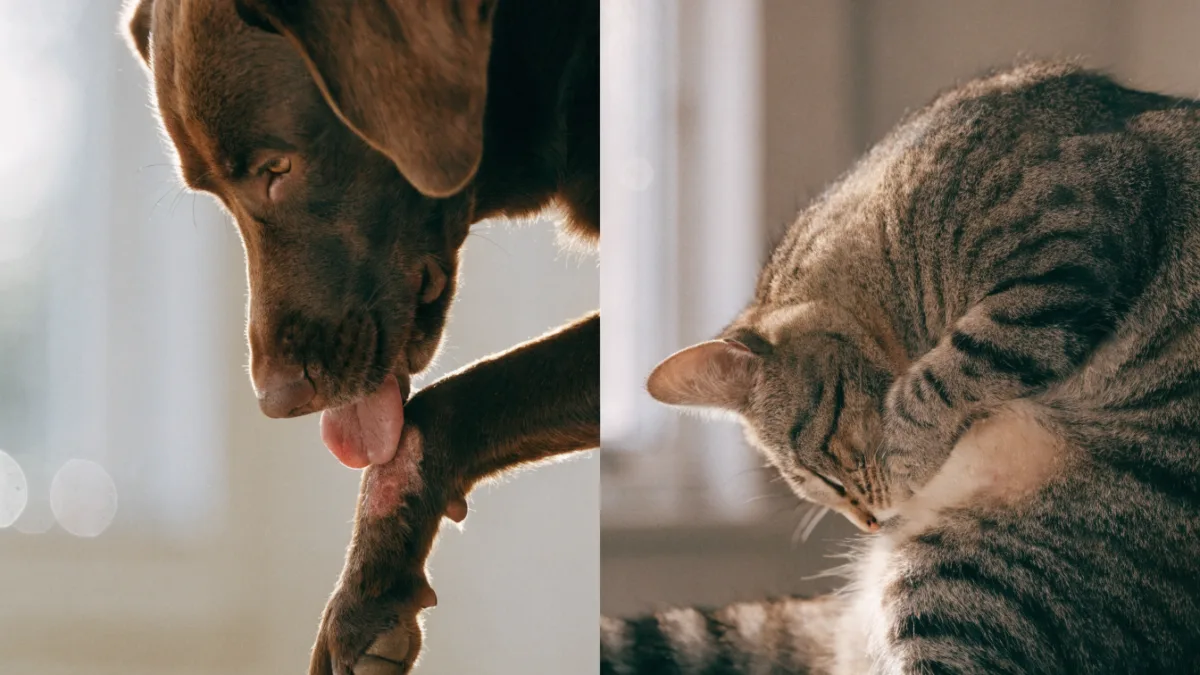
The first time you see a lick granuloma up close, it stays with you. A sweet-natured Golden Retriever named Max, a raw, hairless patch the size of a half-dollar on his left wrist. His owner, Karen, looked exhausted. “He just won’t stop,” she said. “I’ve tried everything — bitter sprays, cones, yelling at him when I catch him doing it. Nothing works.” Clinics still see a Max every single week. What Karen didn’t know then, and what many pet owners still don’t realize, is that compulsive licking and overgrooming aren’t discipline problems. They’re complex medical and behavioral conditions that require patience, detective work, and a treatment plan that addresses both body and mind.
The Itch-Lick Cycle: How a Scratch Becomes an Addiction
Acral Lick Dermatitis (ALD), sometimes called a lick granuloma, is one of the most frustrating conditions I treat. The word “acral” simply means the extremities — these lesions almost always show up on a dog’s lower legs, particularly around the wrist (carpal) or ankle (tarsal) joints. It starts innocently enough. Maybe the dog has an allergy flare-up, a tiny insect bite, or a minor strain. The area itches or aches, so the dog licks it for relief. So far, so normal.
The problem is what happens next. The licking itself causes inflammation and tissue damage, which makes the area itch even more, which triggers more licking. This self-perpetuating loop is what veterinary dermatologists call the itch-lick cycle. But here’s the kicker that makes ALD so stubborn: researchers have found that repetitive licking triggers the release of endorphins — feel-good chemicals — in the dog’s brain. So the behavior literally becomes self-rewarding. Your dog isn’t being stubborn or naughty. Their brain has essentially wired the licking into a behavioral addiction.
I used to think ALD was primarily a psychological issue — a “nervous habit” in anxious dogs. I’ve changed my mind on this. While anxiety and boredom absolutely play a role, we now understand that [1] is remarkably similar to what we see in human obsessive-compulsive disorders. That insight has completely transformed how we approach treatment.
ALD vs. Hot Spots: Not the Same Thing
Let me clear up a common source of confusion. You’ll sometimes see ALD described as a type of “hot spot,” but most veterinary dermatologists — myself included — consider them distinct conditions. Hot spots, or acute moist dermatitis, are superficial, oozy, painful lesions that appear suddenly and can pop up anywhere on the body. They’re often triggered by a single event: a flea bite, a swim that didn’t dry properly, a food allergy flare. ALD, by contrast, is a deep, chronic, thickened lesion that develops slowly over weeks or months and almost exclusively targets the limbs. The tissue becomes nodular and firm — what we call a granuloma. Different problems, different timelines, different treatment approaches.
Dogs Lick Legs, Cats Mow Bellies: Species Differences Matter
While dogs typically create these localized, stubborn leg lesions, cats express the same underlying problem very differently. Feline overgrooming tends to be more widespread and far more secretive. A cat might systematically lick their belly bald, create symmetrical hairless strips down their flanks, or obsessively groom their inner thighs until the skin is raw. Veterinary behaviorists sometimes call this “fur-mowing,” and the pattern can be remarkably precise — almost surgical in its symmetry.
The challenge with cats is that they’re fastidious groomers by nature. A dog scratching loudly at 3 AM is impossible to ignore. A cat quietly licking their abdomen in the corner? Most owners don’t notice until significant hair loss appears. I had a patient — a nine-year-old Siamese named Luna — whose owner brought her in for a routine checkup. The owner was horrified when I pointed out a completely bald, slightly reddened patch on Luna’s belly. “I thought she was just cleaning herself more because she was getting older,” the owner said. In reality, Luna had developed an allergy to a new household cleaner, and the overgrooming had been going on for weeks.
The itch in cats is real — they just express it differently than dogs. Where a dog might scratch noisily, a cat will often just… lick. Silently. Relentlessly. Until the fur is gone.
Is It Medical or Behavioral? The Honest Answer Is Usually Both
One of the biggest debates in veterinary medicine is whether ALD and feline overgrooming start as a primary behavioral issue — an obsessive-compulsive tendency that then damages the skin — or whether they’re always secondary to an undiagnosed medical problem that eventually becomes behavioral. In my experience, it’s almost always the latter initially, but the former takes over.
Here’s what I mean. The licking usually starts because something genuinely itches, hurts, or feels uncomfortable. Common culprits include:
- Environmental or food allergies — the most common trigger I see in practice
- Parasitic infections — mites, fleas, even microscopic Demodex mites that normally live harmlessly on skin
- Underlying joint or tendon pain — a dog with arthritis in their wrist may lick the area trying to soothe the ache
- Boredom, anxiety, or lack of stimulation — especially in intelligent, high-energy breeds like Border Collies, Dobermans, and Labradors
The medical issue kicks off the licking. Then the endorphin loop takes over, and even after you’ve addressed the original trigger, the behavior persists because it’s now self-reinforcing. This is why treating only the skin or only the behavior rarely works. You have to address both.
Don’t Skip the Workup
Well-meaning owners spend hundreds on behavioral supplements and anxiety medications for a dog whose licking was actually caused by a deep bacterial infection in the bone. Conversely, vets treat the skin with every antibiotic and anti-inflammatory available, only to have the lesion return because the underlying anxiety was never addressed. Skin scrapings, bacterial cultures, allergy testing, and sometimes even X-rays are necessary to get the full picture. Skip the detective work, and you’re just treating symptoms.
Breaking the Cycle: Why One Approach Never Works Alone
Successful treatment requires what we call a multi-modal approach. You’re fighting on three fronts simultaneously: healing the physical wound, stopping the itch, and breaking the behavioral habit. Here’s what that typically looks like in practice.
Healing the skin: Many ALD lesions harbor deep bacterial infections that require weeks — sometimes months — of antibiotics. Anti-inflammatory medications may be necessary to reduce the swelling and thickening. In stubborn cases, laser therapy or even surgical removal of the granuloma might be recommended, though I reserve surgery for cases that haven’t responded to anything else.
Stopping the itch: The last decade has brought genuine breakthroughs in targeted anti-itch therapies. Drugs that specifically block the itch pathways in the skin — without the sedation and side effects of older steroids — have been transformative. These medications give the skin a chance to heal while we work on the behavioral component. Talk to your veterinarian about whether these newer options might be appropriate, but never adjust dosages or combine treatments without professional guidance.
Breaking the habit: This is often the hardest part. Physical barriers like Elizabethan collars or inflatable collars may be necessary temporarily. But we also need to address the psychological component. That’s where psychiatric medications have genuinely changed the game. Drugs originally developed for human OCD and anxiety — fluoxetine and clomipramine are common examples — are now standard tools in veterinary behavioral medicine. [2] long enough for new, healthier patterns to establish.
I always pair medication with environmental management. For Max, the Golden Retriever I mentioned earlier, that meant daily puzzle feeders, a structured exercise routine, and removing his access to the room where he most often licked. We treated his underlying environmental allergies with immunotherapy, used targeted anti-itch medication for three months, and started fluoxetine to break the compulsive loop. It took four months, but the granuloma finally healed. Karen cried when she saw fur growing back on his wrist.
What I Want Every Pet Owner to Know
If your dog or cat is overgrooming, please don’t wait. The longer the itch-lick cycle continues, the harder it becomes to break. Don’t blame yourself, and don’t blame your pet. This isn’t a training failure or a personality flaw — it’s a genuine medical condition that deserves the same seriousness you’d give any other health problem.
And while this article focuses on our companion animals, the impulse to overgroom when stressed, itchy, or in pain is something we see across the animal kingdom. Understanding compulsive behaviors in domestic pets gives researchers valuable insight into animal welfare more broadly — from zoo enrichment programs to wildlife rehabilitation. When we learn to recognize and relieve suffering in the animals closest to us, we become better stewards of all creatures. That’s not just good veterinary medicine. That’s the contract we signed when we invited animals into our lives.
Sources
- the neurochemistry driving compulsive licking — pmc.ncbi.nlm.nih.gov
- They help disrupt the endorphin-driven compulsion — dvm360.com