

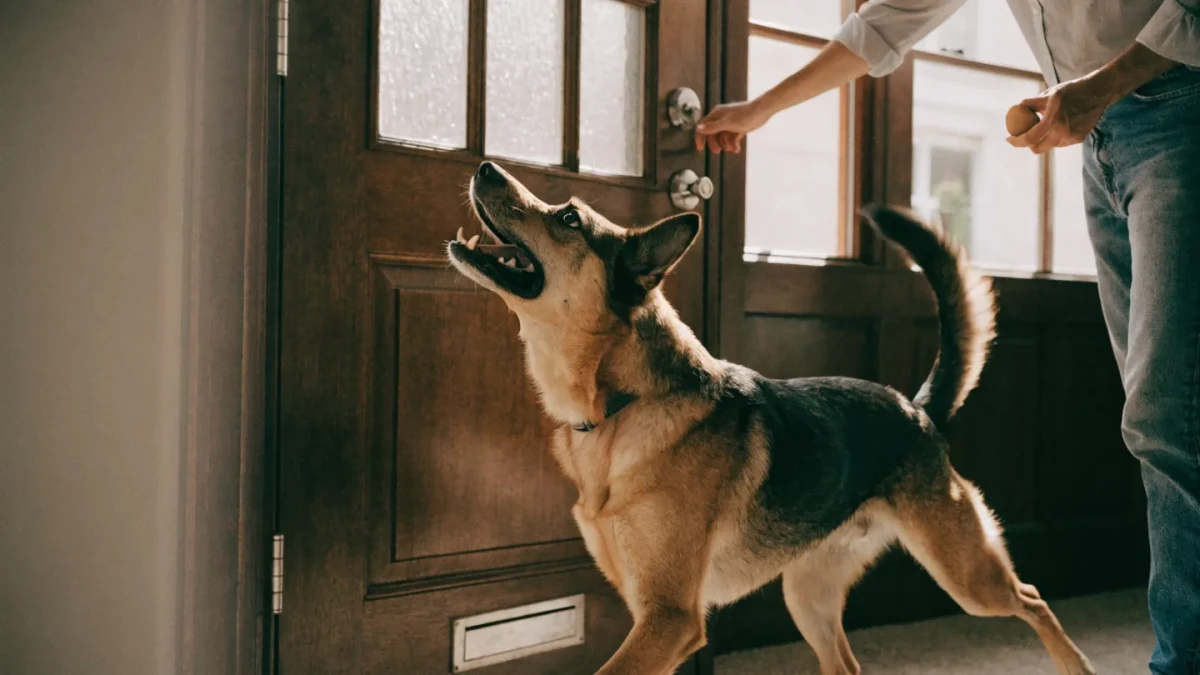
Alert barking is probably the most misunderstood behavior type I work with. Owners want it eliminated. What they can usually realistically achieve is alert barking that's controlled and brief — and honestly, that's actually a reasonable goal.
Your dog barking twice when someone approaches the door serves a function. Your dog barking for six minutes while you're trying to hold a conversation at the front door does not.
Why Alert Barking Exists
Dogs were selectively bred in many cases to alert humans to intruders, strangers, and changes in the environment. The guardian breeds, herding breeds, and terriers especially. Even in mixed-breed dogs, this instinct runs deep.
When your dog barks at the mail carrier, they genuinely believe they're doing their job. And here's the confirming reinforcement that keeps the behavior strong: the mail carrier always leaves. In the dog's worldview, barking at the mail carrier works every time.
You're not going to train away the instinct. You can absolutely train the behavior that follows it.
The Acknowledgment Method
The most effective framework for alert barking is this: one or two barks to alert, then owner acknowledges, then quiet.
When the dog alerts, say something calm and neutral — "I hear it" or "Good dog, I've got it" — in a normal voice. Not excited, not sharp, just acknowledging. This communicates to the dog that the information has been received. Many dogs stop barking on their own once they feel heard.
Then ask for an incompatible behavior: "place" (go to your mat), sit, or find-it (scatter treats for sniffing). The dog can't bark and sniff simultaneously.
Practice this when there's no trigger present first. The dog should already have a solid "place" or "find-it" before you add the doorbell distraction.
Doorbell Protocol
Doorbell barking is one of the most common complaints I hear, and it's very trainable.
Phase 1: Desensitize the doorbell sound. Play a doorbell recording on your phone at low volume during meals or training. Gradually increase volume over sessions. The dog learns the doorbell is just a sound, not a guaranteed crisis.
Phase 2: Build a new doorbell response. When the doorbell rings, ask for "place" immediately. Have the dog go to their mat and settle while you open the door. Build this association in low-distraction scenarios first — ring the bell yourself, ask for place, reward heavily.
Phase 3: Proof with real visitors. Brief your guests: walk slowly, don't rush the dog. Have guests enter and immediately scatter treats near the dog's mat or offer treats for calm behavior. The visitor arriving should predict good things, not just the alarm of the doorbell.
Managing the Escalation Pattern
Many alert-barking dogs have an escalation pattern: one bark, no response from owner, more barking, owner tells them to be quiet, more barking. The "telling them to be quiet" actually often adds to the escalation because it's attention and arousal-feeding.
Interrupt before escalation. Don't wait until the dog is at full arousal volume — intervene after the first one or two barks, acknowledge calmly, redirect. The earlier in the sequence, the lower the arousal to manage.
FAQ
My dog barks at everything — cars, wind, other dogs, sounds from neighbors. How do I manage this?
For dogs that alert-bark constantly to outdoor stimuli, the first step is management: block visual and auditory access as much as possible. Frosted window film, white noise machine, keeping the dog away from windows. You can't train a behavior that's being rehearsed all day. Reduce the triggers first, then work on the response.
Is alert barking worse in certain breeds?
Yes. Herding breeds (especially collies and shepherds), terriers, Nordic breeds (huskies, malamutes), and many guardian breeds have stronger alert-barking instincts than retrievers, scent hounds, or many sporting breeds. This doesn't mean the behavior can't be managed — but "controlled" may be a more realistic goal than "minimal" for high-instinct breeds. (See also: dog anxiety.)
My dog doesn't stop barking even after I acknowledge them. What am I doing wrong?
First, check whether the acknowledgment is coming before the dog is over-aroused. If you wait until they're fully revved up, the acknowledgment may not register. Intervene earlier in the sequence. Second, check that the alternate behavior (place, sit) is strong enough to override the arousal — if the dog doesn't know "place" well in calm settings, they're not going to do it when the doorbell rings. Build the foundation in non-distraction scenarios first.
Alert barking isn't a character flaw. It's a job your dog believes they're doing. Giving them a clear protocol — alert, owner acknowledges, redirect — satisfies the instinct while keeping your household livable.