

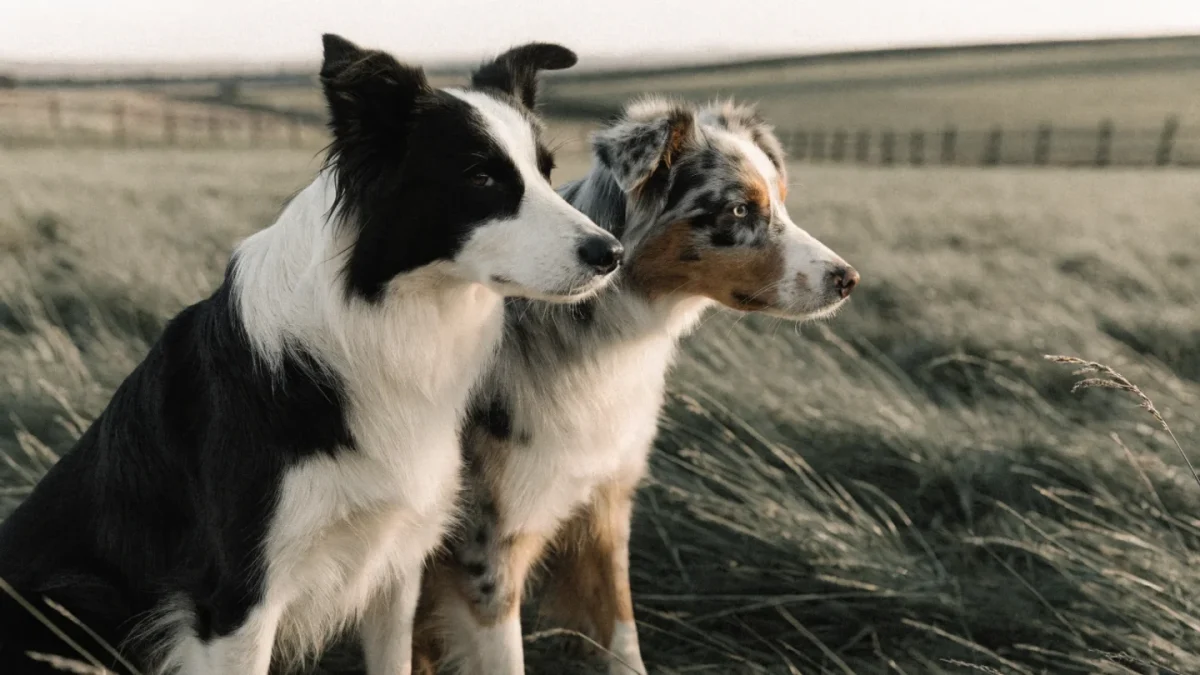
Despite the name, the Australian Shepherd was developed in the western United States during the 1800s — ranchers called them "Australian" because of an association with Basque shepherds who had spent time in Australia before emigrating. The Border Collie, meanwhile, traces to the Anglo-Scottish border region and was refined almost entirely for herding sheep with an intense, crouching stare called "the eye." Both breeds herd. How they approach that job tells you everything about what it's like to live with each one.
Size and Build
| Trait | Border Collie | Australian Shepherd |
|---|---|---|
| Height (male) | 48–56 cm | 51–58 cm |
| Height (female) | 46–53 cm | 46–54 cm |
| Weight (male) | 14–20 kg | 23–29 kg |
| Weight (female) | 12–19 kg | 18–25 kg |
| Build | Lean, athletic | Slightly stockier, more muscular |
The Aussie is the bigger dog — noticeably heavier and wider through the chest. Border Collies are built for agility and speed, with a lighter frame. Both breeds come in a range of coat colors and patterns, including merle, though the merle-to-merle breeding risks (deafness, blindness) apply equally to both. For the full framework I use to compare breeds, see the breed comparisons guide.
Temperament
The Border Collie is widely considered the most intelligent dog breed, and that intelligence comes with a cost. They're intense, obsessive, and need a job. Without structured work — herding, competitive agility, advanced obedience, or comparable outlets — a Border Collie will create its own job, and that job usually involves herding your children, chasing shadows, or developing compulsive behaviors like light fixation.
Australian Shepherds are also intelligent and driven, but they operate at a slightly lower intensity. They're more socially adaptable, more playful, and more capable of switching between "work mode" and "family mode." An Aussie is more likely to play with your kids and then settle on the couch. A Border Collie is more likely to stare at your kids with uncomfortable focus, waiting for them to form a flock.
Both breeds are velcro dogs — they follow their people everywhere. Both are wary of strangers to varying degrees, though Aussies tend toward more overt protectiveness while Border Collies tend more toward avoidance or nervousness.
Exercise and Mental Stimulation
Both breeds need 60 to 90+ minutes of daily exercise. The distinction is mental load.
Border Collies need work that challenges their brains every day. Physical exercise alone doesn't satisfy them. They need complex tasks — agility courses, herding trials, advanced trick training, competitive nose work. A physically tired Border Collie that's mentally understimulated will still be a behavioral problem.
Australian Shepherds are more satisfied with a combination of vigorous physical exercise and moderate mental engagement. A long hike, a game of fetch, and some basic training will settle most Aussies. They're demanding dogs, but they're not relentless about mental complexity the way Border Collies are.
Grooming
Both have medium-length double coats that shed year-round with heavier blowouts in spring and fall. The Aussie's coat is generally thicker and may require slightly more frequent brushing — three to four times per week versus two to three for most Border Collies. Both need attention to feathering on legs, chest, and tail where mats form.
Health
| Health Factor | Border Collie | Australian Shepherd |
|---|---|---|
| Top concern | Epilepsy, Collie eye anomaly (CEA) | Hip dysplasia, epilepsy |
| Lifespan | 12–15 years | 12–15 years |
| Eye issues | CEA, PRA | Cataracts (especially merle) |
| Joint issues | Less common | More common (hip dysplasia) |
| MDR1 gene | Present in some lines | Present in many lines |
Both breeds can carry the MDR1 mutation, which causes sensitivity to certain common medications — ivermectin being the most well-known. DNA testing for MDR1 is standard practice and should be done before administering affected medications. The Border Collie generally has fewer structural health issues, partly due to its lighter build.
Which Fits Your Life?
Choose the Border Collie if you have a specific working or competitive outlet in mind, can provide complex mental challenges daily, and want the most responsive and handler-focused herding dog available. Understand that the intensity is not optional — it's the entire package.
Choose the Australian Shepherd if you want a versatile, active herding breed that adapts better to family life without formal herding work. Aussies still need plenty of exercise and engagement, but they're more forgiving when life gets in the way of the ideal schedule.
For a very different herding breed comparison, see how the Pembroke and Cardigan Welsh Corgis compare — same herding instinct, completely different package. For a complete profile of the Australian Shepherd on its own terms — history, health, and training requirements — see the Australian Shepherd complete breed guide. For an encyclopedic look at the Border Collie's Scottish border heritage, working instinct, and mental stimulation requirements, the Border Collie complete breed guide covers the breed in full.