

I've written about dozens of breeds over the past decade, and the Boston Terrier generates a particular kind of misconception — the kind that sticks because it sounds plausible. People hear "terrier" and make assumptions about behavior. They see "small" and make assumptions about needs. They watch the dog snort and wheeze and assume that's just how the breed sounds. Each of these casual beliefs contains a kernel of something, but the full picture is different enough to matter.
Here are five boston terrier misconceptions myths worth correcting, examined against breed history and observable evidence rather than internet repetition.
1. They're Terriers
The name is the problem. "Boston Terrier" implies a terrier, and people expect terrier behavior: high prey drive, independent thinking, digging, relentless pursuit of small animals, and that wired, alert energy that terrier owners know well.
Boston Terriers are none of that. They're classified in the Non-Sporting Group, not the Terrier Group, and the behavioral reality matches the classification. The "terrier" in the name is a historical artifact — the breed descends partly from the now-extinct white English Terrier, and the name stuck when the Boston Terrier Club of America organized in 1891. But 150 years of selective breeding for companionship has produced a dog that behaves nothing like a Jack Russell, a Fox Terrier, or a Border Terrier.
Boston Terriers have low prey drive. They don't typically dig. They're people-oriented rather than independently motivated. Their energy is moderate and social, not persistent and hunting-focused. Expecting terrier behavior from a Boston is like expecting retriever behavior from a Poodle — the ancestry is there, but the centuries of divergent selection have produced a fundamentally different animal.
2. They're Low-Energy Lap Dogs
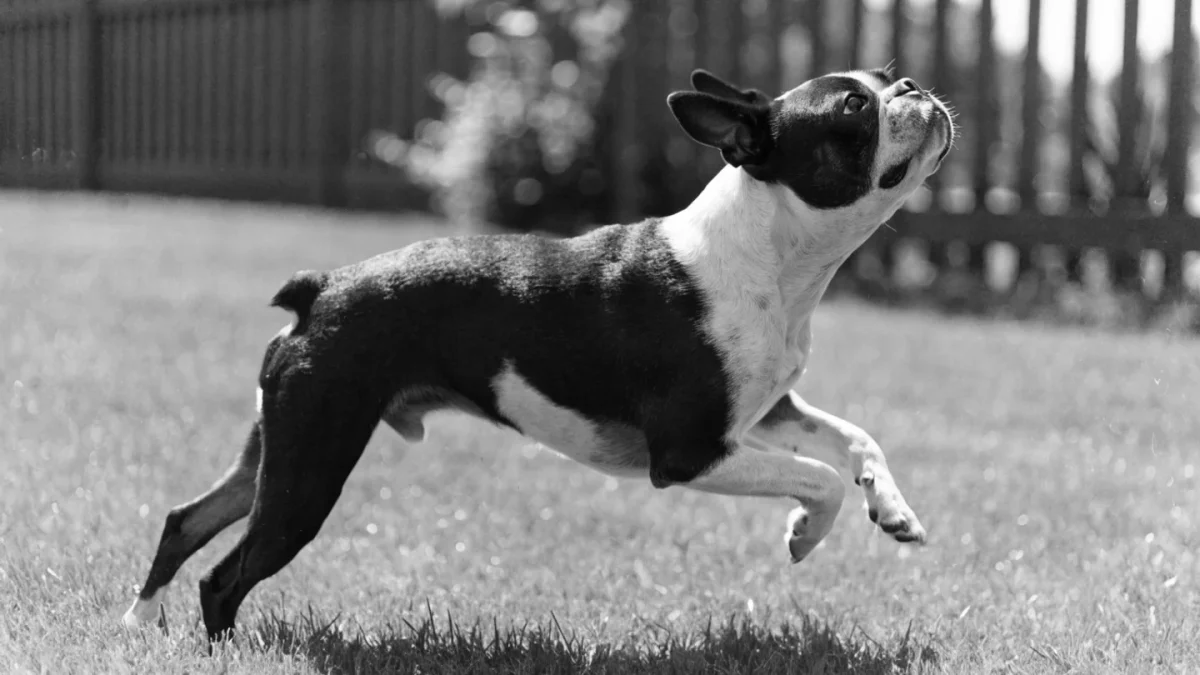
The "American Gentleman" image works overtime here. People picture a small, dignified dog in a tuxedo pattern sitting primly on a cushion. Some Bostons do that. Plenty of others are bouncing, sprinting, toy-destroying bundles of energy that don't fully settle until age three or four.
The breed's energy level spans a wider spectrum than most people expect. Genetics, individual temperament, and age all play roles. Young Bostons in particular can be remarkably athletic and driven — they play hard, they run fast for their size, and they have bursts of intensity that surprise owners who expected a sedentary companion.
Even calmer individuals need 30 to 60 minutes of daily activity. A Boston that gets no physical or mental exercise develops behavioral problems: excessive barking, destructive chewing, resource guarding born from frustration. "Small" doesn't mean "inactive," and treating the breed as a decorative lap dog does it a disservice.
3. Their Breathing Is Just How They Sound
This misconception does the most damage. Owners hear snoring, snorting, wheezing, and labored panting and assume it's a normal breed characteristic — charming, even. Visitors hear it and think, "That's just what Boston Terriers do."
Some degree of respiratory noise is common in brachycephalic breeds. But there's a meaningful distinction between an occasional snort during excitement and chronic noisy breathing at rest. The latter indicates some degree of Brachycephalic Obstructive Airway Syndrome — elongated soft palate, stenotic nares, or other soft tissue compromise that restricts airflow.
Normalizing labored breathing prevents owners from seeking evaluation and potential treatment. A Boston Terrier that breathes heavily at rest, snores loudly enough to disrupt sleep, or can't exercise for fifteen minutes without respiratory distress isn't displaying breed character — it's showing symptoms of airway compromise that may be correctable. Veterinary assessment, and in some cases surgical intervention (nares widening, soft palate shortening), can dramatically improve quality of life.
Not every Boston needs surgery. Many breathe adequately for comfortable daily life. But accepting all respiratory noise as normal prevents the dogs that do need help from getting it.
4. They're Basically Small French Bulldogs
The breeds share a superficial resemblance — both are small, brachycephalic, and popular — but the differences are substantial. Different origins (American Bulldog-Terrier crosses vs. miniaturized English Bulldogs in France). Different builds (Bostons are taller, leaner, square-proportioned; Frenchies are lower, heavier-boned, wider). Different energy levels (Bostons are more athletic; Frenchies tend calmer with greater heat sensitivity). Even the ears differ — Bostons have pointed erect ears, Frenchies the rounded "bat ears."
Treating them as interchangeable leads to mismatched expectations.
5. Small Dogs Don't Need Training
This isn't a Boston-specific myth, but it hits the breed regularly because of its size. The logic goes: the dog weighs 9 kg, it can't drag you down the street, it can't reach the counter, and if it misbehaves you can just pick it up. So why bother with formal training?
Because an untrained small dog is still an untrained dog. It barks at guests, lunges on leash, guards food or toys, snaps when startled, and develops behavioral patterns that erode the quality of the human-dog relationship. The physical consequences are smaller than with a 40 kg breed, but the behavioral problems are identical.
Boston Terriers specifically benefit from training because their intelligence means they learn constantly — the question is whether they're learning what you want. Socialization during the critical period (roughly 3 to 14 weeks) is equally non-negotiable. A Boston exposed to varied people, environments, and other animals during this window becomes the confident, adaptable dog the breed is known for. One that isn't may develop fearfulness or reactivity that's difficult to address later.
For a comprehensive look at the breed's real characteristics, the Boston Terrier complete breed guide separates fact from reputation across health, temperament, and daily care. And for a closer look at the personality behind the myths, the temperament profile covers what the breed is actually like to live with.