

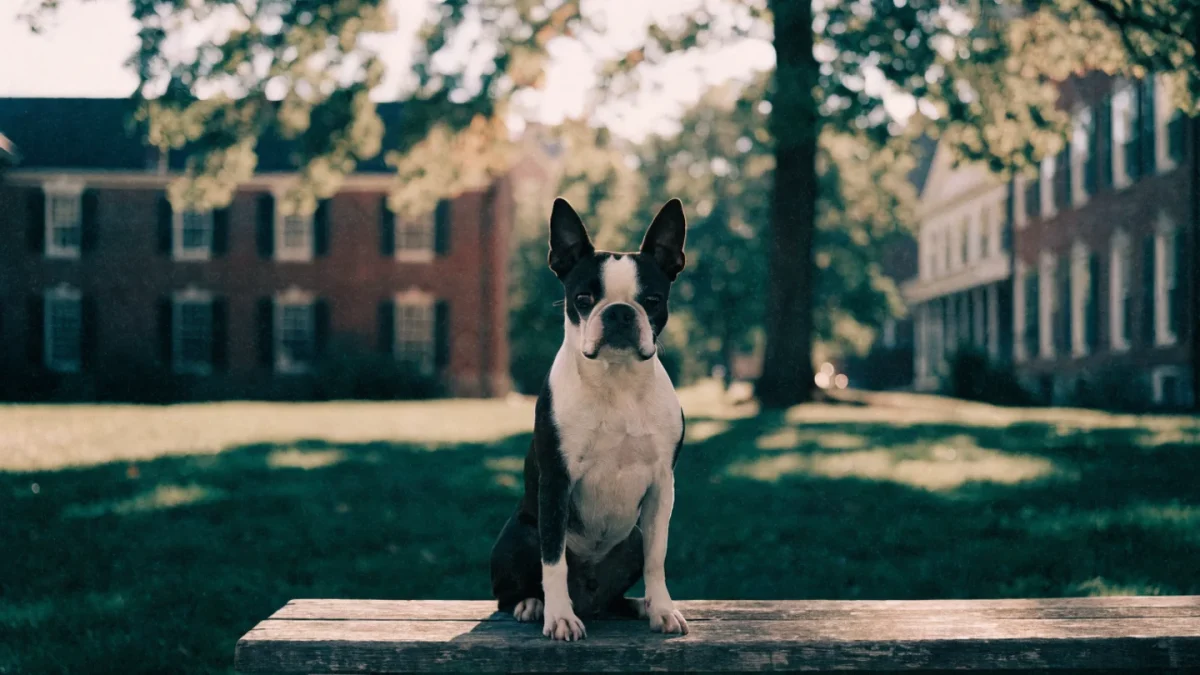
Every Boston Terrier alive today descends from one dog. Not a breed type, not a regional population, not a kennel's bloodline — a single, specific animal. His name was Judge, he weighed roughly 14.5 kg, and he was sold by a stable hand in Boston around 1870 to a man named Robert C. Hooper. That purchase set in motion one of the fastest breed developments in canine history: from crossbred pit dog to national recognition in roughly two decades.
The boston terrier history origins american breed story is unusual in several respects. Most breeds emerge gradually from regional working populations over centuries. The Boston Terrier was engineered deliberately, within a defined geography, from a known starting point. It's one of the few breeds whose founding sire and founding dam are both documented by name. And it carries the distinction of being the first breed developed entirely in the United States to be admitted to the American Kennel Club registry.
Judge: The Founding Sire
The historical record on Judge comes primarily from early breed club documents and the writings of early fanciers. He was described as a well-built, dark brindle and white dog with a blocky head, strong jaw, and compact build. His pedigree was a cross between an English Bulldog and a white English Terrier — the latter a now-extinct breed that was lean, elegant, and prized for ratting and pit work in Victorian England. The history of the Bulldog provides useful context for the "Bull and Terrier" crosses that produced Judge's type.
Judge was not a dog bred for companionship. The English Bulldog and English Terrier cross was a common formula in the 1860s and 1870s for producing dogs suited to pit fighting and vermin control. These "Bull and Terrier" crosses were widespread in England and traveled to America with working-class immigrants. Judge himself reportedly arrived in Boston from England, though the exact circumstances of his importation are unclear.
Hooper bred Judge to a female named Gyp (sometimes recorded as Kate), a smaller white dog weighing roughly 9 kg. Gyp's pedigree is less documented than Judge's, but she was likely of similar Bull-and-Terrier type. Their offspring formed the foundation of the entire breed.
The First Generations
Judge and Gyp produced a male named Eph (also called Well's Eph), who was bred to a smaller female named Tobin's Kate. This second generation established the trajectory the breed would follow: smaller size, more refined proportions, and a move away from the raw bulk of the original fighting type.
Early breeders in Boston's working-class neighborhoods — particularly around the South End — continued crossing the descendants with smaller dogs to reduce size and soften temperament. By the mid-1880s, a recognizable type had emerged: compact, square-headed, well-marked with the characteristic brindle and white or black and white pattern, and significantly smaller than Judge's original 14.5 kg.
The speed of this transformation is remarkable by breed development standards. Within fifteen to twenty years, breeders had halved the average weight, reshaped the skull proportions, and shifted the temperament from fighting readiness to sociability. That's roughly four to five canine generations — an extraordinarily compressed timeline for meaningful breed change.
The Naming Controversy
In 1889, approximately thirty fanciers of these "Round-Head" dogs — as they were informally known — organized the American Bull Terrier Club. The name immediately drew objections. Breeders of both English Bulldogs and Bull Terriers protested, arguing that the new dogs were neither. The resulting dispute was heated enough to stall the club's progress.
In 1891, the club reorganized under a new name: the Boston Terrier Club of America. The decision to name the breed after its city of origin rather than its ancestor breeds was pragmatic, but it created a permanent taxonomic confusion. Boston Terriers are not terriers in any functional sense — they lack the prey drive, the digging instinct, and the independent working style that defines the terrier group. The name is a geographic label, not a behavioral one.
The renaming worked. With the territorial disputes resolved, the club petitioned the American Kennel Club for breed recognition.
AKC Recognition: 1893
The AKC accepted the Boston Terrier into its registry in 1893, making it the first American-developed breed to gain that recognition. The achievement was significant not just for the breed but for American dog culture, which had long looked to European breeds and kennel clubs as the standard of legitimacy.
Early breed standards reflected the dog's fighting ancestry more than modern standards do. The first standards accepted a wider range of sizes and a more muscular build. Over the following decades, the standard progressively refined toward the smaller, more elegant dog recognized today.
The Popularity Boom
Between 1905 and 1935, the Boston Terrier became one of the most popular breeds in the United States. During parts of the 1920s, Bostons accounted for a substantial portion of all AKC registrations — a dominance that no single breed has replicated since. They were the everyman's dog: small enough for city apartments, hardy enough for rural life, and charismatic enough to appear in advertising, postcards, and popular culture.
The breed's popularity was concentrated in the northeastern United States, but it spread nationally through the early twentieth century. Boston Terriers appeared as mascots for businesses, colleges, and military units. Boston University adopted the breed as its mascot in 1922, a connection that persists today.
The Mid-Century Decline and Quiet Persistence
After World War II, the Boston Terrier's popularity declined as larger breeds — German Shepherds, Labrador Retrievers, and Golden Retrievers — rose in public favor. The shift reflected changing American lifestyles: suburban homes with yards favored bigger dogs, and the Boston's urban-companion niche narrowed.
The breed never disappeared. Dedicated breeders maintained the population and continued refining type and temperament through the second half of the twentieth century. But the era of the Boston Terrier as America's most popular breed was over. By the 1960s and 1970s, the breed had settled into the middle of the AKC's popularity rankings — respected and recognizable, but no longer dominant.
The Modern Revival
The twenty-first century brought a resurgence. As urban living expanded, apartment-compatible breeds gained renewed interest. The Boston Terrier's small size, moderate exercise needs, and adaptable temperament aligned with the lifestyles of younger, city-dwelling dog owners. Social media amplified the breed's visual appeal — the tuxedo markings and expressive face photograph well.
This revival brought the same mixed consequences that popularity always brings. Increased demand created market pressure for more puppies, which incentivized less careful breeding. Health screening slipped in some lines. The emphasis on extreme head shapes — flatter faces, larger eyes — pushed some breeding programs toward aesthetics that compromise respiratory and ocular health. The breed's current health profile reflects both its careful historical development and the damage that commercial demand can do.
What the History Explains
Understanding where the Boston Terrier came from clarifies what it is today. The breed's social intelligence, its people-orientation, its physical confidence despite small size, and its adaptability to varied environments all trace directly to the deliberate selection choices made by Boston fanciers between 1870 and 1920.
The health challenges — brachycephalic airway issues, eye vulnerability, spinal anomalies — also trace to those choices. The flat face was an aesthetic preference, not a functional one. The prominent eyes were bred for expression, not durability. Every charming feature of the Boston Terrier carries a health footnote.
For the full breed profile including health details, grooming, and lifestyle compatibility, the Boston Terrier complete breed guide covers everything in one place. And to understand how that historical personality shift plays out in daily life, the temperament deep dive examines the breed's character in practical terms.