

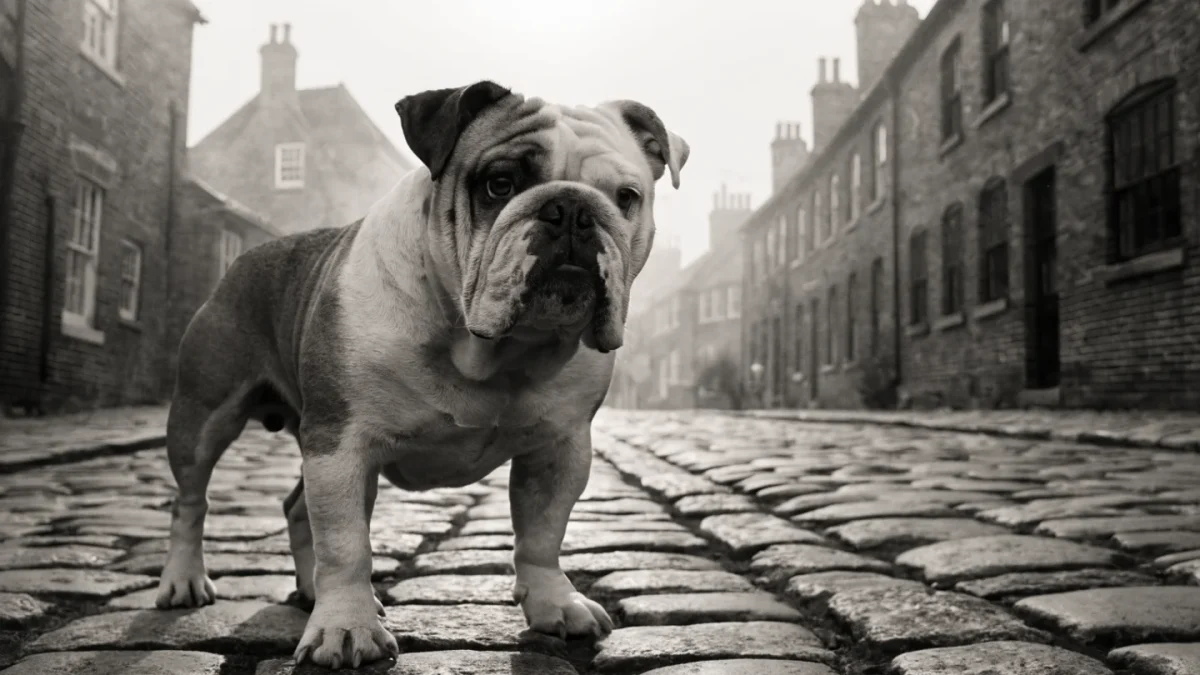
The dog sitting on the couch and the dog that ran across baiting arenas in seventeenth-century England share a name and a general body shape. That's about where the resemblance ends. The original bulldog was an athlete — fast, pain-tolerant, bred to grip a bull by the nose and hold while the animal tried to gore or throw it. The modern English Bulldog struggles to breathe in warm weather and requires intervention to reproduce. Same breed, six centuries of human choices in between.
I've covered a lot of breed histories, and the bulldog's is one of the strangest — not because the transformation is unusual in direction (many breeds have softened from working origins to companion roles) but because it's so complete. Victorian-era breeders didn't refine the bulldog. They rebuilt it from the inside out, keeping the silhouette while replacing almost everything the original selection pressure had produced. What we have now is essentially a tribute act wearing the original costume.
The Baiting Centuries
Bull-baiting was not a fringe pastime. From the 1200s through its ban in 1835, it functioned as mainstream public entertainment across England, supported by local custom, economic incentive, and in some cases municipal law. Towns in several regions required butchers to bait bulls before slaughter, operating under a widespread belief — bizarre by modern standards — that the practice tenderized the meat by thinning the animal's blood.
The mechanics were straightforward and brutal. A bull was tethered to an iron stake by a rope roughly five meters long. Dogs were released one or two at a time. The objective: grab the bull by the nose, the most sensitive point, and pin its head to the ground. A successful dog locked its undershot jaw onto the bull's face and held on while the animal thrashed, spun, and tried to gore it. Dogs that lost their grip were often flung into the air. Injuries and deaths among the dogs were routine.
The physical demands of this work shaped every trait we associate with the breed today. The undershot jaw provided a vise grip that could maintain hold even under tremendous force. The flattened face allowed breathing while clamped onto a target — the nostrils sat far enough back from the jaw that they weren't pressed shut during a grip. The loose, wrinkled skin meant that even when a bull's horn caught the dog, the skin tore or stretched without pulling the dog's body. The low, wide-set build kept the center of gravity near the ground, making the dog harder to throw. The breed's extraordinary pain tolerance ensured that injuries sustained during a bout didn't cause the dog to release.
Every structural feature had a functional origin. That's essential context for understanding today's bulldog, because those same features — exaggerated far beyond their original proportions — are now the source of the breed's health problems.
What the Early Bulldog Actually Looked Like
The bulldog of the baiting era didn't look like the bulldog on your calendar. Historical illustrations and descriptions from the 1700s and early 1800s consistently portray a different animal: taller, leaner, longer-legged, with a more pronounced muzzle and fewer wrinkles. The body was athletic and functional. These were working dogs that needed to run at a bull, dodge horns, and sustain physical effort over the duration of a bout.
A painting by Philip Reinagle from 1790, widely referenced in breed history discussions, shows a bulldog with clearly visible muzzle length, a more proportionate head-to-body ratio, and a body built for movement rather than sedentary companionship. Compare that image with a modern show bulldog, and the degree of anatomical drift across two centuries is striking.
The dog's temperament matched its function. Early bulldogs were described as courageous to the point of recklessness, extraordinarily tenacious, and aggressive toward large animals while often gentle with familiar people. The combination of controlled aggression and human sociability made them effective in the ring and manageable outside it.
The Ban and Near-Extinction
Parliament passed the Cruelty to Animals Act in 1835, outlawing bull-baiting, bear-baiting, and other blood sports involving animals. For the bulldog, this was an existential crisis. The breed had no other purpose. It was not a herding dog, not a retriever, not a guard dog in the conventional sense. Its entire genetic identity had been built around a single job that was now illegal.
The breed's population declined rapidly. Some bulldogs were crossed with terriers to produce fighting dogs for underground dog-fighting rings — the pit bull terrier descends partly from this line. Others were simply not bred. By the 1840s and 1850s, the original bulldog was heading toward extinction, surviving in reduced numbers among enthusiasts who valued the breed's history and character. Smaller specimens — too light for the baiting ring even when it existed — emigrated with displaced English lace workers to northern France, where they became the founding stock of a distinct companion breed; that parallel narrative is told in the history of the French Bulldog.
For a complete overview of how these historical origins connect to the breed's modern characteristics, the bulldog complete breed guide covers the full picture from temperament to health.
The Victorian Reinvention
What happened next is one of the most deliberate breed engineering projects in canine history. A group of breeders — mostly middle and upper-class enthusiasts in London and the Midlands — decided to preserve the bulldog by transforming it from a working animal into a companion breed.
The breeding goals shifted dramatically. Aggression, the defining trait for six centuries, was systematically bred out. Docility, sociability with humans, and a calm household temperament were selected for. The physical form was altered too, though here the changes moved in a direction that prioritized appearance over function. Breeders favored shorter muzzles, broader chests, heavier bone, more prominent wrinkles, and a more compact frame. The breed standard published in 1864 codified many of these exaggerated features. The Bulldog Club, established in England in 1878, further formalized what the "ideal" bulldog should look like.
Within fifty years of the baiting ban, the bulldog had been fundamentally remade. The temperament transformation was a success — the modern bulldog's gentle, stubborn, affectionate personality bears almost no resemblance to the aggression of its baiting ancestors. But the physical changes created a cascade of health consequences that the breed carries today.
Symbol Without Function
By the early 1900s, the bulldog had acquired a symbolic role that outstripped its practical one. It became associated with British tenacity, national character, and stoic determination — qualities attributed to the breed during both World Wars. Winston Churchill's comparison to a bulldog cemented this association in popular culture, though Churchill himself reportedly never owned one.
The irony is worth noting. The bulldog became a symbol of toughness and resilience while becoming, in physical terms, increasingly fragile. Each generation of breeding pushed the anatomy further from function. Muzzles shortened, chests broadened, wrinkles deepened. The dog that symbolized endurance became a breed that overheats on a warm day and cannot, in most cases, reproduce without medical assistance.
This wasn't malicious. Individual breeders weren't trying to create a suffering animal. They were selecting for features that won shows, pleased buyers, and matched an increasingly exaggerated breed standard. The cumulative effect, compounding over decades, produced the modern bulldog — an animal whose appearance departs dramatically from both its working ancestors and from functional canine anatomy.
The Contemporary Reckoning
The last two decades have brought increasing scrutiny to the bulldog's trajectory. Veterinary researchers, animal welfare organizations, and some kennel clubs have raised pointed questions about whether a breed that cannot breathe efficiently, regulate its own temperature, or reproduce naturally has been bred past the point of ethical justification.
These aren't fringe concerns. Peer-reviewed studies have documented the scope of the breed's health burden, and the numbers are difficult to dismiss. The veterinary community's position has shifted measurably from acceptance to concern.
In response, a subset of breeders has begun working toward what's sometimes called the "retro" bulldog — selectively breeding for slightly longer muzzles, less extreme proportions, and more moderate wrinkles. The goal is a dog that looks more like the bulldogs of the early 1900s: recognizably a bulldog, but with enough functional anatomy to breathe, move, and thermoregulate without constant compromise.
Whether this movement gains enough traction to shift the breed's trajectory remains an open question. The show ring still rewards the exaggerated type. Consumer demand still gravitates toward the flat-faced, heavily wrinkled appearance. Changing a breed's direction requires changing what people want to buy, and that's a slower process than changing a breeding program.
What This History Tells Us
The bulldog's story is a case study in how human preferences reshape living animals. Every chapter — the baiting era, the near-extinction, the Victorian reinvention, the symbolic elevation, the health reckoning — was driven by human decisions about what this dog should be and do. The bulldog never had a vote.
Understanding that history is not an argument against owning the breed. It's an argument for owning it honestly — knowing where these dogs came from, why they look the way they do, and what the cost of that appearance is. The bulldog's past is written into its anatomy. The question facing its future is whether breeders and buyers will read that story clearly enough to change the next chapter.