

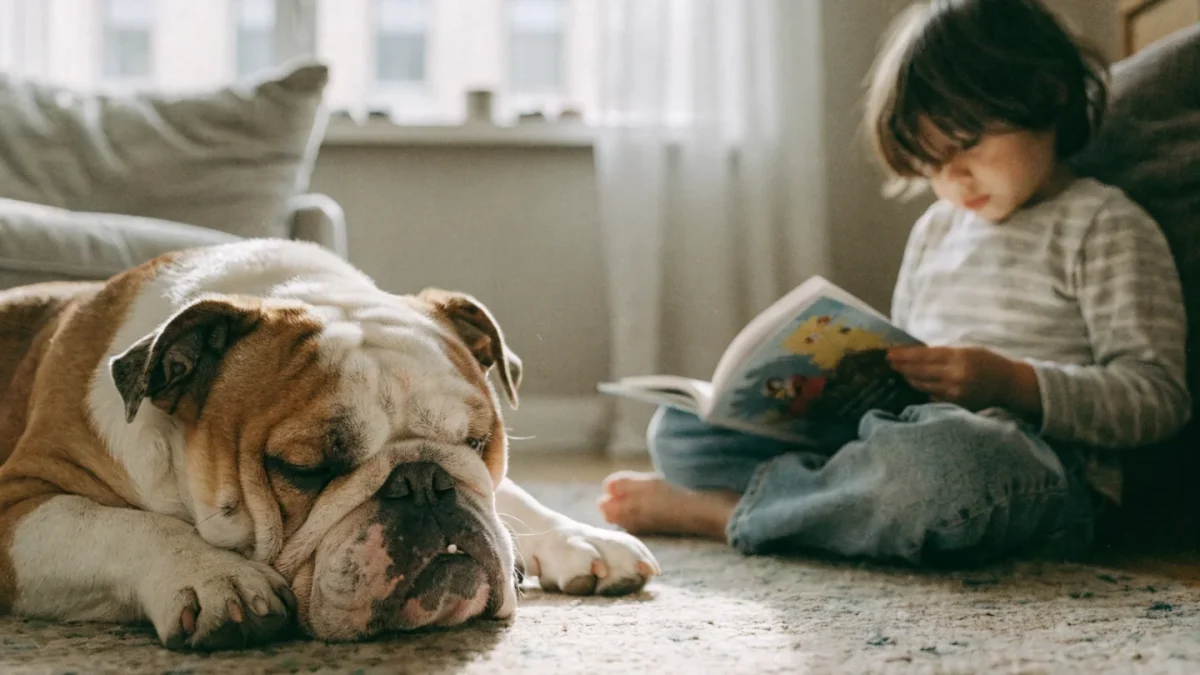
The British Kennel Club registered the bulldog under its "Utility" group for decades — a classification for dogs that no longer serve the practical function they were originally bred for. It's an almost comically understated label for an animal whose ancestors pinned two-thousand-pound bulls to the ground. The modern bulldog's temperament is the product of what might be the most radical personality overhaul in canine history: a fighting dog deliberately reshaped into a couch companion within roughly fifty years after bull-baiting was outlawed in 1835.
Understanding bulldog temperament personality means understanding that transformation, because every behavioral trait owners encounter today — the calm confidence, the stubborn independence, the quiet attachment to their people — carries a trace of the breed's working past.
What the Calm Actually Looks Like
Bulldogs project an air of unbothered serenity that most other breeds can't match. Where a retriever meets the world with eager-to-please energy and a terrier buzzes with alert curiosity, the bulldog observes, considers, and decides whether engaging is worth the effort. This isn't apathy. It's a measured disposition that makes them remarkably steady housemates.
In practice, a bulldog's day involves cycles of moderate alertness and deep relaxation. They'll follow you from room to room — most bulldogs want to be in whatever room their person occupies — but once settled, they settle hard. The sleeping bulldog is a fixture, not easily roused, and the snoring that accompanies it is the breed's unofficial soundtrack.
This calm shouldn't be confused with low emotional engagement. Bulldogs read household moods with surprising accuracy. Owners consistently report that their bulldog responds to tension, sadness, or excitement in the home by adjusting its own behavior — moving closer during stressful moments, offering a head in the lap without being asked. They're not demonstrative the way a spaniel is, but the emotional attunement runs deep.
The Stubbornness Everyone Talks About
It comes up in every conversation about the breed, and it deserves honest treatment rather than dismissal as a charming quirk.
Bulldog stubbornness is real, consistent, and directly connected to the breed's history. Dogs bred for bull-baiting needed to commit to a grip and hold it regardless of pain, distraction, or commands to release. That single-minded tenacity was the entire point of the breeding program for over five centuries. When Parliament banned the practice, breeders selected against the aggression — but the underlying determination survived the transition intact.
What this looks like in a living room rather than a baiting ring: a bulldog asked to do something it hasn't decided to do will simply not do it. Not aggressively — there's no snarling or snapping. The dog just becomes immovable. Ask a bulldog to walk past a spot it wants to investigate, and you'll find yourself leaning into a leash attached to a 25-kilogram anchor. Ask one to come inside when it's enjoying a patch of sunlight, and you'll get a look that communicates, clearly, that your request has been received and declined.
This matters because it shapes the entire approach to living with the breed. Bulldogs don't respond well to repetitive drilling or forceful correction. They respond to motivation. If they understand why something benefits them — a treat, access to a favorite spot, your obvious approval — they'll cooperate willingly. The key is making compliance their idea. Owners who frame training as negotiation rather than command get dramatically better results than those who expect obedient execution.
For a deeper look at how this temperament fits within the breed's full profile, the bulldog complete breed guide covers the physical and health context that shapes daily life with this dog.
With Children and Families
Bulldogs have a genuine patience with children that goes beyond mere tolerance. Their low reactivity means they don't startle easily, they don't match a child's chaotic energy with their own, and they have a high threshold for the kind of clumsy handling that comes with young kids. A toddler who grabs a handful of wrinkle skin is more likely to get a resigned look than a snap.
That said, tolerance isn't infinite, and no dog should be treated as a living toy regardless of breed reputation. A bulldog that feels cornered or is in pain can react defensively. Supervision matters, and children need to learn that the dog's calm demeanor is not an invitation to test its limits.
Bulldogs tend to attach most strongly to one or two family members while remaining friendly with the rest of the household. The primary bond is intense — these dogs track their person's movements, wait outside bathroom doors, and rearrange themselves to maintain line of sight across a room. It's a quiet, persistent devotion rather than demanding attention-seeking.
Social Behavior With Other Animals
Most bulldogs get along peacefully with other dogs, though introductions matter more than breed tendencies. Their non-confrontational nature generally makes them easy to integrate into multi-pet households. They lack the high prey drive of terriers and the herding impulse of working breeds, so cats and smaller animals are usually safe company.
Some intact males show dominance posturing with other male dogs — stiff body language, direct staring, occasional resource guarding. This is manageable with proper socialization and not unique to bulldogs, but it's worth noting because the breed's physical strength and low center of gravity make separating two engaged bulldogs harder than it looks.
The breed's social style with unfamiliar humans follows a predictable pattern. There's an initial moment of reserved assessment — the bulldog watches, decides the newcomer isn't a concern, and then becomes affable. They're not guard dogs in any functional sense, though some develop a territorial alertness that manifests as a low warning bark when someone approaches the home. It's announcement, not aggression.
What Most People Get Wrong About Bulldog Temperament
The biggest misconception is that bulldogs are lazy. They're physically limited by their brachycephalic anatomy — a compromised airway makes sustained activity genuinely difficult. Given a moderate temperature and a functional respiratory system, many bulldogs show considerably more playfulness and drive than their reputation suggests. The couch-potato stereotype often describes a dog whose body won't let it express what its mind wants to do.
The second is that their stubbornness means they're unintelligent. Bulldogs consistently rank low on obedience-based intelligence scales, but those scales measure willingness to repeat commands — not cognitive ability. Problem-solving, spatial memory, and social intelligence in bulldogs are underrated. They learn quickly what benefits them and filter out what doesn't. That's selective intelligence, not absent intelligence.
The third misconception is that bulldogs are inherently aggressive because of their fighting ancestry. The breed hasn't been selected for aggression in nearly two hundred years. The temperament transformation was thorough. Unprovoked aggression in a bulldog is a behavioral anomaly, not a breed trait, and typically signals pain, poor socialization, or mistreatment rather than genetics.
For a narrative account of how the breed's personality was deliberately reshaped after bull-baiting was banned, the history of the bulldog covers that transition in detail.
The Right Owner for This Temperament
The bulldog temperament works best with people who find genuine pleasure in a calm, physically present companion. If you want a dog that anticipates your commands and lives to please, you'll be frustrated. If you want a dog that feels like a low-key roommate with its own opinions and a strong preference for your company, you'll be charmed.
Patience is non-negotiable. Not just during training, but in the daily rhythm of living with an animal that operates on its own schedule. The bulldog will get off the couch when the bulldog decides to get off the couch. If that dynamic appeals to you more than it annoys you, you're the right fit.
People who work from home or have flexible schedules tend to match well with bulldogs. The breed's aversion to extended solitude is a real constraint — these dogs were refined specifically to be with people, and they don't thrive when left alone for eight or ten hours daily. The attachment is deep, and ignoring it creates problems that manifest as destructive behavior, lethargy, or regression in house training.