

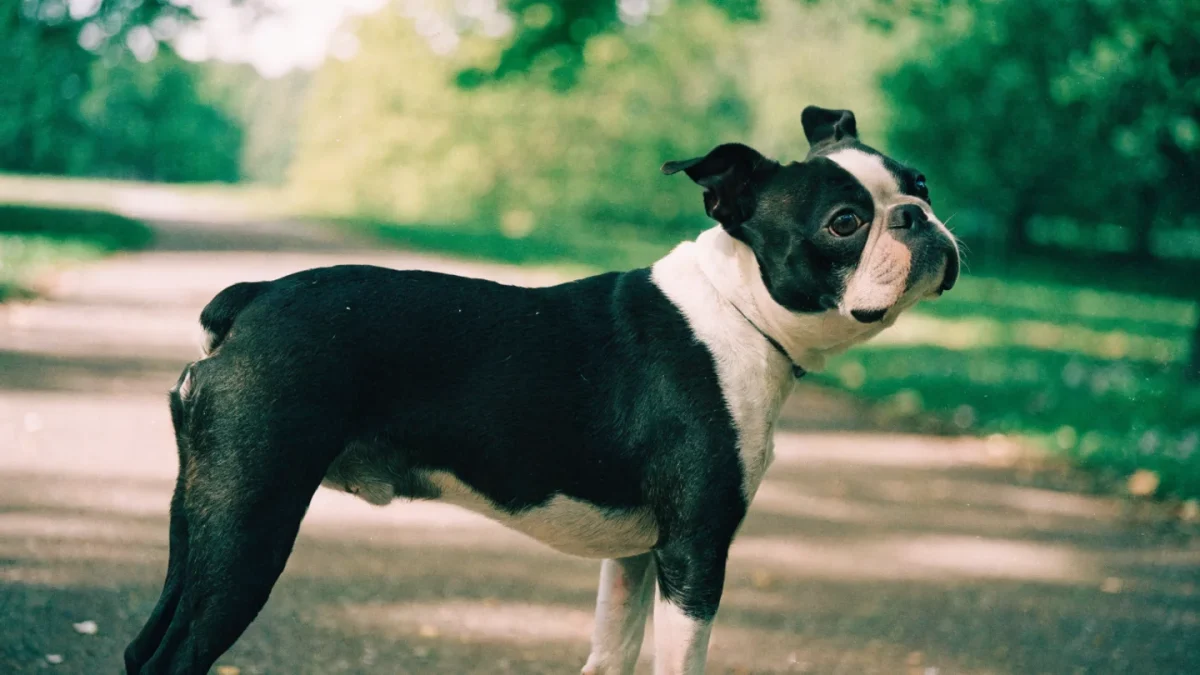
The Boston Terrier wears its genetics on its body more visibly than most breeds. The tuxedo markings, the flat face, the prominent eyes, the naturally short tail — each traces to specific genetic mechanisms, and several carry health implications that matter for breeding decisions. Understanding boston terrier genetics markings brachycephaly means recognizing that what makes the breed visually distinctive is inseparable from what makes it medically vulnerable.
The Tuxedo Pattern: Piebald Genetics
The Boston Terrier's iconic white markings — the muzzle band, blaze, chest, and leg markings — are produced by the S locus, the piebald gene. This gene controls the distribution of pigmented and non-pigmented (white) areas across the coat.
In Bostons, the piebald allele creates a pattern where pigment is restricted to certain areas (typically the dorsal surface, head, and ears) while the chest, muzzle, and limbs display white. The amount of white varies between individuals, from minimal markings to heavily white dogs sometimes called "splash" Bostons.
The breed standard favors a specific distribution: white muzzle band, even blaze between the eyes, white chest, and white on part or all of the forelegs and hind legs below the hocks. Dogs that deviate significantly — either too much white or too little — may be perfectly healthy but don't conform to the visual standard.
The Deafness Connection
The piebald gene has a documented association with congenital sensorineural deafness across multiple breeds, including Dalmatians, Bull Terriers, and white Boxers. The mechanism involves the absence of melanocytes (pigment-producing cells) in the inner ear's stria vascularis. Without these cells, the cochlea doesn't develop properly, and hearing is impaired or absent.
In Boston Terriers, dogs with more extensive white markings — particularly white on or around the ears and head — carry higher risk, as the absence of melanocytes in the inner ear's stria vascularis prevents normal cochlear development. The Boston Terrier Club of America recommends against breeding dogs with white on more than a third of their body for this reason. Unilateral deafness (one ear) is more common than bilateral (both ears) and often goes undetected without BAER testing, since a dog that hears from one ear compensates well enough to appear normal in daily life.
This is why BAER testing is a meaningful part of a breeding program's health protocol. It identifies carriers of unilateral deafness who might otherwise be bred without knowing they carry the trait.
Brachycephalic Skull Genetics
The shortened skull that defines the Boston Terrier's flat face is a polygenic trait — multiple genes contribute to its expression, and no single gene is responsible. The primary effect involves mutations that reduce the length of the maxilla (upper jaw) while leaving the soft tissues of the mouth, throat, and airway closer to their original proportions.
This soft tissue-to-skull mismatch is the genetic foundation of Brachycephalic Obstructive Airway Syndrome (BOAS). An elongated soft palate, stenotic nares, everted laryngeal saccules, and a potentially hypoplastic trachea all result from cramming too much soft tissue into a skull that's been genetically shortened.
The severity varies enormously between individuals, and that variation has a heritable component. Dogs with more moderate facial structure — slightly longer muzzles, wider nostrils, more proportionate palates — tend to produce offspring with better airway function. Dogs with extremely flat faces and pinched nostrils tend to produce offspring with more severe compromise.
This is why evaluating the parents' breathing quality matters as much as any DNA test. A breeder whose dogs breathe quietly at rest and exercise comfortably without respiratory distress is selecting for functional anatomy.
Coat Color Genetics
The breed standard recognizes three color patterns: black and white (the most common, driven by the K locus dominant black allele), brindle and white (the kbr allele allows agouti striping to show through), and seal and white (appears black but shows a reddish undertone in direct sunlight — the exact genetic mechanism distinguishing seal from true black is not fully characterized, though the K locus is involved).
Colors outside the standard — blue, lilac, chocolate, merle — result from dilution and pigment genes not typical of the breed. These are sometimes marketed as "rare" at premium prices, but the blue and lilac dilutions — caused by a recessive mutation in the MLPH (melanophilin) gene — are associated with Color Dilution Alopecia (CDA), a progressive hair loss condition. Merle in double-merle pairings carries significant risk of ocular and auditory defects: a 2009 study in the Journal of Veterinary Internal Medicine found that 15% of double-merle dogs were bilaterally deaf and 10% unilaterally deaf, with frequent eye abnormalities including microphthalmia.
Heritable Eye Conditions
Boston Terriers carry genetic predispositions to several eye conditions, and DNA testing is available for the most significant one.
Hereditary juvenile cataracts. An autosomal recessive condition caused by a mutation in the HSF4 gene, in which cataracts develop bilaterally — obvious cataracts and vision loss typically appearing between nine and fifteen months of age, according to the Universities Federation for Animal Welfare. A DNA test identifies carriers, affected dogs, and clear individuals. This is one of the most straightforward genetic screens available for the breed and should be standard in any breeding program.
Other eye conditions. Cherry eye, corneal dystrophy, and glaucoma occur in the breed with higher-than-average frequency. The genetic basis for these is less clearly mapped, making DNA testing unavailable. Clinical eye exams by a veterinary ophthalmologist remain the primary screening tool.
Spinal Genetics: Hemivertebrae
The naturally short, sometimes screw-shaped tail results from the same developmental pathway that can produce hemivertebrae — wedge-shaped vertebrae in the thoracic spine. Many Bostons carry hemivertebrae without symptoms. In a smaller number, the malformation compresses the spinal cord, producing pain and neurological deficits. The trait is heritable, and spinal X-rays can identify it in breeding stock, though predicting which individuals will develop symptoms is not yet reliable.
What Genetic Testing Can and Cannot Do
DNA testing currently covers juvenile hereditary cataracts and certain other breed-relevant mutations, giving breeders clear carrier status data. What it can't yet predict is the severity of brachycephalic compromise, patellar luxation likelihood, or hemivertebrae symptom risk — these involve multiple genes and environmental interactions beyond current testing. Clinical screening (eye exams, patellar grading, breathing assessments, BAER testing) remains essential alongside DNA testing. Responsible breeding uses both.
For the complete breed profile covering health, temperament, and daily care alongside genetics, the Boston Terrier complete breed guide provides the full picture. And for the historical context of how these genetic traits emerged, the breed's origin story traces the development from a single founding sire through 150 years of selective breeding.