

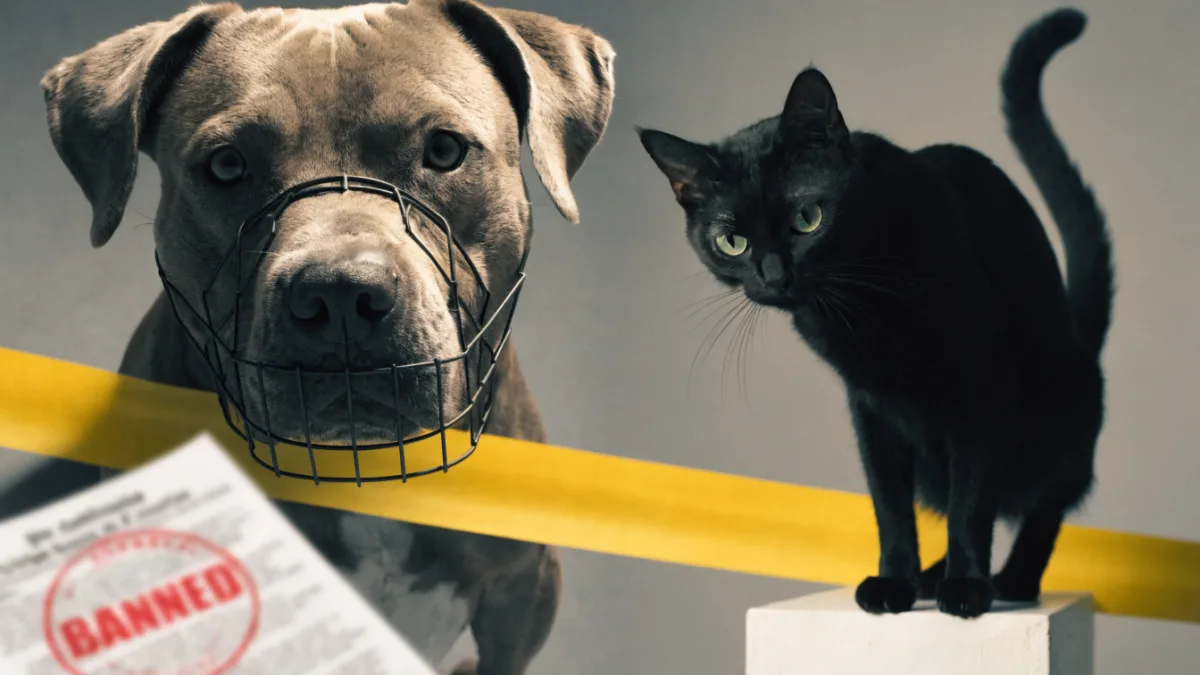
If a domestic shorthair cat decides it hates the mail carrier and launches a coordinated attack on their ankles, the local city council doesn’t convene a special session to draft emergency legislation. If a feral tomcat territorially bites a neighborhood kid, nobody demands that the entire Maine Coon breed be muzzled in public.
But swap that cat out for a dog with a blocky head, and the political machinery of an entire municipality springs into action.
This is the core hypocrisy of Breed-Specific Legislation (BSL). BSL refers to laws that regulate or ban specific dog breeds in an attempt to reduce human injuries. But if we step back and look at how we legislate animal behavior, a glaring double standard emerges. We legislate dogs based on deeply flawed assumptions about their genetics, while entirely ignoring cats—despite the fact that cats possess severe behavioral and ecological impacts of their own.
Invented by Newsrooms, Not Biologists
To understand why BSL is a broken system, you have to look at where it came from. It wasn’t drafted by veterinary behaviorists or epidemiologists. It was drafted by politicians reacting to headlines.
The American Veterinary Medical Association has stated firmly that BSL is not the answer to preventing dog bites. Why? Because BSL is built entirely on visual identification. The most frequent targets of these laws are “pit bull-type” dogs, Rottweilers, and Doberman Pinschers. But here is the biological reality: “pit bull” is not a breed. It’s an umbrella category that encompasses the American Pit Bull Terrier, the American Staffordshire Terrier, the Staffordshire Bull Terrier, and literally millions of random mixed-breed dogs that happen to have short hair, a broad skull, and a muscular build.
I’ve seen DNA test results of dogs seized under BSL that came back as 40% Labrador Retriever, 30% Boxer, and 30% Chow Chow. They were sentenced to death by a municipal code because their cheekbones were too wide. A 2025 study by Tesler and colleagues traced the rapid spread of BSL directly to surges in negative media portrayals of specific breeds. Public panic, not scientific data on canine aggression, drove these laws into existence. [LOCALIZATION CHECK: Breed-specific laws vary wildly by country, state, and municipality.]
The Physics of Bias
People ask me why we don’t have breed-specific laws for cats. The answer is blunt: physics and historical marketing.
Dogs are large, powerful predators. We spent thousands of years selectively breeding them to hunt boar, bait bulls, guard livestock, and fight other dogs. When a 70-pound dog with massive jaw strength attacks a human, the physical damage is catastrophic. Society holds dogs to a different standard of public safety because a dog actually has the hardware to kill a person.
An aggressive Chihuahua or a territorial tabby cat absolutely possesses the intent to cause harm. Animal control officers will tell you that small dogs bite people constantly. But a five-pound cat or a ten-pound terrier lacks the capacity to cause lethal damage. We don’t draft legislation banning Siamese cats because a Siamese cat bite, while painful and prone to infection, doesn’t result in a life-flight helicopter ride to the trauma ward.
The bias of BSL isn’t about the *intent* of the animal. It targets the *capacity* for severe physical damage. But by legislating entire breeds, we’ve decided that a Golden Retriever with a bite history is safer than a perfectly trained American Pit Bull Terrier. That defies logic.
How Cats Actually Face the Law
Cats aren’t completely exempt from the law, but their legislation targets a completely different set of behaviors.
While cats aren’t regulated for human public safety, they are heavily policed for their ecological impact. Free-roaming and feral cats are subjected to trap-neuter-return (TNR) mandates, compulsory microchipping, strict outdoor bans, and even culling programs in certain regions. Conservationists heavily debate the outdoor cat, and for good reason. Feral and outdoor cats are responsible for the extinction of dozens of bird and small mammal species worldwide. In the United States alone, free-ranging domestic cats kill billions of birds and mammals annually.
So, the law treats cats exactly as they are: an invasive, highly efficient predator species that decimates local wildlife. Dogs get regulated because of what they might do to humans. Cats get regulated because of what they are doing to the global ecosystem.
The Cost of Bad Laws
The real-world impact of BSL is devastating. It forces responsible pet owners into heartbreaking choices.
I changed my thinking on BSL completely a few years ago after spending time with a rescue dog named Elsa. She was a brilliantly trained, bomb-proof shelter dog who had passed her canine good citizen test with flying colors. Elsa’s owners lived in a municipality that passed a sudden BSL ordinance. Because Elsa had the physical traits of a restricted breed, the family was told they had 30 days to either move out of the city or surrender their dog to be euthanized.
This happens constantly. Bully breeds already make up a vastly disproportionate percentage of dogs euthanized in shelters. BSL exacerbates this localized population cull by making it illegal to adopt these dogs out or house them in certain cities. The ASPCA strongly opposes BSL because it forces the euthanasia of innocent, well-behaved dogs based on their appearance, ripping them away from families who love them.
Moving from Bloodlines to Behavior
Here is the good news: the tide is turning.
In recent years, there has been a massive legislative pushback against BSL. States and municipalities are repealing breed bans and replacing them with breed-neutral “dangerous dog” laws. These laws do what we should have done all along: they focus on the individual dog’s actual behavior and the owner’s negligence. Even the insurance industry is shifting. Landlord and liability policies are moving away from blanket breed bans, replacing them with requirements for behavioral assessments or canine good citizen certifications.
If we want safe communities, we have to address the deed, not the breed. Dogs don’t attack because of their skull shape; they attack because of poor socialization, lack of training, abuse, or negligent ownership. Until we hold the person holding the leash accountable, banning specific breeds will never make us safer. It will just fill shelters with dead dogs while an angry tabby cat continues to terrorize the mail carrier in peace.