

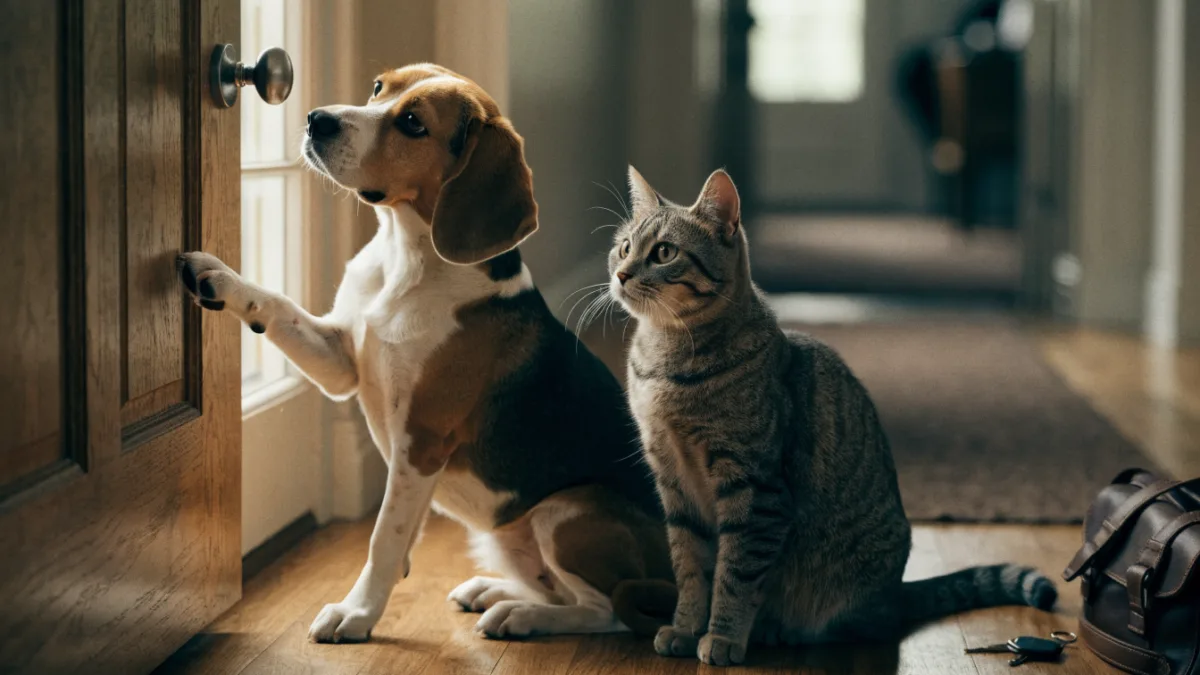
Remember when we all worked from home for a year and a half? Your dog loved it. Your cat probably did too, even if she’d never admit it. Then offices reopened, and millions of pets went from having their favorite human around 24/7 to suddenly losing them for eight, nine, ten hours a day. I’ve seen the fallout firsthand — a Lab mix named Cooper who ate through a drywall wall, a Siamese cat who started pulling out her own fur. These weren’t “bad” pets. They were pets in full-blown panic.
It’s Not Just a Dog Problem
Most people think of separation anxiety as a canine issue. It’s not. Cats get it too, and the post-pandemic remote-work shift made that painfully obvious. When you’re home all day, every day, your pet builds an entirely new expectation of what normal life looks like. You become their constant. Their anchor. Pull that anchor away overnight, and you’ve got an animal who has no idea how to cope.
Dogs tend to show their distress loudly. Cats are sneakier about it, which means their suffering often goes unnoticed longer — or gets mislabeled as the cat just “being a cat.”
What Canine Distress Actually Looks Like
I worked with a German Shepherd named Ruger last spring. His owner had been home for two years straight, then took a job requiring three days a week in the office. Within a month, Ruger had destroyed two couch cushions, chewed the leg off a dining room chair, and was howling loud enough that neighbors filed noise complaints.
Classic dog separation anxiety signs include:
- Destructive chewing — especially near doors or windows where you exit
- Excessive barking, howling, or whining that starts right after you leave
- Pacing, panting, and drooling that seem disproportionate to the situation
- House-soiling in a dog who’s otherwise reliably house-trained
- Escape attempts — scratching at doors, chewing through crate bars, pushing through screens
Here’s the thing that catches people off guard: the destruction usually happens in the first thirty minutes after you leave. That’s when the panic spikes hardest. By the time you’re an hour into your workday, your dog has often exhausted themselves and is lying down. You come home to the aftermath and assume it happened all day. It didn’t. It happened fast and furious, then crashed.
Feline Distress Flies Under the Radar
Cats express anxiety differently. A dog tears up your couch — you know something’s wrong. A cat stops using the litter box, and you might think she’s just being difficult. She’s not.
Feline separation anxiety can show up as:
- Excessive vocalization — loud, persistent meowing when you’re gone
- House-soiling outside the litter box, often on bedding or clothing that smells like you
- Overgrooming — licking belly or leg fur until it’s thin or bald
- Clingy behavior when you are home — following you room to room, demanding constant attention
- Changes in appetite — eating much less, or much more, than usual
- Hiding more frequently or becoming unusually aggressive
The overgrooming one is easy to miss. I had a client with a tabby named Pepper who’d been fine for years. After the client returned to office work, Pepper started licking her belly raw. The owner thought it was allergies. It took three vet visits before someone asked about recent routine changes.
This Isn’t Spite. It’s Survival.
The biggest misconception I hear from owners is some version of: “He knows what he did was wrong. Look at his face when I come home.”
I understand why people think this. You walk in, your dog has shredded your favorite shoes, and he’s cowering in the corner with his ears pinned back. Looks guilty, right?
It’s not guilt. It’s fear. Your dog has learned that when you come home to destruction, bad things happen — you yell, you act tense, maybe you shove him outside. He’s reading your body language and responding to that. He has no ability to connect “I chewed a shoe six hours ago” with “my person is upset right now.” Dogs don’t think in those causal chains.
Same with cats. Your cat isn’t peeing on your bed to punish you for leaving. She’s saturating your scent with her own because mixing those smells makes her feel safer. It’s an act of desperate self-comfort, not retaliation.
These behaviors — the chewing, the howling, the inappropriate elimination — they’re all excessive self-soothing mechanisms. The animal is flooded with stress hormones and is doing whatever they can to bring that level down. Chewing releases endorphins. Vocalizing is a distress call. It’s the same way a person might bite their nails raw during a panic attack.
Is It Really Anxiety, or Something Else?
This is where things get tricky, and it’s a genuine debate among behavior professionals. Sudden destructive behavior or changes in litter box habits could be separation anxiety. They could also be a medical issue that’s been triggered or worsened by stress.
Before assuming it’s purely behavioral, rule out the medical side. A dog who suddenly starts having accidents might have a urinary tract infection that flares up when stress suppresses their immune system. A cat who stops eating could have dental pain or kidney issues. Cognitive decline in senior pets can also mimic anxiety symptoms — an older dog who paces and whines might be experiencing confusion related to canine cognitive dysfunction rather than separation distress.
I always tell clients: start with a vet visit. Even if you’re confident it’s behavioral, you need that baseline. If there’s a medical component, no amount of training will fix it until the medical issue is addressed.
What Actually Helps
There’s no single fix that works for every animal. Anyone who tells you otherwise is selling something. But there are solid, evidence-based approaches that give most pets a real shot at feeling better. Let’s break them down.
Gradual Desensitization
This is the backbone of treating separation anxiety, and it requires patience. You’re teaching your pet that being alone isn’t dangerous, and you build that confidence in tiny increments.
Start by picking up your keys and walking toward the door — but don’t leave. Do that a dozen times until your dog stops reacting. Then step outside for five seconds. Come back. Build up to thirty seconds, then a minute, then five minutes. If your pet shows distress at any stage, you’ve pushed too far. Go back to an easier level.
I know it sounds tedious. It is. But rushing this process is the number one reason treatment fails. You’re literally rewiring how their nervous system responds to your absence.
Environmental Management
Make being alone less awful by building positive associations with your departure. Food puzzles, stuffed rubber toys that you can freeze to make them last longer, lick mats spread with wet food — these give your pet something engaging to focus on instead of panicking.
The key is that these special items only appear when you leave. They’re “alone time” treats. When you come home, they go away. This creates a small positive flip: your leaving now triggers something good, not just something scary.
For cats, think vertical spaces they can access when you’re gone, window perches for bird-watching, and puzzle feeders designed for felines. Some cats also respond well to having a radio or TV left on at low volume — the background noise can be comforting.
Safe Spaces, Not Punishment
I’m not a fan of crate training as a solution for separation anxiety. Here’s why: if your dog is already panicking, trapping them in a small space often makes the panic worse. I’ve seen dogs break teeth trying to escape crates during anxiety episodes. That’s not treatment. That’s compounding trauma.
Instead, create a comfortable area where your pet already chooses to rest. Maybe that’s a corner of the living room with their bed, some water, and a piece of clothing that smells like you. For some dogs, limiting access to one or two rooms actually reduces anxiety — too much empty space can feel overwhelming. For others, having the full run of the house is better. You’ll need to observe and adjust.
Professional and Veterinary Support
Some cases of separation anxiety are severe enough that training alone won’t cut it. If your pet is causing physical harm to themselves — breaking claws, cracking teeth, causing raw spots from chewing — it’s time to bring in a veterinarian or a veterinary behaviorist.
Anti-anxiety medication isn’t a failure. I used to think it was. I’d tell owners to just be more consistent with training, and I was wrong. For some animals, their nervous system is so revved up that they literally cannot learn while in that state. Medication brings the baseline arousal down enough that the training you’re doing can actually take hold. It’s often temporary — you use it as a bridge while building new habits, then taper off under veterinary guidance.
Working with a qualified behavior professional also matters, especially for severe cases. Look for someone who uses positive, force-free methods. Anyone who talks about asserting dominance or being the pack leader doesn’t understand the science of anxiety.
What I Want You to Take Away From This
If your pet is struggling with your return to the office, they’re not broken and you’re not a bad owner. You’re both navigating a transition that neither of you chose. The pets who got us through lockdowns and isolation are now paying the price for our return to normalcy, and they deserve patience while they adjust.
Start small. Be consistent. Celebrate tiny wins — five minutes of quiet alone time is progress if your dog was previously panicking the moment you reached for your keys. And don’t wait to get help if you need it. The longer separation anxiety goes untreated, the harder it becomes to resolve.
Your pet doesn’t need you to be perfect. They just need you to show up, pay attention, and keep trying. That’s the deal we made with them when we brought them into our lives — through lockdowns and office commutes and everything in between.