

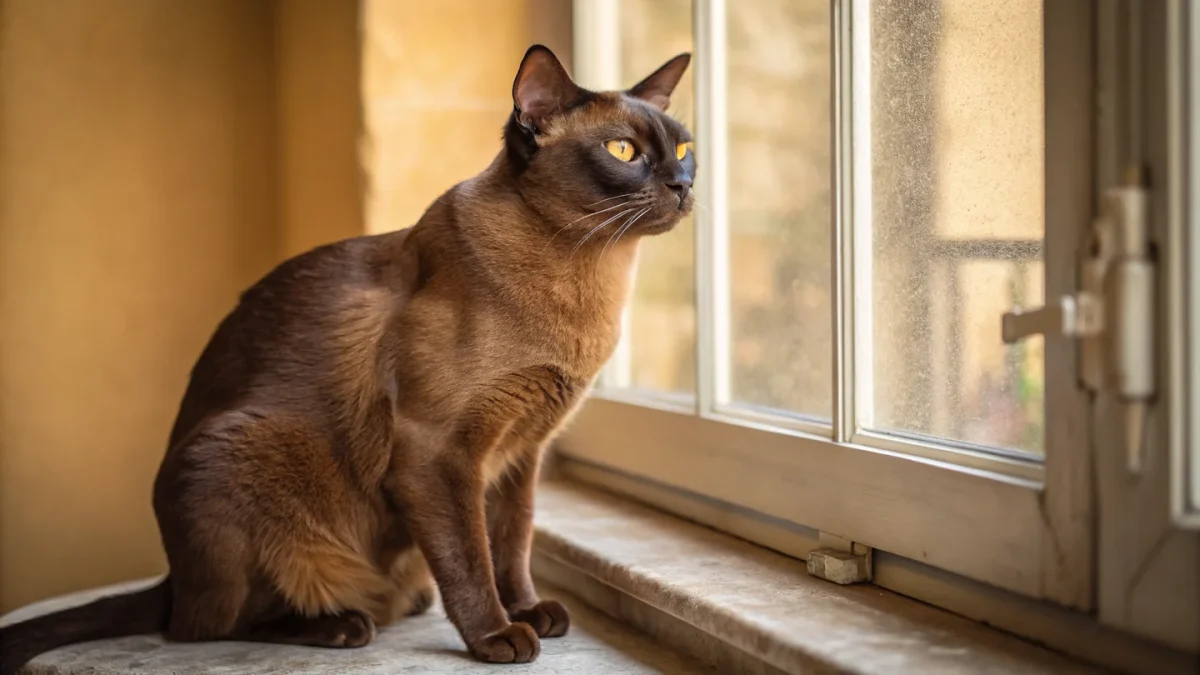
Most pedigree cat breeds begin in the fog: a pair of cats with an interesting trait, crossed with purpose, eventually recognized. The foundation animals are usually names in registries, sometimes a photograph, occasionally a physical description. The Burmese is different. It begins with a specific cat, a specific person, a specific date, and breeding results that were published in a scientific journal.
This is, in the history of domestic cat breeds, genuinely unusual.
Wong Mau
In 1930, Dr. Joseph Thompson of San Francisco received or acquired a small, dark brown female cat that had been brought from Rangoon (now Yangon), Burma. Her name was Wong Mau.
Wong Mau's appearance was unusual. She was darker than any Siamese and lacked the Siamese's extreme linear body type. She had a shorter muzzle, a slightly rounded head, and a warm, rich brown coat that was solid — not pointed in the way Siamese coloring works, though with subtle darker points at the extremities. Thompson recognized her as potentially representing a distinct type from any cat he had previously encountered.
He was right, but for reasons that became clearer only through the breeding program he established.
The Breeding Program
Thompson, working with geneticist Clyde Keeler from Harvard and breeder Virginia Cobb, mated Wong Mau with a Siamese male (there being no other cats of similar type available). The results were revealing:
The kittens fell into three distinct groups. Some were clearly Siamese-patterned — pale bodies with dark points. Some resembled Wong Mau — intermediate coloring. Some were a very dark, rich brown throughout their coats, darker than Wong Mau herself.
Through a series of back-crosses, the breeders demonstrated that this dark brown type — what they called "sable" — bred true when paired with other sable-typed individuals. Wong Mau herself was, the genetics revealed, not a pure specimen of this type but a hybrid: what we now would call Tonkinese-type, carrying one copy of the gene responsible for the Burmese pattern and one copy of the Siamese gene. This explained why her kittens showed three phenotypes.
The breeding program was formally documented, and the results — "Genetics of the Burmese cat" — were published in the Journal of Heredity in 1943 by Thompson, Keeler, and Cobb. This publication makes the Burmese cat's foundation perhaps the most scientifically documented of any domestic breed's origin.
Recognition and Development
The breed received formal recognition from American cat registries in the 1930s and 1940s, though the exact timeline varied by registry and the breed temporarily lost recognition in some registries during a period when outcrossing to Siamese was producing inconsistent results. Full recognition with the requirement of documented Burmese-to-Burmese breeding was eventually reinstated.
In the United Kingdom and Europe, the breed developed independently from imported stock and subsequent breeding programs. This separate development produced the divergence between the American Burmese (strongly rounded, cobby) and the European Burmese (more moderate, slightly wedge-shaped) that characterizes the breed today. The European vs American Burmese article covers this distinction in detail.
Wong Mau's Legacy
The genetic contribution of a single cat to an entire recognized breed is, actually, not as rare as it sounds in the cat fancy — foundation animals by definition have outsized influence. What makes Wong Mau's story distinctive is that the mechanism was documented, studied, and published rather than simply asserted.
The Burmese cat breed guide covers the living breed — what the cats are actually like today, what they need, and what they give back. But the story of Wong Mau is worth knowing: it's the origin story that other breeds' legendary temple cats and divine transformations actually cannot match, because this one is simply true.