

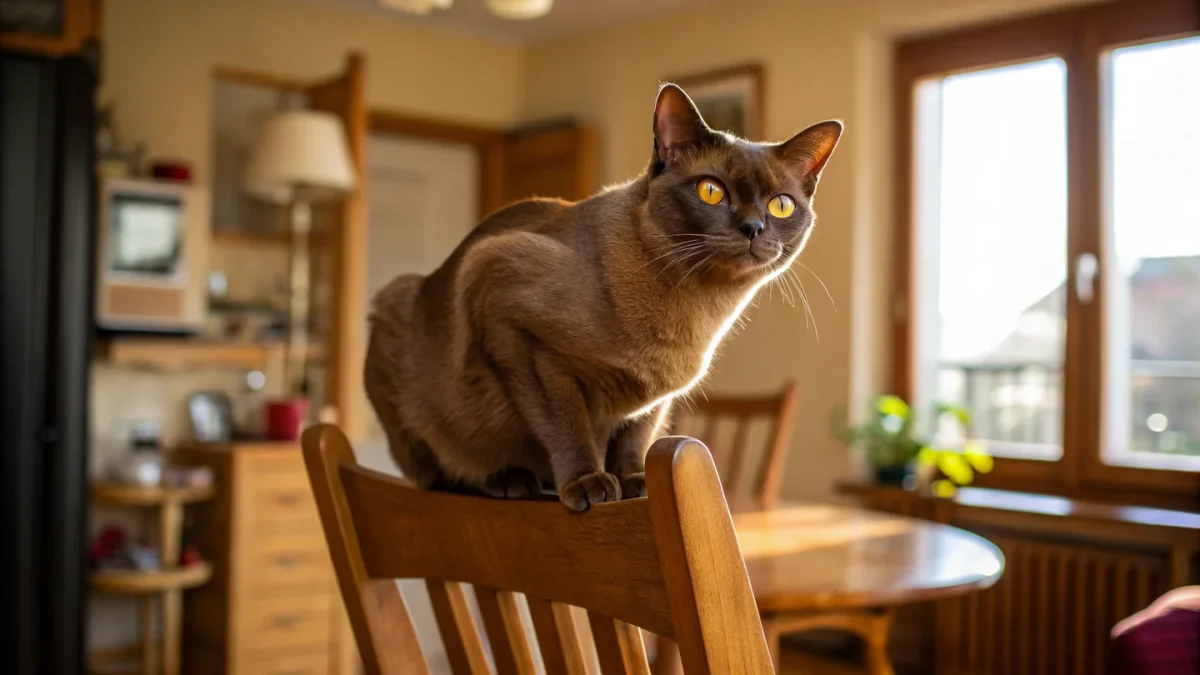
Pick up a Burmese and the first thing you notice is the weight. These cats are dense — the old breeders called it "a brick wrapped in silk," and that's not far off. The body is compact, heavily muscled, and warm to the touch in a way that feels almost intentional. The coat lies flat and close, with a satin finish that catches light differently from one angle to the next. The eyes are large, gold to amber, set in a face that's round without being flat — an expression somewhere between curious and genuinely pleased to see you.
Then the cat starts talking. Burmese are vocal, but not in the Siamese way — they don't yowl for effect. They have a lower, more conversational register, and they use it persistently. They'll follow you room to room, offer opinions on what you're doing, and settle into whatever lap or shoulder seems warmest. If you've spent time around breeds known for independence, a Burmese will reorient your expectations. This is a cat that wants contact, not just proximity. The term "velcro cat" exists in the breed community for a reason, and the first time you try to put one down and it climbs back immediately, you'll understand it.
The Burmese is one of the most sociable, people-dependent, emphatically affectionate cats in the world. If the Russian Blue is the reserved loyalist and the British Shorthair the dignified stoic, the Burmese is the enthusiast — present, vocal, physically insistent about connection, and genuinely happier in company than alone.
Origins: Wong Mau and Dr. Thompson
Dr. Joseph Thompson brought Wong Mau from Burma (now Myanmar) to San Francisco in 1930. She was a small, dark-brown cat with a slightly rounder face and more compact body than the Siamese of the era. Thompson recognized her as potentially distinct from both the Siamese and from Tonkinese-type cats, and he set up a formal breeding program with the help of geneticist Clyde Keeler and breeder Virginia Cobb.
When Wong Mau was bred to a Siamese — the closest available breed at the time — her kittens fell into three types: some looked Siamese, some looked like Wong Mau herself, and some were a solid very dark brown. This result, later explained through Burmese genetics, revealed that Wong Mau was herself a hybrid (likely what we now call a Tonkinese type) rather than a pure specimen of whatever breed she carried.
The consistent dark brown kittens from those early litters — what breeders called "sable" — were selected and bred together to produce the American Burmese. The early standard emphasized the rounded head, the sable coat, and the muscular, compact body that remains characteristic today.
The breeding results of this early program were published in the Journal of Heredity in 1943, which is one of the reasons the Burmese has unusually well-documented foundation genetics compared to most breeds that rely on oral tradition and show records alone.
In Europe, independent development using imported and crossed stock produced what became the European Burmese — a distinct type with a more elongated body, more angular head, and a longer nose than the American version. The European Burmese also recognized a wider range of coat colors more quickly. Today the two types are recognized separately in most international registries.
Physical Characteristics
American Burmese: The show standard emphasizes extreme roundness. Round head, round eyes, round cheeks, rounded body. Medium-sized and surprisingly heavy for their visual size — Burmese have a characteristic density that surprises people who pick them up. The body is compact and muscular. Eye color is gold to yellow. Coat is satin-like in texture — short, close-lying, with a natural sheen.
European Burmese: More moderate in its proportions. The head is a modified wedge shape with a more visible muzzle than the American type. Body is longer and more slender. Eye color ranges from gold to yellow to slightly green-tinted. The coat is equally fine and lustrous.
Both types come in sable (the original dark brown) and a range of dilutes and variations: blue, chocolate, lilac, red, cream, and tortoiseshell patterns, with the American type historically recognizing fewer color variants than the European standard — CFA currently accepts just four (sable, champagne, platinum, and blue), while GCCF and FIFe recognize ten, including chocolate, lilac, red, cream, and the tortie combinations.
Temperament: The Velcro Cat
The Burmese is one of the most dog-like cats in terms of human attachment behavior. This is not a casual characterization — Burmese genuinely follow their people through the house, prefer to sleep with their owners, will play fetch reliably with some individuals, and demonstrate separation distress when left alone for extended periods.
The "velcro cat" reputation is earned. A Burmese that has bonded with you will be physically present: in your lap when you sit, on your pillow at night, at your feet while you cook. They don't observe from a distance. They engage.
Vocally, the Burmese is moderately talkative. Not the relentless commentary of a Siamese, but more engaged than the quiet Russian Blue. They have a distinctive voice — softer and lower than a Siamese, but used regularly to communicate wants and opinions.
Play drive is high and persists longer into adulthood than in many breeds. Burmese are athletic, enjoy games, and maintain a kitten-like enthusiasm well into middle age. Interactive play matters — puzzle feeders, wand toys, fetch games, anything that involves you.
Intelligence is high. Burmese learn quickly, which means both that they can be trained to do things (they are among the more trainable cat breeds in terms of learning games and behaviors) and that they learn to open things, find things, and engineer access to places you'd prefer they didn't access.
What Most People Get Wrong About the Burmese
They're just brown cats. The sable coat is the traditional and most recognizable color, but modern Burmese come in a range of colors — blue, chocolate, lilac, red, cream, and the various tortie combinations. More to the point, the Burmese is not primarily a visual breed. Its defining characteristic is personality, not coat color.
They're related to Birmans. The names create confusion constantly. The Birman (Sacred Cat of Burma) and the Burmese cat share a geographic reference but are completely different breeds — different body type, coat type, color pattern, temperament, and history. A Birman has a semi-long silky coat with white gloves and blue eyes. A Burmese has a short satin coat with no white markings and golden eyes.
They're low-maintenance because they're short-coated. The coat is genuinely low-maintenance. The personality is not. A Burmese left alone for long hours without adequate stimulation or companion animals will become visibly unhappy. The "low maintenance" framing ignores the significant social and emotional investment the breed requires.
They're suitable for someone who wants independence. This is perhaps the most practically important misconception. The Burmese is precisely the wrong breed for someone who wants a cat that's content alone. It is the right breed for someone who genuinely wants a constant companion.
Health Considerations
The Burmese carries some documented breed-specific health concerns that responsible breeders work to address.
Burmese head defect (craniofacial abnormality): A genetic defect that causes severe skull malformation was identified in American Burmese lines, more common there than in European lines. Affected kittens are not viable. A UK testing lab that screened around 800 European and UK Burmese found the mutation in roughly 1% of that population — lower than in American lines, which is exactly why the geographic distinction matters here. Genetic testing is available, and reputable breeders test breeding animals to avoid pairing two carriers.
Hypokalemia (low blood potassium): A periodic muscle weakness condition documented particularly in Asian Burmese lines. A genetic test is available for the responsible mutation.
Diabetes mellitus: The Burmese has a statistically elevated risk of diabetes compared to many other breeds — particularly the Australian/New Zealand Burmese population, where this has been studied more extensively. A Brisbane clinic study found diabetes in 22.4 per 1,000 Burmese cats versus 7.6 per 1,000 domestic shorthairs and longhairs — roughly three times the rate, and it shows up later in life in Burmese too. Weight management and appropriate nutrition are important preventive considerations.
Feline orofacial pain syndrome (FOPS): A neurological condition causing episodes of face-scratching and apparent oral discomfort has been reported with higher frequency in Burmese than in many other breeds — a retrospective study of 113 diagnosed cats found 100 of them were Burmese, about as clear a breed skew as you'll find in feline neurology.
General cat health management — annual veterinary examinations, dental care, parasite prevention, appropriate nutrition — applies fully.
Grooming: The Low-Overhead Coat
The Burmese coat is one of the genuinely low-maintenance coats in the pedigree cat world. Short, close-lying, with no undercoat to mat or shed dramatically. Weekly hand-grooming (literally running your hands along the coat) or a soft brush removes loose hair and distributes skin oils. The natural satin sheen is part of the coat's structure, not a product of grooming products.
Bathing is not a regular requirement under normal circumstances. The coat stays clean under the Burmese's own fastidious grooming habits.
Standard care: nail trimming every two to three weeks, ear cleaning as needed, and dental hygiene (which is genuinely important — periodontal disease is common in cats generally, and regular tooth brushing significantly reduces its development).
Living With a Burmese
The Burmese is best suited to households where it will have company for most of the day. A second cat — ideally another Burmese or a similarly sociable breed — provides critical company during the hours its people are away. A Burmese left as a sole pet in an empty house for full working days regularly will often develop stress-related behaviors.
They are adaptable to apartments and smaller spaces provided their social and play needs are met. Vertical space — cat trees, wall shelves — satisfies their climbing drive and gives them vantage points.
Children who understand appropriate handling will generally find the Burmese wonderfully interactive and patient — the breed's combination of robustness and sociability makes it one of the better family cats among the "people-dependent" types.
The Right Owner for a Burmese
The Burmese is the breed for someone who wants a cat that participates in their life rather than inhabiting the same space. If your vision of a cat involves choosing to interact or not on a daily basis, the Burmese will have feelings about that choice — and will make them known.
Ideal Burmese households: work-from-home situations, multi-pet households with compatible animals, families with older children who engage actively with pets, and anyone who genuinely wants a constant companion.
Not ideal: people who want an independent cat, those who travel frequently without arrangement for their cat's company, anyone seeking a quiet, undemanding background presence.
The payoff for meeting the Burmese's social requirements is complete: few cats offer the combination of intelligence, warmth, and genuine emotional responsiveness that the Burmese delivers when its needs are met.
Frequently Asked Questions
What is the difference between the American and European Burmese?
The American Burmese has a rounder head, rounder face, and more compact body — sometimes described as cobby. The European Burmese has a more moderate, slightly wedge-shaped head, longer nose, and more slender body. Both share the same general temperament, short satin coat, and golden eye color. They are considered separate breeds or varieties in most international registries.
Are Burmese cats good for first-time cat owners?
The temperament can work well for first-time owners, particularly those who want an interactive companion. The breed communicates clearly, is responsive to attention, and is fairly hardy. The key consideration is meeting the high social need — a Burmese left alone too much will struggle. If that's managed, the breed is genuinely accessible.
How do Burmese cats handle being alone?
Poorly, as a general rule. The Burmese is among the breeds most likely to develop anxiety, stress-related behaviors, or depression when regularly left alone for extended periods. A second companion animal or significant interactive play before and after absences helps, but the breed genuinely thrives on company.
Do Burmese cats get along with dogs?
Often yes, when introductions are managed carefully and the dog has a compatible temperament. The Burmese's social drive extends to other animals, and many individuals form real relationships with dogs. High-prey-drive dogs or very boisterous breeds are harder matches.
How long do Burmese cats live?
Burmese are known for above-average longevity — 16 to 18 years is not unusual, and some individuals reach their early twenties. The elevated diabetes risk makes weight management and regular veterinary monitoring particularly important for longevity.