

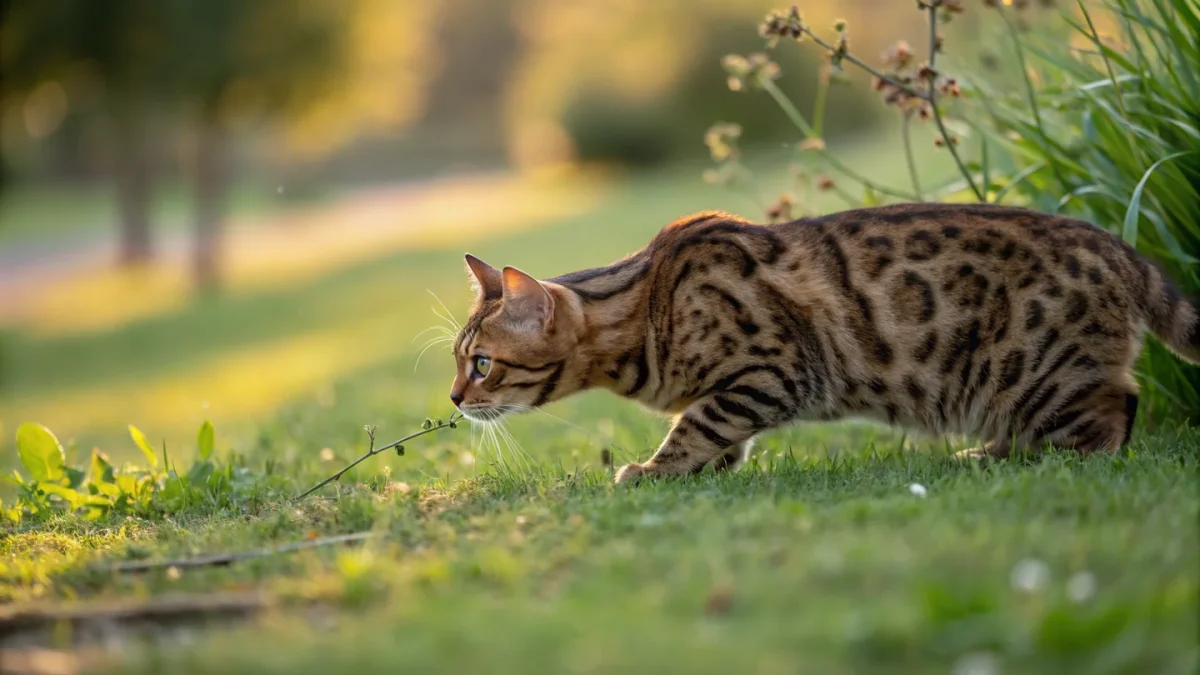
Nothing in domestic cat breeding prepares you for the Bengal coat up close. In a cat show ring, Bengals stop people mid-stride — not because they're large or unusual in shape, but because the coat looks like it belongs to an animal that shouldn't technically be in the building. Rosettes with dark outlines and tawny centers, arranged in a pattern that tracks across the flanks like an ocelot's. And then, in the right light, the glitter effect: individual hairs tipped in a way that catches light and makes the coat appear to shimmer. It's not a trick of photography or show-day preparation. It's structural. A feature inherited from the Asian leopard cat ancestor, expressed now in a thoroughly domestic animal that will absolutely knock your water glass off the counter at 3 a.m.
The Bengal cat is one of the most visually striking animals in domestic cat breeding. It is also one of the most misunderstood — frequently purchased by people drawn to the appearance and surprised by the reality. This guide covers both.
Origins and the Hybrid Question
The Bengal's wild ancestor is the Asian leopard cat (ALC), a small wild cat native across a large range of Asia, from Pakistan through Southeast Asia to Japan and Indonesia. The ALC is roughly the size of a large domestic cat, with a spotted coat, bold face markings, and notably wilder instincts — more independent, more athletic, and less amenable to human interaction than any domestic breed.
Jean Mill's work in the 1980s, alongside contributions from other breeders and researchers including Dr. Willard Centerwall who worked on ALC crosses for disease resistance research, established the foundation of the modern Bengal. The goal from Mill's perspective was always a domestic cat with a wild appearance — not a wild cat, and not a working animal, but something that looked like it belonged in a forest while living in an apartment.
The critical threshold is generation. A first-generation (F1) Bengal has one ALC parent — 50% wild ancestry. This is not a pet in any conventional sense. F1 Bengals are largely unpredictable, difficult to socialize adequately, and in many jurisdictions are classified as exotic animals subject to ownership restrictions.
F2 Bengals (one ALC grandparent) are still substantially wild in temperament and difficult for most owners. F3 remains challenging. It is F4 and beyond — conventionally called "SBT" (studbook tradition) Bengals — that are considered domestic by registries and that most responsible breeders sell as pets. By this point, wild ancestry is four or more generations removed. The temperament is domestic. The coat is spectacular.
The Bengal Coat: What Makes It Unique
The Bengal coat is what draws most people to the breed, and it is genuinely unlike anything else in domestic cats.
Spotted and rosetted patterns are the most prized. Rosettes are multi-toned spots that echo the marking pattern of leopards and jaguars — a dark outline surrounding a center that contrasts with the background. This three-dimensional patterning on a domestic cat is the signature achievement of Bengal breeding. Good rosettes have clear definition, contrasting tones, and scatter across the body in irregular patterns that don't look stamped on.
Marbled Bengals have a different pattern — flowing, horizontal swirls rather than spots, creating an abstract marble effect. The genetics of marbled vs spotted involves the tabby pattern gene and how it interacts with the wild-type background.
The glitter effect is one of the more remarkable features of the Bengal coat. Individual hair strands contain tiny translucent cells that catch and reflect light, giving the coat a metallic shimmer in direct light that is sometimes described as "glitter" or "sparkle." This is not a treatment or grooming product — it is structural to the hair shaft and comes directly from ALC ancestry.
Base colors range from brown (the most common) to silver, snow (in three variants: seal lynx, seal mink, seal sepia), and charcoal.
Bengal Temperament: The Honest Version
The Bengal's personality is not for every household, and understanding it accurately before acquiring one saves a lot of difficulty. Among active cat breeds, the Abyssinian cat breed draws the most frequent comparisons — but even the Abyssinian's considerable energy runs a step below what a Bengal demands.
These are athletic, high-drive, highly intelligent cats that do not default to quiet coexistence. They climb. Everything. Kitchen counters, refrigerator tops, curtain rods — if there is a vertical surface, a Bengal will find a way up it. They interact with water in ways that unsettle owners who weren't expecting a cat that plays in water bowls, bats water out of glasses, or is fascinated by running taps.
They hunt. The prey drive in Bengals is substantially stronger than in most domestic breeds. Households with small animals — birds, hamsters, rabbits, fish — should think carefully about this. The drive is not trainable away; it is structural.
They are intelligent in a way that creates problems without adequate stimulation. A bored Bengal does not sit quietly. It systematically solves the puzzle of how to access whatever you've tried to keep inaccessible. It locates the one thing you really didn't want knocked off a shelf. It expresses its frustration with a level of destruction that can surprise first-time Bengal owners.
Against this: a well-stimulated Bengal with an engaged owner is enormously rewarding. The athletic displays are impressive. The coat is stunning. The cat interacts with its environment in ways that are genuinely fascinating to observe. Many Bengal owners describe them as more like a dog than a cat — they fetch, they follow, they respond to their names, and some learn leash walking with remarkable ease.
Bengal Cat Generations Explained
The generation system matters significantly for anyone acquiring a Bengal:
F1 (50% ALC): One ALC parent. Not a domestic pet by most standards. Very difficult to keep, requires specialist knowledge, and is restricted or prohibited in many jurisdictions.
F2 (25% ALC): One ALC grandparent. Still challenging, still often restricted. Not suitable for typical household situations.
F3 (12.5% ALC): Closer to domestic temperament but still variable. Some registries and jurisdictions still restrict F3.
F4 and beyond (SBT): The domestic Bengal. Four or more generations removed from the wild ancestor. Registered as domestic cats. This is what responsible breeders sell as household pets.
The SBT designation requires documentation showing that both parents and at least one grandparent were also SBT — ensuring the wild ancestry has truly receded. Anyone selling a Bengal without generation documentation should prompt skepticism.
What Most People Get Wrong About Bengals
The most common misconception is that wild appearance equals wild temperament in a linear way. The temperament of an SBT Bengal is domestic, but energetic and high-drive in a way that exceeds most other breeds. This is not the same as being wild — an SBT Bengal can be affectionate, bonded, and manageable. But "domestic" doesn't mean "easy."
The second misconception is about shedding. Bengal owners frequently report that the Bengal coat sheds less than expected. The single-layered, dense, unusually short coat does shed, but the tight structure means loose hairs tend to fall in the coat rather than distributing widely around the house. This impression of low-shedding is real but relative.
Third: people sometimes assume the glitter coat requires special maintenance. It doesn't. The light-refraction structure is inherent in the hair. Normal care — weekly brushing — is sufficient.
Bengal Health
Bengals are generally healthy cats with a robust constitution, but several specific conditions warrant awareness:
Progressive retinal atrophy (PRA-b): A hereditary form of PRA specific to Bengals, caused by a variant in the KIF3B gene — a different mutation than those found in other breeds. Can lead to blindness by around one year of age. DNA testing is available and responsible breeders test breeding animals. A large-scale genetic epidemiology study published in PLOS Genetics in 2021 found the KIF3B variant present as a carrier state in approximately 6.9% of Bengals tested across multiple countries, making carrier screening a meaningful tool for responsible breeding programs.
Hypertrophic cardiomyopathy (HCM): Thickening of the heart muscle. Affects many cat breeds, Bengals included — the breed is recognized among those with documented predisposition. The overall prevalence of HCM across the cat population is estimated between 3% and 15% depending on the study population, with purebreds at the higher end of that range. No Bengal-specific prevalence figure has been conclusively published, which is why North Carolina State University's College of Veterinary Medicine is currently running a dedicated Bengal HCM genetic study. Regular cardiac screening is advisable.
Flat-chested kitten syndrome (FCKS): A developmental condition where the chest doesn't form correctly, affecting respiratory capacity. A 2017 Swedish study of 138 Bengal litters found thoracic malformations in approximately 6% of 566 kittens, a rate higher than that observed in domestic shorthair cats. Of affected kittens, roughly 36% did not survive the first four weeks. Mild cases can reach adulthood with intervention.
Tritrichomonas foetus: A protozoal gastrointestinal parasite causing chronic diarrhea. Bengals are overrepresented in diagnosed populations: a retrospective study of 104 T. foetus cases published in BMC Veterinary Research found Bengals among the top breeds represented, and UK surveillance data consistently identifies young pedigree cats — Bengals included — as significantly more likely to test positive than domestic crossbred cats.
Bengal Cat Care
Activity Requirements
This is a daily commitment, not an occasional indulgence. Interactive play sessions of 20–30 minutes twice a day are a minimum for mental health. A Bengal left without stimulation will create its own — at your expense.
Cat trees need to be tall and solid — Bengals are heavier and more vigorous than the average cat tree expects. Wall-mounted climbing systems give altitude in a way that floor-standing structures often can't adequately provide.
A leash-trained Bengal benefits enormously from outdoor stimulation. Many take to harness training readily if introduced young.
A second cat is strongly advisable if the Bengal will be alone during the day. Energy channeled into play with another cat is energy not channeled into investigating what's behind the refrigerator.
Grooming
The Bengal coat is low-maintenance. Weekly brushing, nail trimming, and dental care are the essentials. The coat maintains itself reasonably well and doesn't mat or tangle.
Feeding
Bengals are lean, muscular cats with active metabolisms. Quality nutrition without excess carbohydrate loading is appropriate. Some owners prefer raw or high-protein diets on the basis of the wild-type ancestry, though no peer-reviewed evidence currently supports specific dietary requirements for SBT Bengals beyond standard feline nutritional guidelines.
The Right Owner for a Bengal
The Bengal is a cat for someone who wants an active participant in their household, not a decorative presence.
The right Bengal owner has time for daily interactive engagement, a home environment that can accommodate climbing and activity, other animals (or is home frequently) to provide company, and ideally experience with cats before acquiring a Bengal as a first cat.
People who are rarely home, who want a cat that sits quietly and exists aesthetically, or who have small animals as existing pets should look carefully at whether a Bengal suits their situation. The potential for the relationship to be extraordinary is real — but so is the potential for a mismatch that's difficult for both parties.
FAQ
Are Bengals good with children?
SBT Bengals can be good with children who understand how to interact with cats and can match the Bengal's energy. Their activity level suits engaged children who want an interactive animal. Very young children or those who want to handle the cat passively may find the Bengal less suitable — they want play, not cuddles.
Do Bengals get along with other cats?
Varies significantly by individual and introduction approach. Many Bengals do well with other active cats. The prey drive means introductions to smaller, more passive cats should be managed carefully and may not work well in all cases.
Are Bengals legal to own?
SBT Bengals (F4 and beyond) are legal in most places as domestic cats. F1-F3 Bengals are restricted or prohibited in many jurisdictions. Laws vary significantly by country, state, and municipality — verify local regulations before acquiring any Bengal.
Do Bengal cats like water?
More than most domestic breeds, yes. Many Bengals are fascinated by water — playing in water bowls, investigating running taps, sometimes entering shallow baths. This is not universal but is common enough to be considered a breed characteristic.
How long do Bengals live?
Typically 12–16 years with good care. The hybrid vigor of the breed means Bengals are generally robust, though the specific hereditary conditions warrant monitoring throughout their lives.