

There are cats you live with and cats you live alongside. The Oriental Shorthair is firmly in the first category — a breed that participates in your life rather than coexisting with it. For a complete look at this breed's origins and care needs, the Oriental Shorthair's complete background covers the full picture.
Understanding the Oriental Shorthair temperament before bringing one home matters more for this breed than for most. Their social requirements are real, their vocalizations are constant, and their energy doesn't have an off switch. None of these things are flaws — they're features, for the right owner. But they need to be understood as commitments, not mild preferences.
The Vocal Baseline: What "Chatty" Actually Means
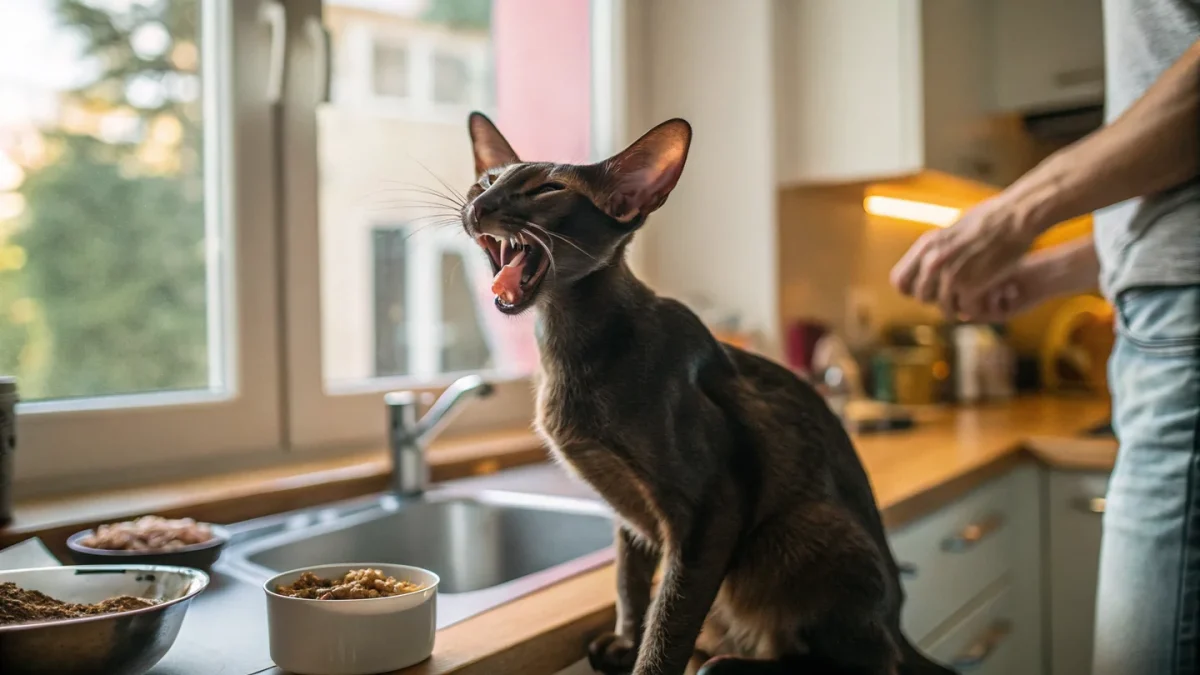
When breed guides describe the Oriental Shorthair as "vocal," they're describing a category of communication that goes well beyond what most cat owners have experienced. This isn't a cat that meows at the food bowl and at bedtime. This is a cat with an ongoing running commentary.
The Oriental Shorthair vocalizes to greet you at the door. To announce that you've been in another room for too long. To express an opinion about the weather. To narrate the activity outside the window. To register dissatisfaction with the texture of a surface they've been placed on. To communicate that the water bowl is positioned three inches too far from the wall.
The voice itself is distinctive — generally lower and less piercing than the classic Siamese wail, with a melodic quality that owners describe as conversational. There's real variation in volume and tone: a chirp for interest, a trill for greeting, a drawn-out moan for complaint, a rapid-fire chatter in response to watching birds. Many Oriental Shorthair owners report learning to distinguish specific vocalizations reliably, because the cats are consistent in their use.
For some people, this is exactly what they want. For others — including people who work from home in calls or who share walls with neighbors — it's a genuine practical consideration.
Social Bonding: The Intensity of Attachment
The Oriental Shorthair doesn't just like people. They lock onto them with a fidelity that exceeds most breeds and a few species.
The typical attachment pattern involves a primary person — usually whoever spends the most time with the cat — and a secondary social network of family members and approved visitors. The primary bond manifests as consistent physical proximity: this cat will find you in whatever room you're in, will rearrange itself near you within minutes of you sitting down, and will redirect its attention to you when you speak from across the room.
This attachment is not passive. Oriental Shorthairs are proactive about initiating contact — they don't wait for you to come to them. They initiate grooming sessions (cat grooming of humans is common in this breed), they bring toys, they request engagement through specific vocalizations. The relationship feels reciprocal in a way that not all breeds achieve.
The flip side of intense attachment is genuine distress when the attachment figure is absent. Oriental Shorthairs don't simply become quieter when left alone — many develop stress responses. Destructive behavior, excessive grooming, reduced appetite, and what can only be described as a funk that persists for hours after the person returns are all documented in single-cat households where the owner works full days away from home.
The standard solution, and it works reliably, is a companion cat. Two Oriental Shorthairs together redirect their social energy at each other when the human isn't available. The bond between them is as intense as the human bond — they typically become inseparable — but it covers the gap during working hours in a way that toys and window perches cannot.
Energy Level and Play Drive
The Oriental Shorthair sits at the high end of feline activity levels, and the energy persists well past kittenhood. Adults in their prime (age 2-7) are genuinely athletic: they jump to high surfaces with ease, investigate everything new with methodical thoroughness, and initiate play unprompted throughout the day.
Fetch — actual retrieve-and-return fetch — is more common in this breed than in almost any other cat breed. Many Oriental Shorthairs learn this behavior spontaneously, without training, and will conduct sustained fetch sessions with small toys. It's one of those behaviors that reinforces the "dog-like" descriptor that follows the breed.
Play sessions need to be genuinely engaging. Wand toys that mimic prey movement work well. Puzzle feeders provide mental engagement that pure play sometimes doesn't. High perches and cat trees satisfy the climbing drive. Rotation of toys — keeping some unavailable and cycling them — maintains interest over time.
Two 15-minute play sessions are a floor, not a ceiling. Oriental Shorthairs typically have more energy available than that, and homes where play time is consistently limited see more of the redirect-onto-household-objects behavior that owners find frustrating.
Curiosity as a Personality Trait
Oriental Shorthairs are curious in a way that's more thoroughgoing than the baseline feline curiosity. They don't just notice new things — they investigate them systematically. A new object in the house gets sniffed, pawed, batted, occasionally moved, sat upon, and assessed until the cat is satisfied it understands it.
This curiosity extends to humans. Guests who arrive at a home with an Oriental Shorthair are typically approached and assessed within minutes — the breed doesn't hide from strangers in the way that many more cautious breeds do. An Oriental will walk up to an unfamiliar person, conduct a thorough olfactory investigation, and then make a judgment call about whether the person merits further attention. The judgment is usually favorable.
The curiosity is also the mechanism behind the behavior owners describe as "helping" — an Oriental Shorthair involved in whatever you're doing, whether you want feline involvement or not. Open a laptop: the cat sits on it. Lay out papers: the cat sits on them. Start a video call: the cat walks across the camera. This isn't random; they're genuinely interested in activity, and they insert themselves into it.
Territorial Behavior and Multi-Cat Households
Oriental Shorthairs are generally not aggressive territorial defenders, but they do form strong attachments to their preferred spaces — particularly elevated perches and prime resting spots. In multi-cat households, competition for high-value spots is more common than outright aggression, and providing multiple equivalent options (same height, same view) prevents most of it.
The breed typically does well with other cats, particularly those of similar energy level. Two Oriental Shorthairs together form partnerships that are among the more spectacular examples of feline bonding — constant contact, synchronized grooming, coordinated play. They don't require same-breed companions, though; active breeds like Abyssinians, Cornish Rex, and Devon Rex tend to be compatible socially.
Lower-energy breeds can struggle with an Oriental Shorthair's persistent attempts at engagement. A Persian who wants to sleep in peace will have strong feelings about living with an Oriental who wants to play at 2 AM.
The Independence Question
People sometimes ask whether the Oriental Shorthair is "independent." The answer requires some definitional clarity.
They're not aloof. They don't choose solitude. They don't maintain the emotional distance that some breeds — Chartreux, for example, or Russian Blue — keep as a default. In that sense, no, they're not independent.
But they're also not submissive or dependent in a way that reads as needy to people who have experience with Siamese cats. Oriental Shorthairs are confident. They make choices about when to engage and when to rest, about which surfaces they'll occupy and which rules they'll acknowledge. They're not dogs — they don't follow instructions uncritically. The social intensity and the independent nature coexist, which is part of what makes them interesting animals to live with.
Managing the Demands
The practical question for prospective owners is not whether the Oriental Shorthair's temperament is appealing — most people find it appealing in theory — but whether their life accommodates what the breed actually needs.
Two things matter most:
Companionship coverage: Whether that's a companion cat, a work-from-home arrangement, or a rotating cast of household members, this breed needs social contact for most of the day. Eight to ten hours of regular solitude is a hardship for an Oriental Shorthair.
Active engagement: Daily play, environmental enrichment, and tolerance for participation in everything you're doing. This isn't a casual arrangement — it's a relationship with a cat that takes the relationship seriously.
Given those things, the Oriental Shorthair is among the most rewarding cats alive. The vocal, present, intensely curious creature that follows you from room to room is the same creature that will sit on your chest purring when you're sick, that will greet every arrival with genuine enthusiasm, and that will make the unremarkable hours of home life substantially less unremarkable.