

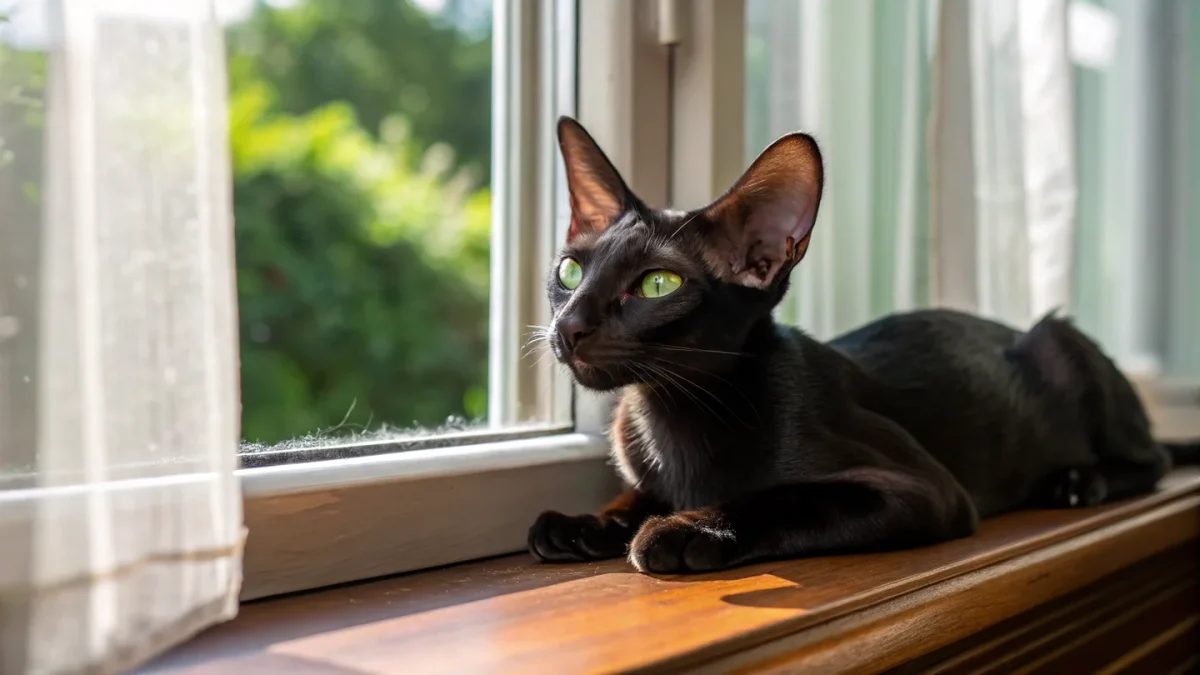
Picture a cat that looks like it was built by an engineer with a mandate to maximize surface area for ears. The Oriental Shorthair has a skull that narrows to a fine wedge, cheekbones that flare wide, and then — at the very top of that wedge — two enormous triangular ears that seem to be receiving signals from another dimension. The body follows the same logic: long neck, long legs, long tail, ribs that you can almost see. There is nothing compact or rounded about this cat. Everything extends.
And then it opens its mouth.
Siamese cats have a reputation for being vocal, but Orientals treat conversation as a competitive sport. I've spent time in my friend's cattery — she breeds Maine Coons, a breed that communicates mostly through silent stares — and she once borrowed an Oriental for a weekend from a fellow breeder. By Sunday morning she was calling it "the commentator." The cat had opinions about breakfast timing, the location of the litter box, and whether the kitchen window should be open. It delivered these opinions continuously, at volume, with apparent conviction that they would be acted on. They mostly were.
Origins: The Siamese Family Tree
The Oriental Shorthair's story begins in Thailand — then called Siam — where manuscripts dating to the 14th century depicted cats resembling the angular, large-eared body type we associate with the modern "Oriental" family today. These weren't the round-faced cobby cats of European fancy; they were lean, lithe, and clearly built for something.
British breeders began experimenting in earnest in the 1950s and 1960s, crossing Siamese with domestic shorthairs and Russian Blues to introduce new coat colors while maintaining the distinctive Siamese body type. The goal was straightforward: a Siamese-bodied cat that could carry any color, not just the four point patterns the Siamese standard permitted. By the early 1970s, these cats were being exhibited under various regional names — Foreigns, Colorpoints, Foreign Whites — before the umbrella term "Oriental" took hold.
The CFA's 1977 recognition formalized what had been developing for two decades. Since then, the breed has been further expanded with the Oriental Longhair (same cat, flowing coat), and the gene pool has been deliberately kept connected to the Siamese and Balinese to maintain diversity and structural soundness.
Physical Characteristics
The Oriental Shorthair's silhouette is one of the most distinctive in the cat world. Everything is angular and extended — a long, tubular body on fine-boned legs, a wedge-shaped head that comes to a point at the muzzle, and ears so large they're described in breed standards as "strikingly large, wide at the base." Those ears aren't just decorative; they're functional amplifiers that make these cats acutely aware of everything happening in their environment.
Body: Medium-sized, long, and lean. Males typically weigh 8-12 pounds; females 6-8 pounds. Despite looking delicate, they're surprisingly muscular.
Head: Long wedge extending from the tip of the muzzle to the base of the ears in straight lines. No stops, no curves — pure geometry.
Eyes: Almond-shaped, set at a slant. Typically vivid green, though some white-coated individuals carry blue or odd eyes.
Coat: Short, fine, and lying close to the body. There's almost no undercoat, which means minimal shedding compared to most shorthaired breeds and a texture that feels more like silk than fur.
Colors: This is where the Oriental diverges spectacularly from the Siamese. Solid colors (ebony, blue, chestnut, lavender, red, cream, white, fawn, cinnamon), shaded patterns, smoke, tabby in four different patterns, bicolor, parti-color — the combinations run into the hundreds. The breed's genetic versatility is unmatched.
Temperament: The Conversationalist
If you want a cat that minds its own business, the Oriental Shorthair is the wrong choice. Full stop.
These cats vocalize constantly — not just at feeding time or when they want something specific, but as a running commentary on the day's events. They announce arrivals, departures, the mail slot rattling, a bird on the fire escape, and their personal dissatisfaction with the thread count of your sheets. The voice is typically lower and less piercing than the classic Siamese yowl, but it's no less frequent.
What distinguishes the Oriental Shorthair's social behavior is the intensity of their attachment. They don't just like people — they require people. Loneliness hits them hard. A solo Oriental left alone for 10 hours routinely develops stress behaviors: excessive grooming, destructive activity, or a profound funk that takes days to shake. This is a two-cat household breed unless someone is home most of the day.
When they have what they need — company, stimulation, vertical space, and someone willing to hold a conversation — they're among the most rewarding cats to live with. They learn quickly, engage with puzzle feeders with genuine enthusiasm, play fetch unprompted (a behavior more common in this breed than almost any other), and insert themselves into every domestic activity with cheerful inevitability.
What Most People Get Wrong About the Oriental Shorthair
The most common misconception is that the Oriental Shorthair is "just a Siamese with different colors." Genetically, this has some truth — they share the same body type and vocal tendencies, and the breeds are outcrossed together. But the Oriental has been selectively developed for 70 years as its own breed, with its own gene pool management and its own standard. An ebony Oriental Shorthair is no more "a Siamese" than a Golden Retriever is "just a yellow Labrador."
The second misconception is that they're fragile because they look fragile. The slender build fools people. These cats are athletic, sturdy, and remarkably long-lived — lifespans of 12-15 years are common, and individuals reaching 18 or 19 aren't unusual. The lean body is an efficient body.
Third: people assume they're aloof or neurotic because of the "high-strung Siamese" reputation. The Oriental Shorthair is more accurately described as emotionally extroverted. They're not anxious by default — they're engaged. Given a stable, enriched environment with consistent human contact, they're confident, curious, and remarkably sociable with strangers.
Health and Longevity
The Oriental Shorthair shares health predispositions with the Siamese family. The most significant is progressive retinal atrophy (PRA), a genetic condition that can cause vision loss — responsible breeders test breeding stock. Dilated cardiomyopathy (DCM) appears at higher rates in this family than in some other breeds — veterinary reference literature names Siamese specifically, alongside Burmese, as breeds carrying elevated risk, historically tied to taurine sensitivity. Dental crowding is a real concern given the narrow jaw; regular dental checks matter more here than in cobby-faced breeds.
The near-absent undercoat that makes grooming easy also means these cats are sensitive to cold. They don't thermoregulate as efficiently as double-coated breeds, so ambient temperature matters, and drafty environments will have them huddling into warm spots quickly.
Lifespan is generally excellent for a pedigreed cat — the lean body and absence of exaggerated conformation features (unlike brachycephalic breeds) means fewer structural health problems over time.
Grooming: Surprisingly Low-Maintenance
The single short coat is one of the Oriental Shorthair's practical advantages. Weekly brushing is sufficient for most coats; during seasonal transitions, twice a week addresses any minor shedding increases. A chamois or rubber grooming glove works better than a wire brush on this coat type — you want to follow the lie of the fur, not disturb it.
The large ears collect debris. Weekly inspection and gentle cleaning with a cotton ball or soft cloth prevents buildup. Because of the dental crowding risk, teeth deserve attention from an early age — introducing tooth brushing gradually as a kitten is far easier than starting with an adult.
Nail trimming every two to three weeks. Nothing exotic required.
Living With an Oriental Shorthair
Activity level: High. These cats need daily active play — wand toys, puzzle feeders, climbing structures. Two 15-minute play sessions aren't enough; they need sustained engagement throughout the day.
With children: Generally excellent, provided the children understand interaction on the cat's terms. Orientals are not tolerant of rough handling, but they're also not easily spooked — they engage rather than flee.
With other cats: Strongly recommended. Two Orientals, or an Oriental with another active breed, is the standard recommendation for working households. They're not territorial in the aggressive sense, but they'll redirect their social energy at a feline companion if the human isn't available.
With dogs: Variable. A dog that will engage in play and companionship (not chase) can work well. The Oriental's confidence means they don't typically cower from dogs; they're more likely to walk up to the dog and start something.
Apartment living: Fine, with caveats. Vertical space is essential — these cats climb and perch naturally. An apartment with cat trees, shelves, and window access works. An apartment where they're confined to a low, understimulating environment does not.
Feeding
The Oriental Shorthair's lean body means they don't carry reserves efficiently. Twice-daily scheduled feeding — rather than free-feeding — helps prevent the low blood sugar dips that can affect very lean cats. High-protein diets suit the breed's naturally athletic build.
Monitor weight carefully in spayed/neutered individuals. The lean phenotype can mask gradual weight changes that would be obvious on a cobby-framed cat.
The Right Owner for an Oriental Shorthair
Be honest with yourself before pursuing this breed. If you work long hours away from home, travel frequently, or want a low-maintenance companion that entertains itself, the Oriental Shorthair will make both of you miserable.
The right owner for an Oriental Shorthair genuinely enjoys a chatty, present, involved cat. They have time for daily interaction, are home for a significant portion of the day (or have a companion cat in residence), and find the breed's personality entertaining rather than exhausting. They're prepared to invest in enrichment — climbing structures, puzzle toys, play sessions — and can tolerate a cat that will follow them from room to room indefinitely.
This is a breed for people who don't particularly want a cat that's decorative and separate. The Oriental wants to be part of everything. For the right person, that's exactly the point.
Frequently Asked Questions
Are Oriental Shorthairs hypoallergenic?
No cat is truly hypoallergenic, including the Oriental Shorthair. They produce the Fel d 1 protein that triggers most cat allergies. The short, low-shedding coat means less airborne dander than heavy-shedding breeds, which some people with mild allergies tolerate better — but this is not the same as being hypoallergenic.
How do Oriental Shorthairs get along with Siamese cats?
Very well, typically. They're the same body type, the same vocal communication style, and the same activity level. The breeds are still outcrossed for genetic diversity, so their personalities align closely.
Do Oriental Shorthairs like to be held?
Many do, but on their own terms. They'll initiate lap time when they want it and abandon the arrangement when they've had enough. Forcing holds doesn't work well with this breed.
How long do Oriental Shorthairs live?
The average is 12-15 years. Well-cared-for individuals regularly reach 15-18 years. Excellent longevity for a pedigreed breed.
Are Oriental Shorthairs good for first-time cat owners?
With realistic expectations, yes. They're not shy or difficult to socialize, but their social demands are higher than average. A first-time owner who works long hours might find the breed's needs overwhelming. Someone home frequently who wants an interactive, present companion will find them rewarding from day one.