

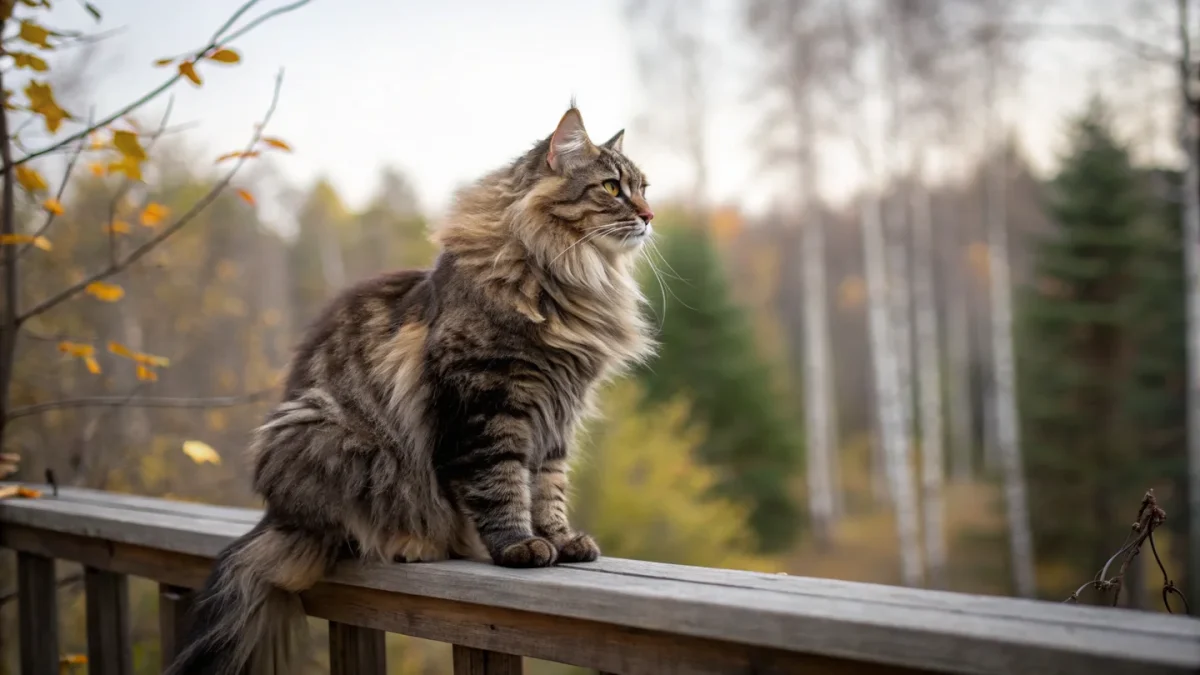
The first time I really understood what a Maine Coon was, I was sitting in my friend's cattery watching a brown tabby male named Arlo walk across the room. I say "walk" loosely. He moved like a small, furry linebacker — this massive, deliberate stride, tufted paws hitting the floor with actual weight you could hear. He stopped in front of me, looked up with these wide gold eyes, chirped once, and headbutted my knee so hard my coffee sloshed. Seventeen pounds of cat who'd decided I was interesting. Arlo has been my mental reference point for this breed ever since.
The Maine Coon is one of the oldest and most beloved domestic breeds in North America, and everything people say about their size and personality is largely true — but what surprised me most, spending time around them, is how much individual variation exists within a breed that has such a strong reputation. Understanding what you're actually getting into — the real maintenance demands, the space requirements, the particular quirks — is worth doing before you fall in love with a kitten photo.
Where They Came From — and How They Almost Disappeared
This is where the Maine Coon story gets genuinely fascinating, and I could spend an entire article just on the origin theories. The most scientifically supportable explanation involves natural selection: long-coated cats from Europe, brought aboard ships and then abandoned or escaped in the New England colonies, bred with local shorthaired cats over several generations. The harsh Maine winters favored cats with dense coats, large frames, and tufted paws — essentially what we see today. A landmark study on cat breed genetics published in Genomics found that North American cats cluster genetically with cats from Western Europe, consistent with the colonial-import origin rather than any specific Turkish or Middle Eastern founder population.
The folklore versions are more colorful, and honestly, more fun to tell. One story holds that the breed descends from cats belonging to Captain Charles Coon, a 19th-century ship captain who kept long-haired cats on his vessel. When his ship anchored in Maine ports, cats escaped and interbred with local ferals. Hence "Coon's cats," eventually shortened to Maine Coons. Charming but historically unverifiable.
And then there's the raccoon theory — that Maine Coons are part raccoon, accounting for their ringed tails and tufted ears. Genetically impossible. Cats and raccoons cannot produce viable offspring. The similarity in appearance is convergent evolution, not shared ancestry. But I understand why the myth stuck. You see a big brown tabby with a banded tail sitting on a fence at dusk, and the silhouette is genuinely convincing.
Here's the part of the timeline that doesn't get told enough: this breed nearly vanished. Maine Coons appear in agricultural fair records in the 1860s, and a brown tabby named Cosey won Best Cat in Show at the 1895 Madison Square Garden show — the first formal American cat show. But then Persian cats flooded the show circuit, and for the better part of a century, nobody cared about the big shaggy New England barn cat. The Central Maine Cat Club formed in the early 1950s to revive interest; the Maine Coon Breeders and Fanciers Association followed in 1968. The Cat Fanciers' Association didn't grant Championship status until May 1976. That's an 80-year gap between Cosey's win and the breed being taken seriously again. The comeback is one of the more remarkable stories in cat fancy history.
My friend who breeds them — a breeder I've known for years — has a framed photo of Cosey on the wall of her cattery. She points to it every time someone asks about the breed's history. "People act like Maine Coons were always popular," she told me once. "They were almost gone."
Built for New England Winters
Maine Coons are genuinely large cats. Not "big for a house cat" — legitimately massive. Adult males run 13 to 18 pounds; females 8 to 12, per TICA's breed standard. Individual males occasionally reach 25 pounds, though neutered cats often run larger than intact males, since the absence of sex hormones delays growth-plate closure and extends the growth period.
The body is rectangular and muscular, built for function. The legs are substantial, with large, round paws that historically may have aided navigation on snow. Polydactyly — extra toes — occurs in Maine Coons at higher rates than in most breeds. Researchers estimate that up to 40% of the early breed population carried the trait, and the geographic distribution of polydactyl cats along the Atlantic seaboard correlates with historical port dates, supporting the theory that the trait spread from New England via ships. Some breeding lines actively preserve it today.
The coat is dense, water-resistant, and uneven in length — longer on the stomach and flanks, shorter on the shoulders, with a substantial ruff around the neck. The texture is silky rather than woolly, which matters for maintenance (more on that later). The tail is long, bushy, and carried high. Ears are large, tufted at the tips — the technical term is "lynx tipping" — and set high on the head. Eye color ranges from gold to green to odd-eyed, with white cats sometimes having blue eyes. The face has a slightly squared muzzle and a gentle, somewhat wild expression.
The breed comes in virtually every color and pattern except those produced by hybridization — colorpoint patterns, for instance, are not accepted in CFA competition. Tabby patterns dominate. Brown tabby is the most iconic, but solid colors, tortoiseshells, and bi-colors all appear.
The "Dog-Like" Reputation
"Dog-like" is the adjective that gets attached to Maine Coons constantly, and having spent time around Arlo and the other cats at my friend's cattery, I understand why it sticks. They follow you from room to room. They greet you at the door. Arlo fetches crumpled paper balls — not occasionally, but reliably, the way Kit fetches bumpers.
They're social without being demanding in the way Siamese cats can be. They want to be near you, not on top of you, and they're quieter, using chirping trills more often than loud meows. I was at a show in Portland a couple of years ago and watched a Maine Coon named Duchess sit calmly on a judging table while three strangers examined her. No hissing, no squirming. Just this steady, tolerant curiosity. Her owner told me she does the same thing at home when guests arrive — walks up, checks them out, then settles nearby. That composure is breed-typical, not just one exceptional cat.
Maine Coons are playful well into adulthood. The kitten phase lasts longer than in most breeds — many owners report their cats remaining kitten-energetic until age 3 or 4. After that the play drive softens but never fully disappears; a 7-year-old Maine Coon will still bat a toy around with obvious enthusiasm.
They're intelligent and curious in ways that can cause household problems: opening cabinet doors, figuring out child-proof latches, knocking things off counters in deliberate experiments rather than accidents. Mental stimulation matters.
And they're good with children and other pets, including dogs, more often than not. They won't tolerate endless handling — they'll remove themselves from situations they find uncomfortable — and they don't love being picked up and carried. They'd rather sit beside you. But for a multi-pet, multi-kid household, they're one of the more adaptable breeds I've encountered.
Three Things New Owners Don't Expect
First: that coat is not self-maintaining. Maine Coons seem so adaptable that people assume everything about them is low-effort. It isn't. A Maine Coon that isn't groomed regularly develops mats — behind the ears, under the arms, around the neck ruff. The good news is the texture is forgiving: a bi-weekly brush generally suffices outside of shedding season. But skip it, and you'll be dealing with mats that need cutting out.
Second: they need vertical space. A cat this size crammed into a small apartment without adequate climbing opportunities is visibly less content than one with room to move. Cat trees, wall shelves, access to different rooms — it makes a measurable difference.
Third: "good-natured" doesn't mean "no effort." This is a cat that needs engagement — toys, interactive play, a companion animal if you're away for extended hours. My friend has told me about buyers who return kittens because they were "destructive." They weren't destructive. They were bored. A bored Maine Coon is creative about expressing it.
The Coat Is Easier Than You'd Think
Two to three sessions per week with a wide-toothed comb or slicker brush, working through the coat systematically. Hit the mat-prone areas first: behind the ears, where the front legs meet the body, the belly. The neck ruff gets its own pass.
Bathing isn't required but is well-tolerated by most Maine Coons if introduced young — more so than many breeds. The water-resistant coat means you'll need to really work the water in. Nail trimming every 2-3 weeks. Ear cleaning monthly — remove wax buildup, don't go deep. Dental care matters for long-term health: brushing if the cat allows it, dental treats at minimum.
Space, Companions, and the Long Adolescence
Maine Coons do fine in apartments if given sufficient enrichment and exercise, though a home with safe outdoor access lets them express their natural hunting and exploratory behaviors more fully.
They don't do well with complete isolation. If your household is empty for 10+ hours a day and you can't get a second cat, this breed may not be your best match. If you have another cat — or a dog with a calm temperament — a Maine Coon will thrive in that company. I've watched Dolly interact with the cats at my friend's cattery, and even she, suspicious of every living thing, tolerates the Maine Coons. Something about their unflappable energy seems to disarm even nervous dogs.
The breed reaches full physical maturity slowly: most domestic cats complete growth by 12–18 months, while Maine Coons continue filling out until 3–5 years. This extended adolescence means buying food and equipment sized for where they're going, not where they currently are. My friend calls the 18-month mark "the awkward phase" — all legs and ears, not yet filled into that broad chest. It's a long wait, but the payoff is a striking adult cat.
The Health Conversation Every Buyer Needs to Have
Hypertrophic cardiomyopathy is the big one. HCM — a thickening of the heart wall — is the most significant breed-specific health concern in Maine Coons. A 2005 study identified the A31P mutation in the MYBPC3 gene as a breed-specific cause, and a large European study later found this mutation in approximately 41% of the breed population. That number alone should tell you why asking breeders about genetic testing isn't a niche request — it's the bare minimum. Testing is available through laboratories including UC Davis Veterinary Genetics Laboratory, and responsible breeders will have results ready before you ask.
Hip dysplasia is the other conversation. It occurs in Maine Coons at rates unusual for cats — a 2018 study by Loder and Todhunter found a prevalence of 24.9% in the OFA registry, and a larger study of over 5,000 pedigree-registered Maine Coons put it at 37.4%, with severity increasing with age and body mass. Cats with hip dysplasia may show reduced jumping activity or occasional lameness. Given the breed's size and weight, it's worth understanding the risk.
Spinal muscular atrophy is rarer and less severe — it's caused by a deletion in the LIX1 gene on chromosome A1, autosomal recessive, confirmed by UC Davis researchers. It's not painful and doesn't significantly shorten lifespan, but affected cats develop a characteristic swaying hindquarter gait beginning around 3-4 months. A DNA test exists. Use it, or make sure your breeder did.
The overall lifespan picture is reasonable for a large breed: 12-15 years, consistent with a Swedish insurance study that found a median longevity above 12.5 years. Good genetics, good diet, indoor living, and regular vet care push cats toward the higher end of that range.
Honest Fit Assessment
Maine Coons are wonderful cats, but "wonderful" doesn't mean "right for everyone."
They're right for people who want a cat that's engaged with household life — who actually want a pet that shows up in every room rather than one that maintains feline mystery from a distance. Families with children and other pets do particularly well with this breed. The patience, the social nature, the willingness to coexist with chaos — it makes them a genuinely good all-household cat.
They're wrong for people who want a low-key, independent cat that requires minimal interaction. Wrong for very small spaces without enrichment solutions. And wrong for anyone who isn't prepared to commit to regular grooming — a neglected Maine Coon coat isn't just unsightly, it's genuinely uncomfortable for the cat.
If you're considering buying from a breeder, ask about HCM and hip dysplasia testing before you ask about color or price. The right breeder won't be offended. They'll be relieved you asked.
Frequently Asked Questions
How big do Maine Coon cats actually get?
Males: 13-18 pounds. Females: 8-12. Some large males hit 25, but that's the exception. They don't reach full size until 3-5 years, which is considerably later than most domestic cats.
Are Maine Coons good with kids and other pets?
Generally yes — and more consistently than most breeds. They're patient, tolerant, and tend to remove themselves from stressful situations rather than reacting with aggression. Individual personality varies, but the breed's baseline temperament is remarkably even. I've seen them coexist happily with dogs, other cats, and small children who haven't yet learned the concept of "gentle."
How much grooming does a Maine Coon need?
Two to three sessions per week with a wide-toothed comb. Focus on behind the ears, armpits, and neck ruff. Spring and fall shedding seasons need more attention. The silky texture mats less readily than you'd expect from a coat that size.
Do Maine Coons like to be held?
Not particularly. They prefer to be near you — beside you on the couch, at your feet while you work, following you to the kitchen. Being picked up and carried around isn't their preference. Kittens socialized to handling tolerate it better.
How long do Maine Coons live?
12-15 years is the typical range. A Swedish insurance study found a median longevity above 12.5 years, with over half of cats in the study reaching that age. Genetics, diet, veterinary care, and indoor vs. outdoor living all influence where an individual cat falls in that range.