

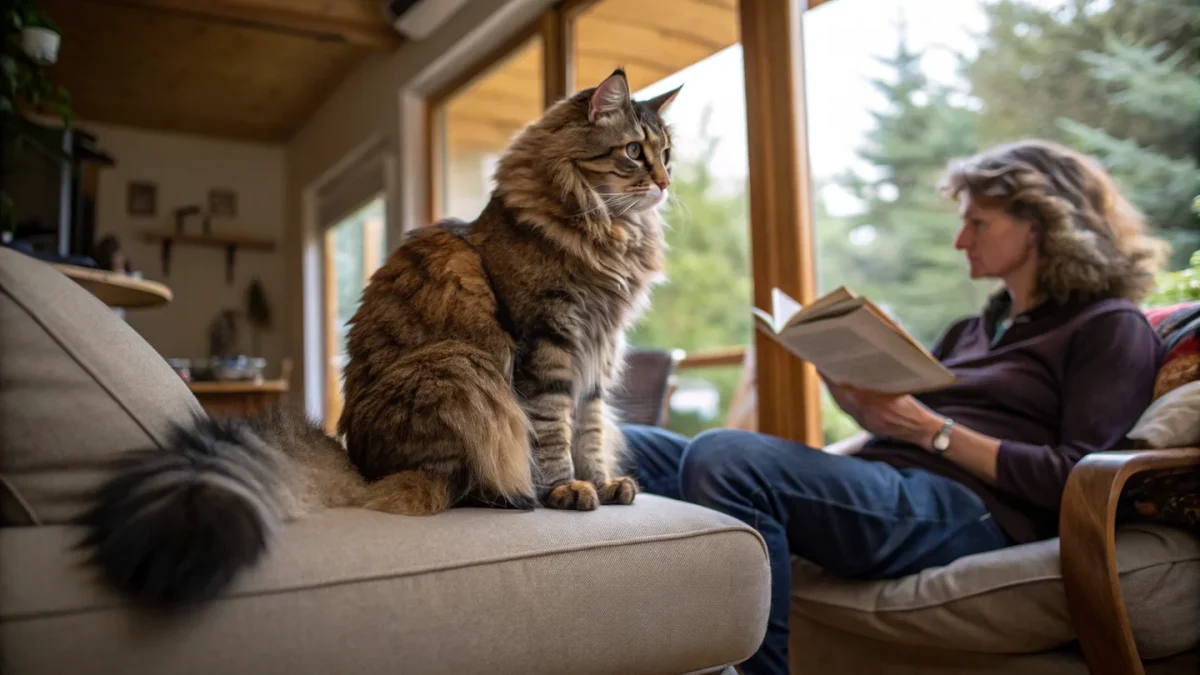
Most cats decide when they interact with you. Maine Coons decide to interact with you approximately always.
This isn't an exaggeration made by smitten owners. The Maine Coon's tendency toward near-constant human engagement is one of its most documented traits, and it catches first-time Maine Coon owners off guard regardless of how much they've read about it. You'll plan for a cat that's more involved than average and still be surprised by how present this breed actually is.
For the full profile on the breed — size, coat, history, health — see the complete Maine Coon breed guide. This piece focuses specifically on what that temperament looks like in practice, the variations within it, and what it means for your household.
The "Dog-Like" Label
Veterinarians, breeders, and owners reach for the same descriptor independently: dog-like. Maine Coons greet people at the door. They follow owners from room to room. They come when called by name — not always on the first call, because they're still cats, but reliably on the third or fourth. Many Maine Coons learn to retrieve toys reliably, a behavior documented as one of the breed's most recognized traits by CFA breed documentation and widely reported by breeders and owners across decades.
What makes this useful as a descriptor rather than just flattering hyperbole is that it's specifically about the social orientation. Most cats choose one person and become deeply attached to that one person while remaining indifferent to everyone else. Maine Coons tend to be interested in all the people in the household — and often in guests, whom they'll approach with curiosity rather than hiding under the bed.
The underlying mechanism isn't fully understood. Some of it is likely the same selection pressure that made Maine Coons function as working farm and ship cats — needing to be comfortable with human activity rather than avoiding it. The sociability was practically useful before it became a personality selling point. This is a plausible hypothesis consistent with the breed's documented working history, though specific studies isolating the genetic basis of feline sociability in Maine Coons haven't yet been published.
Playfulness and Activity
Maine Coons have an extended kitten period by domestic cat standards. Most cats reach psychological maturity around 1-2 years. Maine Coons tend to remain in what might be called an adolescent engagement level until 3-4 years — curious, playful, frequently underfoot. After that, the activity level moderates but doesn't disappear.
A 7-year-old Maine Coon will still investigate anything new in the house within minutes of it appearing. They'll still show up when you open a bag or start an interesting-sounding project. They'll still chase a toy with visible enthusiasm, even if they're not quite as acrobatic about it as they were at two.
This persistent playfulness is part of what owners love. It's also part of what can become exhausting if you weren't expecting a cat that's genuinely interactive rather than decorative.
Fetch is worth mentioning specifically because it's unusual. A meaningful percentage of Maine Coons — far more than in most breeds — learn to retrieve small toys and bring them back for another throw. This seems to appear with almost no training in cats that have the inclination for it, and it's one of the behaviors CFA breed documentation consistently identifies as characteristic of the Maine Coon's dog-like social orientation. If you've never watched a cat play fetch, the first time it happens with a Maine Coon is genuinely delightful.
Vocalizations: Chirps, Trills, and the Occasional Trill-Meow Hybrid
Maine Coons have a distinctive vocal range. They chirp and trill — sounds that seem too small for a cat their size — and use these more often than a full-throated meow for everyday communication. You'll hear the trill when they're greeting you, when they see something interesting outside, or when they're requesting something without particularly needing it immediately.
The full meow appears when something is actually wanted: breakfast that's late, a door that needs opening, or an affront that requires lodging a formal complaint. Maine Coons aren't silent, but they're not loud. They land somewhere between the constant commentary of a Siamese and the near-total silence of a Russian Blue. If the breed's social orientation is the opposite of what you're after — and some people genuinely prefer the self-contained affection of a Persian cat temperament — that's useful to know before committing.
Some Maine Coons are chattier than others, and individual variation within the breed is substantial. But the characteristic sound — that incongruously bird-like trill — is common enough that you'll recognize it as a Maine Coon thing if you spend any time around them.
With Families and Children
Maine Coons are among the genuinely good choices for family households with children. The combination of patience, low reactive aggression, and adaptability to a busier environment makes them more tolerant of a child-heavy household than many breeds.
They're patient with children who are learning how to interact respectfully with cats. When they've had enough, they leave — they remove themselves from the situation with dignity rather than scratching. That's not universal (no cat behavior is), but it's the pattern.
The one caveat is size. A large Maine Coon male being enthusiastically petted by a 4-year-old may not be ideal for either party. Very young children need supervision with any cat, and a cat that weighs 18 pounds is a more substantial animal for a small child to navigate than a 7-pound Siamese. Maine Coons are patient, but they're also big enough that an accidental bonk from an excited cat is a real possibility.
With Other Pets
The Maine Coon's social orientation extends to other animals. They typically accept other cats reasonably well, particularly when introductions are handled properly. They're often good with dogs, especially dogs that have been socialized around cats — the Maine Coon's confident, non-fearful demeanor tends to produce better outcomes with dogs than the flight-response of more anxious breeds.
A Maine Coon and a calm, cat-accepting dog will often develop something that looks genuinely like friendship: resting near each other, grooming each other, playing in a way that looks bilateral rather than one animal tolerating the other. This is not guaranteed, but it's common enough that Maine Coons are regularly recommended for mixed-species households.
What doesn't typically work: a Maine Coon and a high-prey-drive dog, or a Maine Coon and a very territorial resident cat who won't accept a newcomer. The Maine Coon's adaptability is real, but it can't override a fundamentally hostile resident animal.
Quirks Worth Knowing
Maine Coons tend to be water-curious. Many of them are fascinated by running water, will investigate full sinks and bathtubs, and occasionally wade into shallow water rather than avoiding it. Outdoor Maine Coons have been reported playing near streams. Breed historians trace this trait to the breed's working history near coastal New England waterways, and their water-resistant double coat makes wet-paw encounters considerably less uncomfortable for them than for most cats. This isn't universal, but it's common enough that a running faucet is a reliably effective Maine Coon attention-getter.
They're manual explorers — paws are constantly deployed. Opening things, testing textures, investigating containers, pawing at moving objects. Cabinet handles and lever-style door handles in particular are objects of sustained interest to some Maine Coons. The internet is full of videos of Maine Coons opening doors, and it's because they actually do that.
They're vocal problem-solvers. If something isn't accessible or isn't working the way they want, a Maine Coon will attempt multiple approaches before giving up. This is sometimes inconvenient. It's also genuinely interesting to watch.
Realistic Expectations
Maine Coon temperament is real — the sociability, the playfulness, the adaptability are consistent enough across the breed to be reliably predicted. But within those consistent traits there's substantial individual variation. Some Maine Coons are more reserved than others. Some are chattier. Some fetch; some show no interest in fetch. Some are velcro cats who are genuinely always touching you; others are social but prefer a 12-inch buffer.
The kitten you choose will grow into a cat shaped by both genetics and the environment you provide. Consistent socialization, adequate play and enrichment, and stable routines produce the best expression of the Maine Coon temperament. A Maine Coon that's been isolated, under-stimulated, or insecurely attached will still be a large cat with a bushy tail, but you'll miss what makes them wonderful.