

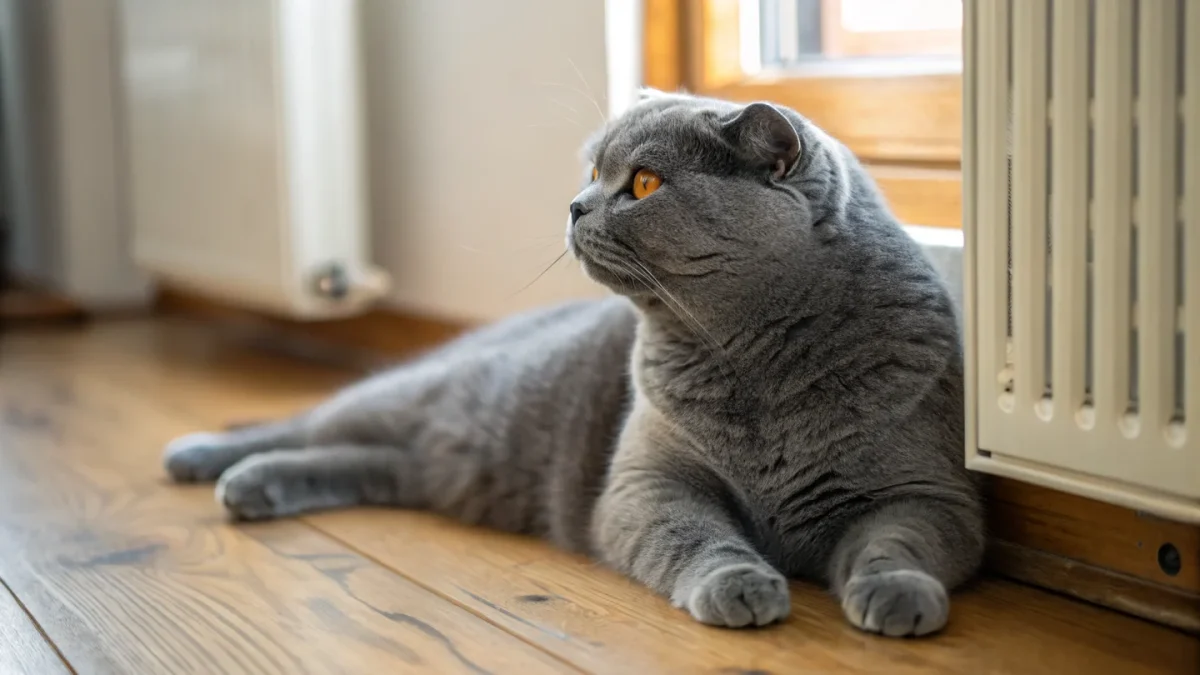
The Scottish Fold's defining physical trait is a genetic mutation that causes joint pain. Not might cause. Not in some cases causes. The TRPV4 gene mutation that folds the ear cartilage affects cartilage and bone throughout the entire body, and all cats carrying the fold gene develop osteochondrodysplasia — a progressive, painful skeletal condition — to some degree. That's the conversation. Not the barn cat in Perthshire, not the charming origin story, not the celebrity owners. The conversation is whether a breed defined by a mutation that causes lifelong discomfort should continue to be bred, and what responsible ownership looks like if you already have one.
I've watched this debate intensify across my years covering cat breeds. Veterinary organizations in multiple countries have taken positions on it. Some have moved beyond position statements to outright prohibition. The breed's defenders argue that heterozygous Folds — cats with one copy of the gene, the standard folded-ear cat — have variable severity and can live well with proper monitoring. The critics argue that "variable severity" still means suffering, and that the owl-eyed appearance people find irresistible is inseparable from the condition causing it.
Both of those things are true. That tension is what this guide is about.
The Fold Gene: Appearance and Consequence
The characteristic ear fold is caused by a dominant mutation in the TRPV4 gene. A single copy of the mutation (Fd) causes the cartilage of the ear to fold forward. This same gene affects cartilage and bone development throughout the body, not just the ears.
When a cat carries two copies of the fold gene (Fd/Fd — homozygous), the skeletal effects are severe and clearly visible: a condition called osteochondrodysplasia (OCD), involving abnormal cartilage and bone development that causes pain, stiffness, and reduced mobility. The tail stiffens, the limbs show abnormal bone development, and the cat is in persistent pain.
What became clear more recently is that cats with one copy of the fold gene (Fd/fd — heterozygous, the standard folded-ear cat) are not spared this condition — they develop OCD to varying degrees, just typically more slowly and with more variability than homozygous cats. Radiographic surveys of heterozygous Folds consistently find blinded reviewers scoring their joint films worse than straight-eared cats, even though a 2023 genetic and radiographic evaluation found clinical signs showed up in only a fraction of the heterozygous cats studied. The mutation alone doesn't write the outcome — but it loads the dice in a direction that matters.
This is the central health controversy of the Scottish Fold: the fold that makes the cat beautiful is inseparable from the gene causing skeletal disease. They cannot be separated because they are the same mutation. Breeding for folded ears in every generation means, necessarily, breeding for OCD susceptibility in every generation.
The Ethical Situation
Responsible engagement with the Scottish Fold requires honest acknowledgment of this situation rather than minimization.
Several major veterinary organizations have stated positions opposing Scottish Fold breeding on welfare grounds, citing OCD as an inherent harm produced by the breed standard.
Some countries and regions have restricted or banned the breeding of Scottish Folds. Others have not. The debate continues in veterinary genetics and animal welfare communities, and the legal landscape is changing.
The response from responsible breeders has focused on several approaches: breeding Folds only to Scottish Straights (cats with normal ears from the same breed population), never breeding Fold-to-Fold (which produces homozygous cats with severe disease), and monitoring breeding animals with regular radiographic evaluation. These practices reduce the severity of OCD expression but do not eliminate it.
This is information a prospective Scottish Fold owner should have before acquiring the cat. The cat's appealing appearance comes with a genuine, documented health trade-off. Some people weigh that information and proceed with a well-bred Fold from health-tested parents; others decide the ethical concern overrides the appeal. Both are considered positions based on the same facts.
Physical Description
The Scottish Fold's most defining feature is the folded ear — the cartilage bends forward, with the ear tip pressing down toward the skull, giving the cat its characteristic "cap" appearance. Not all Fold kittens develop folded ears — only those with at least one copy of the Fd gene. Kittens born with normal straight ears from folded parents are called "Scottish Straights" and are genetically valuable for breeding programs precisely because they can't contribute Fd/Fd combinations.
The degree of fold varies. The tightest folds ("triple folds") press the ear fully against the skull. Less extreme folds leave the ear partially raised. The appearance of the fold changes somewhat in the first weeks of a kitten's life — kittens are born with straight ears, and the fold (if it will occur) develops at approximately 3–4 weeks.
Beyond the ears, the Scottish Fold has a distinctly round appearance:
- Head: Broad and round, with full cheeks and a short, well-developed muzzle.
- Eyes: Large, rounded, set wide apart. Add significantly to the owl-like impression.
- Body: Medium-sized, rounded and stocky. Neither elongated nor cobby in the extreme. The body type is sometimes compared to the British Shorthair, which shares the same round-headed, stocky build.
- Coat: Can be shorthaired or longhaired (longhaired Folds are sometimes called Highland Folds). Both coat lengths occur from the same genetic background.
- Colors: Virtually every color and pattern — solid, tabby, bicolor, pointed, ticked.
Typical size: Males 4–6 kg (9–13 lbs), females 3–4.5 kg (6–9 lbs).
Scottish Fold Temperament
In personality, the Scottish Fold tends toward the calm and adaptable end of the domestic cat spectrum. They're not high-energy cats in the way Abyssinians or Bengals are. They're social, relatively gentle, and accepting of most household situations.
They bond with their families and prefer company to solitude, but the degree of social demand is notably lower than Siamese or other high-attachment breeds. A Scottish Fold left alone for a working day is unlikely to redecorate the house; it is more likely to find a comfortable spot and wait.
The calm temperament is one reason the breed has been popular: it adapts to varied household sizes, presence levels, and other animal companions with less drama than more reactive breeds. Children who engage calmly with cats find Scottish Folds generally receptive; the breed is not notably reactive to ordinary handling.
The sitting posture that Fold owners know well — the "Buddha sit," where the cat sits upright with back legs extended forward — is distinctive and charming. Whether this posture indicates relaxation or comfort, or reflects early skeletal stiffness in the hindquarters, is a question worth asking of any fold showing it frequently and young.
What Most People Get Wrong About Scottish Folds
The most significant thing people get wrong is treating the health controversy as fringe concern rather than established veterinary science. Osteochondrodysplasia in Scottish Folds is not a rare complication or an edge case — it is a predictable consequence of the fold gene. This doesn't mean every Fold lives in obvious pain (the severity varies considerably), but it does mean the condition exists in the breed as a direct consequence of its defining genetic characteristic.
The second misconception is that the folded ears require special cleaning. They don't need more frequent cleaning than straight ears — though the closed position does mean wax accumulates in a different way, and some Folds do require more regular ear cleaning than upright-eared cats. What matters more is regular ear checks to catch wax buildup before it becomes a problem.
Third: people sometimes assume the breed's calm temperament makes it particularly unhealthy or "dull." Calmness is a personality trait, not a health marker. A well-socialized Scottish Fold is an engaged, responsive companion — it simply expresses that engagement less dramatically than high-energy breeds.
Scottish Fold Health
The OCD discussion above is the primary health consideration. Alongside it:
Polycystic kidney disease (PKD): Scottish Folds have an elevated prevalence of PKD compared to random-bred cats — a 2023 large-scale epidemiological study in the Journal of Feline Medicine and Surgery found the PKD1 mutation in nearly 7% of Scottish Folds tested against under 1% of random-bred cats, a fivefold difference in the odds. DNA testing for the common PKD1 mutation is available and should be part of responsible breeding programs.
Heart disease: Hypertrophic cardiomyopathy (HCM) occurs in Scottish Folds, as it does across many cat breeds. Regular cardiac screening is advisable.
Ear care: The folded ear position creates a slightly more enclosed environment than upright ears. Some Folds accumulate wax more rapidly and require more frequent ear cleaning.
Regular veterinary monitoring of joint mobility, pain responses, and tail flexibility is advisable for all Scottish Folds, starting in kittenhood, to catch OCD expression early and manage it appropriately. Cats showing stiffness, reluctance to jump, shortened gait, or resistance to tail handling should be evaluated.
Scottish Fold Care
Day-to-Day Requirements
The Scottish Fold's activity needs are moderate. Daily interactive play sessions — 15–20 minutes — satisfy the social and predatory instinct without requiring the sustained intensive engagement that higher-drive breeds demand. Environmental enrichment (cat trees, window views, puzzle feeders) supplements active play.
Given the OCD context, monitoring for pain or mobility changes is part of the care routine. A Fold that was previously athletic and stops jumping from heights, or carries its tail stiffly, or shows sensitivity to touch along its back and legs, is showing signs that need veterinary evaluation.
Grooming
Shorthaired Scottish Folds need weekly brushing. Longhaired Folds need 2–3 sessions per week. Ear cleaning should be performed more regularly than with upright-eared cats — check weekly, clean if wax is visible. Dental care and nail trimming apply as standard.
The Right Owner for a Scottish Fold
If you proceed with a Scottish Fold after understanding the health context, the practical match is with someone who wants a calm, adaptable companion that suits varied households and activity levels.
The Fold's moderate temperament makes it one of the more flexible breeds for different household situations — quieter homes, multi-pet households, families with children who aren't intensely active with their animals. It doesn't demand peak engagement and isn't a handful for owners who don't have hours for interactive play.
The health consideration requires someone willing to stay attentive to the cat's physical condition and respond to early signs of OCD expression, rather than waiting until discomfort is obvious. Early management — appropriate pain support, keeping the cat at healthy weight, not encouraging jumping that stresses affected joints — makes a significant difference in quality of life.
FAQ
Are Scottish Folds always in pain?
Not always, and not uniformly. The OCD condition exists across the breed, but severity varies. Cats from conscientious breeders who avoid Fold-to-Fold breeding and monitor for OCD may show mild effects that remain manageable. Cats from irresponsible breeding programs may develop severe disease early. The honest position is that all Folds carry the gene causing OCD, and all should be monitored — severity is not predictable from appearance alone.
Are Scottish Folds legal everywhere?
No. Several countries and some regional jurisdictions have restricted or banned Scottish Fold breeding on welfare grounds. The legal landscape varies and is changing.
Do folded ears cause hearing problems?
Folded ears alone do not cause deafness or significant hearing impairment. The fold affects the ear's external position, not the internal structures. White Scottish Folds with blue eyes are subject to the same congenital deafness risk as any white-blue-eyed cat — this is related to the gene affecting pigmentation, not the fold gene.
Can you breed two Scottish Folds together?
You should not. Breeding two folded cats (Fd/fd x Fd/fd) produces a probability of homozygous (Fd/Fd) offspring, who develop severe OCD. Responsible breeding practices pair Folds with Scottish Straights to avoid this.
What is a Scottish Straight?
A Scottish Straight is a cat from Scottish Fold breeding lines with normal, upright ears — carrying zero or one copy of the Fd gene but not expressing the fold. They have the same round build and gentle temperament as Folds, without the ear fold or its associated health implications. Some people choose Scottish Straights specifically because they want the breed's personality without the ethical complexity of the fold.