

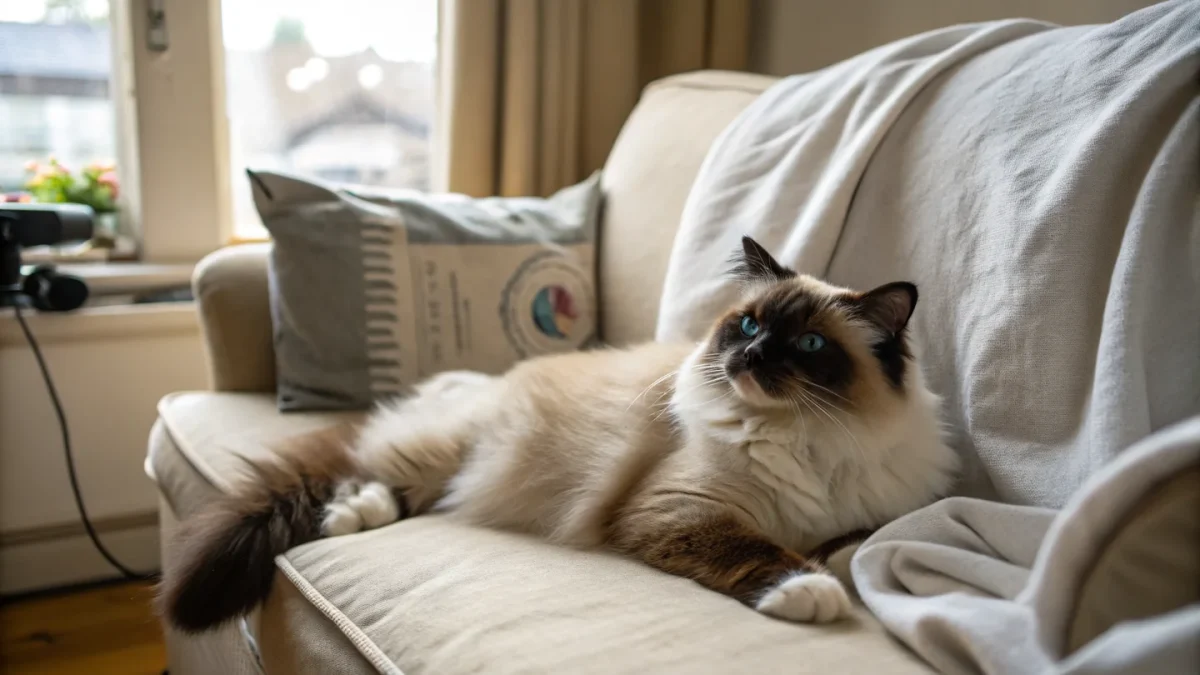
The Ragdoll breed was developed by one woman — Ann Baker, a cat breeder in Riverside, California — beginning in the early 1960s, and the origin story she constructed around the breed is one of the most eccentric in domestic cat history. Baker claimed that a white longhaired cat named Josephine, after being injured in a car accident, had kittens with an unusually docile, pain-tolerant temperament due to genetic changes caused by the accident. She promoted this claim aggressively, trademarked the breed name in 1975, required franchising agreements from other breeders through her International Ragdoll Cat Association (IRCA) founded in 1971, and eventually cut ties with mainstream cat registries to form her own.
None of that is scientifically accurate — car accidents don't alter cat genetics. But the cats themselves are real, and the temperament Baker observed in Josephine's offspring proved genuinely heritable. What she likely stumbled onto was a combination of natural temperament variation and consistent selection for docility. The Ragdoll's extraordinary calm when handled is genetically based, not mythological.
Origins and History
Ann Baker began her breeding program with Josephine, a white non-pedigreed cat, and several of her offspring — including Daddy Warbucks, a male with Birman-like coloring who became the foundational sire, and Fugianna, from which all Ragdoll lines descend. She named the resulting breed "Ragdoll" for the cats' tendency to go limp when picked up. The first Ragdolls were officially registered in the National Cat Fanciers Association in December 1966.
The strange commercial structure Baker imposed — requiring official IRCA registration fees and claiming the breed possessed unique pain tolerance due to supernatural causes — eventually drove other breeders away. Denny and Laura Dayton, early breeders who had purchased a founding breeding pair from Baker in 1969, broke away in 1975 and were instrumental in getting the breed recognized by major cat associations. Their work led directly to TICA accepting Ragdolls for championship competition in 1979, the first major registry to do so, with the CFA following by granting championship status in 2000. Without their effort, the Ragdoll might have remained a cult breed tied to one breeder's restrictions.
Ann Baker died in 1997. The mainstream Ragdoll breeding world had long since moved on, and the breed was gaining recognition internationally through the late 1980s and 1990s. Today it's one of the most popular breeds globally. A group of breeders who departed the IRCA in 1994 went on to establish the Ragamuffin cat, a related but distinct breed that shares the Ragdoll's origins and gentle temperament while allowing a far broader range of coat colors.
The Birman connection in the early genetics is the most likely explanation for both the colorpoint pattern and the tendency toward docility that Baker observed. Daddy Warbucks, the foundational sire, is described in breed records as resembling a Birman and is believed to have carried the white spotting gene present in the mitted pattern. Birmans are themselves known for calm, placid temperaments, and research on heritable behavior traits in cats has confirmed that docility — including low reactive aggression — has meaningful genetic heritability across breeds.
Physical Characteristics
Ragdolls are large cats — genuinely large, comparable to Maine Coons, though structured differently. The CFA breed standard puts adult males at 15–20 pounds, with females proportionately smaller at 10–15 pounds, noting that it is not unusual for a mature male to reach or exceed 20 pounds. The breed takes an unusually long time to reach full maturity: the standard specifies four years for full size and coat development.
The body is substantial and semi-cobby — not as extreme as a Persian, but with a broad chest, strong legs, and a build that reads as solid rather than elegant. The hindquarters are slightly higher than the front, giving them a characteristic gait.
The coat is semi-long — longer than a shorthair but not as dense or heavy as a Persian. The texture is silky and minimal in undercoat, which is the reason Ragdolls mat less readily than you'd expect from a cat of their size. The coat is longer around the neck (a ruff), on the tail, and on the hind legs. The stomach fur is shorter than the sides and back.
All Ragdolls carry the colorpoint gene — meaning the color concentrates on the "points" (face, ears, legs, tail) while the body remains lighter. There are three recognized pattern variations within the colorpoint framework:
Colorpoint — the classic version: colored points on a lighter body, no white.
Mitted — same colorpoint distribution but with white paws and a white chin. A white stripe runs along the belly.
Bicolor — an inverted "V" of white on the face, plus white on all four legs and underbelly.
Color varieties include seal (dark brown points), blue (gray), chocolate, lilac, red, cream, and tortie/lynx variations. All Ragdolls have blue eyes — vivid, deep blue — as a breed constant.
Temperament and Personality
The limpness is real. Pick up a well-socialized Ragdoll and the cat genuinely relaxes in your arms rather than tensing up, which is the opposite of most cats' response to being lifted. This isn't trained behavior — it's a temperament trait that's been consistently selected for through the breed's development. Not every individual does it dramatically, but it's observable in most of them.
Beyond the signature limpness, Ragdolls are simply calm. They have low activity levels compared to most breeds, and their play drive, while present, isn't frantic. They're floor cats as much as furniture cats — unlike many active breeds that need vertical space, Ragdolls are often found at ground level. They're not particularly inclined to climb high, and many owners find their cats choosing mid-level perches and floor spots over tall cat trees.
They're quiet. Ragdolls communicate with soft voices — more chirps and trills than loud meows — and don't vocalize constantly. This is a meaningful consideration for apartment living or noise-sensitive households.
Ragdolls are notably gentle. They're tolerant of handling, patient with children, and slow to react defensively. They will walk away from situations that bother them before they'll scratch or bite. This makes them among the most genuinely safe breeds for households with children, though "safe" doesn't mean they enjoy every interaction — they still deserve respectful handling.
They're people-oriented without being anxious about it. A Ragdoll will follow you around the house out of curiosity and mild social interest, but they don't typically develop the kind of separation anxiety that some highly dependent breeds do.
What Most People Get Wrong About This Breed
The most persistent misconception is that Ragdolls don't feel pain or are somehow genetically pain-resistant. This myth traces back directly to Ann Baker's original marketing claims. It is false. Ragdolls have normal pain responses. Their tendency to go limp when handled is a temperament trait related to relaxed muscle tone and socialization, not an absence of sensation. They should receive the same veterinary attention and gentle handling as any cat.
The second misconception concerns the coat. The silky, relatively low-mat texture leads people to assume Ragdolls need minimal grooming. They don't need daily combing like a Persian, but semi-weekly brushing is required to prevent tangles, particularly during shedding season. The neck ruff and hindquarter fur are the main problem areas.
Third: people assume that because Ragdolls are docile, they're suitable for any living situation. Their calm temperament is a genuine asset, but these are large cats with social needs. A Ragdoll left alone in an unstimulating environment for extended periods will become visibly lethargic and sometimes depressed. They do best with consistent human presence or a feline companion.
Grooming and Coat Care
Two brushing sessions per week with a wide-toothed comb is the minimum for most Ragdolls. The coat's silky texture and low undercoat density mean mats are less frequent than in Persian cats, but they're not impossible — neglected Ragdolls develop tangles in the ruff, hindquarters, and the feathering on the back of the legs.
During shedding seasons (spring and fall), daily brushing is advisable to manage the volume. The lighter-colored body fur shows on dark furniture, which is an aesthetic consideration for many owners.
Bathing is well-tolerated — Ragdolls are among the cats that most readily accept water if introduced to it as kittens — and an occasional bath keeps the coat clean and reduces allergen burden (though no cat is fully hypoallergenic). All cats produce Fel d 1 protein, the primary allergen, and Ragdolls are not exceptions to this.
Living With a Ragdoll
Ragdolls adapt well to apartment life precisely because of their low activity level. They're not climbers, not destructive when bored, and not vocal enough to disturb neighbors. What they need is consistent human presence and social engagement.
They're excellent family cats. The combination of size, gentleness, and patience with children makes them genuinely one of the better choices for households with kids old enough to interact respectfully. They're also reliably good with other cats and typically adjust well to calm dogs.
The one household that might find a Ragdoll unsatisfying is one that wants an active, engaging cat — a hunter, a fetcher, a midnight acrobat. Ragdolls will play, but they don't sustain high-energy activity the way a Bengal or Abyssinian does. If you want a lap cat and a calm presence, they're close to ideal.
Is This Breed Right for You?
Ragdolls are most at home with people who want a large, calm companion that actively enjoys being with them rather than simply tolerating them. They're indoor cats through and through — their trusting temperament and low-prey-drive make them poorly suited for outdoor life and its associated risks.
The best Ragdoll owners have stable routines, enough home presence to keep the cat company, and realistic expectations about coat maintenance. They're not no-maintenance cats, but they're substantially lower maintenance than a Persian.
If the Ragdoll's calm sounds like what you want, it's worth knowing that you'll get a cat that stays kitten-charming in many ways well into adulthood — playful enough to be entertaining, calm enough to be restful, and affectionate in a way that doesn't exhaust you.
Frequently Asked Questions
Why do Ragdolls go limp when you pick them up?
This is an inherited temperament trait — a genuine behavioral characteristic that's been selected for throughout the breed's development. It reflects relaxed muscle tone and a trusting, unstressed response to handling rather than any physiological abnormality. Not every Ragdoll does it dramatically, but most show some degree of relaxation when held compared to more reactive breeds.
Are Ragdolls really pain-resistant?
No. This myth was promoted by the breed's founder, Ann Baker, and has no scientific basis. Ragdolls experience pain normally. Their calmness when handled reflects temperament, not altered pain response.
How big do Ragdoll cats get?
Males typically reach 15–20 pounds; females 10–15 pounds, per the CFA breed standard. The breed matures very slowly — full size and coat development takes up to four years. Don't be surprised when your "large" kitten at 6 months is still noticeably smaller than a 4-year-old Ragdoll.
Do Ragdolls need a lot of grooming?
Semi-weekly brushing is the baseline. The silky coat mats less readily than a Persian's, but the ruff and hindquarter feathering require regular attention. During spring and fall shedding seasons, more frequent brushing prevents loose fur buildup on furniture.
Are Ragdolls good with other pets?
Yes, generally. Their patient, gentle temperament makes them compatible with other cats and with calm dogs. Their low aggression level is an asset in multi-pet households, though individual compatibility always matters more than breed reputation alone.