

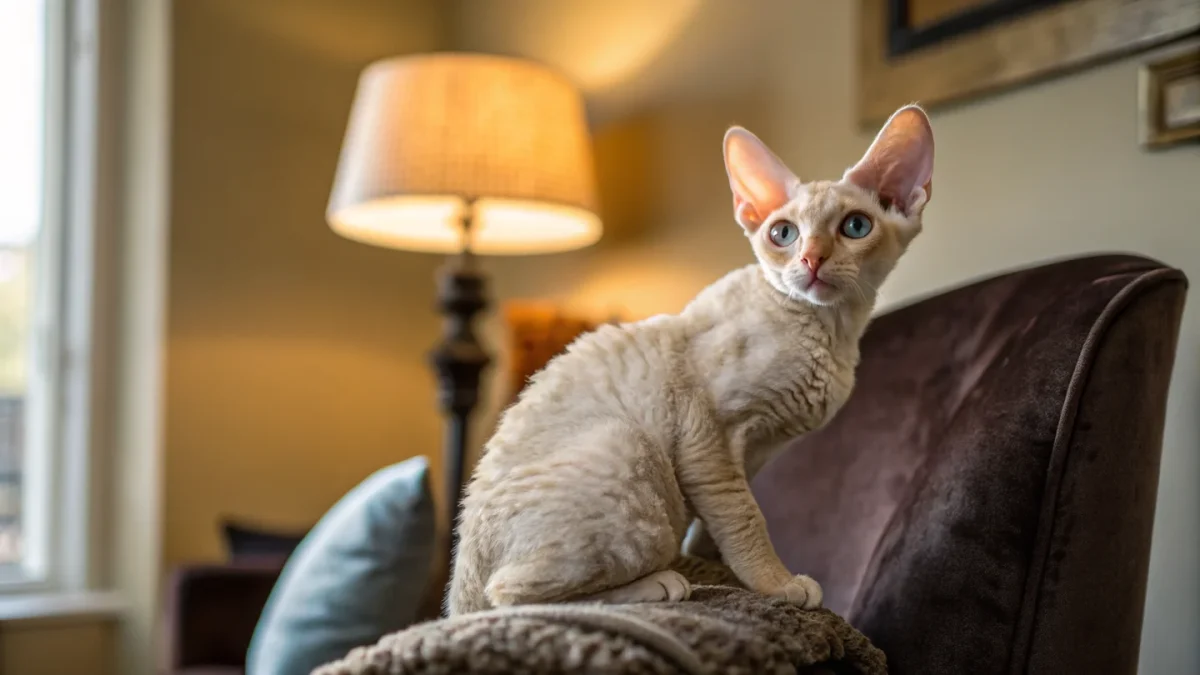
The Devon Rex breed exists because of a single stray tomcat with an unusual coat who was spotted in Buckfastleigh, Devon, in 1959. A woman named Beryl Cox noticed the tom haunting an old tin mine and, when one of her cats produced a litter sired by him, a curly-coated kitten appeared among the offspring. She named him Kirlee. When genetic testing later revealed that Kirlee's curl mutation was completely different from the one already established in the Cornish Rex, a new breed had been discovered entirely by accident.
The devon rex cat breed is one of those animals that ruins people for ordinary cats. They attach themselves to their owners with an intensity that's less "pet relationship" and more "bonded partnership," follow from room to room with cheerful persistence, and have a talent for inserting themselves into activities you didn't realize needed cat involvement. Warm, mischievous, and stubbornly present — they're often described as part cat, part dog, part monkey.
Origins: The Tin Mine Cat and Kirlee
The story of the Devon Rex is inseparable from Beryl Cox and Kirlee, born in 1959 from a litter fathered by that unidentified curly-coated stray in the Devon countryside. Cox recognized the kitten's unusual coat immediately and contacted the breeders who were then working with the Cornish Rex — a separate curly-coated breed that had appeared in Cornwall a decade earlier.
The assumption was that the two mutations were the same. They weren't. When Kirlee was crossed with Cornish Rex females, all offspring had straight coats — proof that the mutations were independently recessive and located on different genes. The Devon Rex was established as its own distinct breed, and Kirlee became the founding sire of an entire breed line.
The Cat Fanciers' Association accepted the Devon Rex for championship competition in 1979. Since then, careful breeding has expanded the gene pool beyond Kirlee's descendants through regulated outcrossing, though the breed's foundation remains connected to that one curly cat from the Devon moors.
Physical Characteristics
The Devon Rex has a look that divides opinion — some find it otherworldly and strange, others find it irresistible. There's no middle ground. The pixie-like features that define the breed are unlike anything in the mainstream cat world.
Head: A modified wedge with large, low-set ears that dominate the face. The eyes are large, oval, and set wide, giving the cat a permanently alert, slightly mischievous expression. The muzzle is short with prominent cheekbones and a strong chin.
Body: Small to medium, compact and surprisingly muscular for the size. Devon Rex cats feel heavier than they look. Males typically weigh 8-10 pounds; females 5-8 pounds.
Coat: The defining characteristic. Short, soft, and wavy — the result of a mutation that affects all three coat layers (guard hairs, awn hairs, and down). The guard hairs are so fragile that many Devon Rex cats have thin patches or near-bald areas around the neck, belly, and behind the ears. This is normal for the breed and not a sign of illness. The coat feels softer than almost any other breed — closer to down than to conventional cat fur.
Temperature sensitivity: The sparse coat provides minimal insulation. Devon Rex cats seek warm spots obsessively and are known to burrow under blankets, drape themselves across laptops, and claim heating vents as personal property. This heat-seeking behavior is something they share with Sphynx cats, another breed whose reduced coat means body temperature management happens at the owner's expense.
The KRT71 Gene: Why the Coat Curls
The Devon Rex coat is caused by a mutation in the KRT71 gene, which codes for keratin 71 — a structural protein essential for the normal development of the inner root sheath of hair follicles. When this protein malfunctions, the structural integrity of the hair shaft is compromised, producing the characteristic wave. Because the guard hairs are most affected and most fragile, Devon Rex coats vary widely from individual to individual — some are covered in tight waves, others have a more open wave, and some have quite sparse, almost velvety coats.
Critically, the KRT71 mutation in Devon Rex is different from the mutation responsible for the Cornish Rex coat (which affects a different gene entirely, Rex3 on chromosome B1). The two breeds cannot share their curl — crossing them produces straight-coated offspring. This was the experimental proof, with Kirlee as the subject, that established Devon Rex as a genetically independent breed.
Temperament: The Pixie-Faced Troublemaker
There's a reason Devon Rex owners frequently say their cats think they're dogs. The typical Devon Rex behavior profile — following their person everywhere, greeting at the door, learning to fetch, participating in activities they weren't invited to join — tracks more closely to a social dog than to the independent-minded domestic cat of popular imagination.
They're intensely interactive. Shoulder-riding is common from kittenhood; many Devon Rex cats claim a specific shoulder as their perch and will return to it repeatedly throughout the day. They're athletic climbers and acrobats — the ears aren't the only thing that suggests Yoda; the leaping ability is genuinely impressive.
The mischievous streak is real. Devon Rex cats open cabinets, investigate bags with methodical determination, steal food from plates with apologetic eyes, and manage to make these infractions feel charming rather than criminal. They're smart enough to problem-solve and curious enough to make that a constant project.
They're also unusually gentle with children and tolerate handling well. Kittens especially benefit from early socialization, but even adult Devon Rex cats tend toward engagement rather than avoidance when strangers appear.
What Most People Get Wrong About the Devon Rex
"Low-maintenance because the coat is short." This is the most common mistake prospective Devon Rex owners make.
The sparse, fragile coat actually requires more thoughtful grooming than most shorthaired breeds. Brushing too vigorously breaks the delicate guard hairs and causes bald patches. The coat should be patted or smoothed with a barely damp hand rather than combed. The large, warm ears accumulate wax and require regular gentle cleaning. And because the coat offers minimal insulation, this is a cat whose environment requires active management — they should not be left in cold rooms or drafty spaces.
The second misconception is that "low-shedding means low-allergen." Devon Rex cats shed less than most breeds, yes. But they still produce Fel d 1, the primary cat allergen, and the shorter coat doesn't eliminate airborne protein. Some people with cat allergies find Devon Rex tolerable — others don't. There's no guarantee.
Third: people expect a mellow, sedentary lap cat. The Devon Rex is a lap cat — but a frenetic one. They'll rest in your lap between the acrobatics and the investigation and the theft of your snack, but their base energy level is high. You're getting a cat that chooses you as home base, not a cat that sleeps twelve hours and asks nothing.
Health Considerations
The Devon Rex carries some breed-specific health predispositions that informed owners should know.
Hypertrophic cardiomyopathy (HCM) — thickening of the heart muscle — appears in the Devon Rex at rates that concern cardiologists who study feline breeds; the breed is one of five named in a 2024 multi-breed effort to classify feline HCM gene variants precisely because population data and clinical experience point to higher-than-average prevalence. Echocardiogram screening of breeding cats is standard practice among responsible breeders.
Devon Rex myopathy (also called spasticity or muscular dystrophy-like syndrome) is a rare but serious neuromuscular condition seen in the breed. Affected cats show muscle weakness, head tremors, and difficulty eating or swallowing. The genetic basis has been identified — a mutation in the COLQ gene — and a DNA test is available through veterinary genetics laboratories. Reputable breeders screen for this.
Malassezia dermatitis — a yeast infection of the skin — appears more commonly in Devon Rex than in other breeds, likely related to the coat structure and skin chemistry. The large ears are particularly susceptible.
Dental disease: the Devon Rex's shortened muzzle creates some dental crowding, making regular dental hygiene more important than in long-muzzled breeds.
Grooming: The Right Approach
Because the Devon Rex coat is so fragile, the approach matters more than the frequency.
Never brush vigorously. Hard bristle brushes and metal combs will snap the guard hairs and leave bare patches that can take months to fill back in. Groom with a soft rubber grooming glove, a chamois cloth, or simply a lightly dampened hand — smooth the coat rather than working through it.
Ears every week. The large, warm ear canals accumulate wax efficiently. A soft cotton ball with a gentle ear cleaner keeps buildup under control. Don't probe deeply.
Bathing occasionally — more than most cats need. The Devon Rex's skin produces oils at normal rates, but the sparse coat doesn't absorb or distribute them the way a full coat would. A gentle bath every few weeks prevents a greasy buildup, particularly around the neck and behind the ears.
Nail trimming every two weeks. Their agile feet are used constantly.
Living With a Devon Rex
Alone time: Not this breed's strength. A Devon Rex in a single-cat, working household will redirect their social energy into everything you own, usually destructively. A companion cat or regular human presence is close to a requirement.
Children: Very good. Their tolerance for handling is high, their play drive aligns well with children's energy, and they're sturdy enough not to be injured by normal play. Teach children appropriate interaction from the start.
Dogs: Often excellent, for the same reasons — the Devon Rex's social personality and low prey drive mean they often befriend compatible dogs enthusiastically.
Climate: These cats feel cold acutely. Central heating matters. Provide a range of warm sleeping options: heated cat beds, blankets, spots near heating vents.
Enrichment: High-energy breeds need mental engagement. Puzzle feeders, wand toys, and interactive play sessions matter more for Devon Rex than for sedentary breeds. Their intelligence means they'll engineer their own entertainment if you don't provide it — which is rarely what you want.
The Right Owner for a Devon Rex
The Devon Rex is a remarkable companion for people who want involvement, not just coexistence. If you want a cat that drifts through the house like furniture — graceful and present but fundamentally separate — this is not that cat.
The Devon Rex is for someone who genuinely enjoys daily interaction, can handle a cat that considers no surface off-limits and no activity private, and finds the breed's pixie energy entertaining rather than draining. They're ideal for households where someone is home frequently, for families with older children who'll play actively with them, and for people who appreciate a cat with actual opinions.
They're not for anyone who prioritizes immaculate countertops or a fully unshared meal.
Frequently Asked Questions
Are Devon Rex cats hypoallergenic?
No cat is truly hypoallergenic, including the Devon Rex. They shed less than many breeds and their lighter coat disperses less dander, which means some people with mild cat allergies find them more tolerable — but there's no guarantee. The Fel d 1 protein is still present.
How is the Devon Rex different from the Cornish Rex?
Both are curly-coated, but the mutations causing those coats are completely different. Devon Rex carries the KRT71 mutation; Cornish Rex carries a different mutation on a separate gene. They cannot "share" their curl — crossing them produces straight-coated offspring. The body types also differ: Cornish Rex is more slender and Greyhound-like, Devon Rex is more compact with a rounder, more pixie-like face.
Do Devon Rex cats get along with other pets?
Usually very well. Their high sociability extends to other cats and often to compatible dogs. Early introduction helps, but Devon Rex cats are generally less territorial than average.
What is Devon Rex myopathy?
A rare inherited neuromuscular condition seen in some Devon Rex cats, causing muscle weakness, head tremors, and swallowing difficulties. Responsible breeders screen for this. Ask to see health clearances before acquiring a kitten.
How much do Devon Rex cats shed?
Less than most shorthaired breeds, but they do shed. The coat is sparse to begin with, and individual variance is high — some Devon Rex cats are quite covered in waves, others have thin, patchy coats naturally. Shedding is modest rather than heavy.