

When the Sphynx was first exhibited at a cat show in the 1960s, the audience reaction was split almost evenly: half the people were captivated, and the other half couldn't quite hide their alarm. That split persists today. The Sphynx is the breed that divides rooms — and yet it has become one of the most recognizable, sought-after, and genuinely beloved cats in the world. The reason isn't the lack of fur. It's what's underneath it.
The Sphynx cat breed produces some of the most sociable, attention-hungry, theatrically affectionate cats you will ever meet. They are warm to the touch, physically demanding of contact, and emotionally invested in their humans in a way that surprises even experienced cat owners.
Origins: A Wrinkle in Toronto
The modern Sphynx traces directly to a single kitten born in Toronto, Canada, in 1966. A domestic shorthair named Elizabeth produced a hairless male kitten the owners named Prune. That kitten was the result of a spontaneous natural mutation — the same kind of genetic accident that has produced hairless cats sporadically throughout recorded history, including in Mexico in the early 1900s and elsewhere. What changed in 1966 was that breeders decided to pursue the mutation deliberately.
Early breeding programs were difficult. Hairless-to-hairless pairings caused health problems, and the gene pool was dangerously shallow. The breed stabilized significantly in the late 1970s when breeders in the Netherlands worked with two hairless kittens found in Toronto and crossed them with Devon Rex cats. The Devon Rex, another breed defined by an unusual coat mutation, contributed genetic diversity while maintaining a similarly large-eared, angular body type. Devon Rex crossbreeding remains part of responsible Sphynx breeding programs today and explains the occasional faint fuzz some Sphynx cats have on their extremities.
By the 1980s the breed had achieved formal recognition. The current Sphynx standard emphasizes a medium-sized, muscular, heavy-boned body — considerably stockier than the waif-like appearance might suggest.
What the Sphynx Actually Looks Like
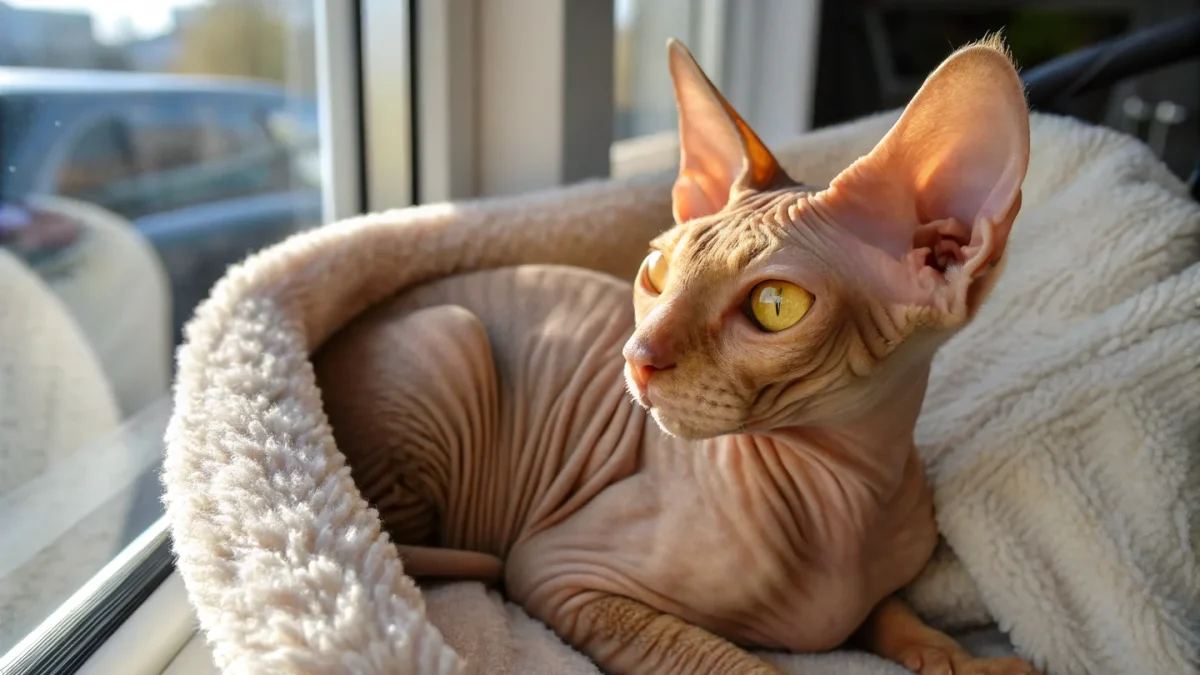
Most people think of the Sphynx as simply a cat with no fur. That's a narrow view. The skin of a Sphynx has the texture of warm suede and is visibly wrinkled around the muzzle, between the ears, and at the shoulders. The coat is not entirely absent — most Sphynx have a very fine, downy layer of hair that you feel more than see. Peach fuzz, essentially. Some individuals are completely nude from nose to tail; others have a light coverage on the ears and feet.
The body under that skin is impressive. Sphynx cats are powerfully built for their size, with broad chests, rounded abdomens that feel almost paunchy after a meal, and muscular hindquarters that give them surprising athletic ability. The head is a modified wedge shape with enormous, bat-like ears set wide on the skull. Eyes are large, lemon-shaped, and set at a slight angle — they come in any color, and in a hairless cat, they read with unusual intensity.
The color and pattern of the skin mirrors what the coat would have been had the cat had fur. A Sphynx described as "black" has dark, charcoal-grey pigmented skin. A calico Sphynx shows the familiar patches of orange, black, and cream directly on the skin surface.
Temperament: The Social Acrobat
If you have owned cats that were content to share your home on their own terms — appearing for meals, tolerating the occasional pet, going about their business — the Sphynx will upend your expectations.
Sphynx cats are extroverts. They want to be at the center of whatever is happening in the household. They will greet visitors enthusiastically rather than hiding under the bed. They will follow you from room to room with the dedication of a dog. They will insert themselves into your laptop, your book, your dinner plate. Not aggressively — cheerfully, insistently, as if physical contact with you is their primary occupation.
The Sphynx is also one of the few cat breeds that genuinely enjoys being held for extended periods. Their thermoregulation is less efficient than a coated cat's because they have no insulating fur layer, so they actively seek warmth — your lap, your neck, under the covers at night. This is not trained behavior. It's biology.
Vocally, the Sphynx is moderately chatty. Not as relentlessly opinionated as a Siamese, but not the silent observer a Russian Blue tends to be. They communicate in burbles and chirps as much as conventional meows.
Play drive is high and remains elevated into adulthood. Puzzle feeders, wand toys, and climbing structures will get daily use. A Sphynx left alone without stimulation will redecorate your shelves for you.
What Most People Get Wrong About the Sphynx
The hypoallergenic myth. This is the most persistent misconception about the breed and the one that causes the most disappointment. The Sphynx is not hypoallergenic. The protein responsible for cat allergies in most people — Fel d 1 — is produced primarily in the salivary glands and sebaceous (skin) cells, not the fur itself. A hairless cat still produces this protein and transfers it to their skin surface through grooming. Without fur to trap the allergen, Sphynx skin secretions actually make direct contact with surfaces more easily. Some allergy sufferers report better tolerance with Sphynx cats; others find them worse. Research has consistently shown that fur length and coat type have no significant influence on Fel d 1 production levels — the primary variables are sex (intact males produce markedly higher levels than neutered males or females) and individual genetics, which can cause Fel d 1 output to vary up to 80-fold between individual cats regardless of breed. There is no reliable evidence the Sphynx is categorically safer for allergy sufferers, and spending time with an individual cat before committing is the only responsible test.
They're high maintenance. Yes and no. They don't require brushing or mat removal. But the oils that a coated cat distributes through its fur — and which the fur then gradually sheds — accumulate on Sphynx skin. Without intervention, this produces a tacky, brownish residue especially in the skin folds and ear canals. Weekly bathing is non-negotiable maintenance for a Sphynx, not an optional spa treatment.
They're delicate. The waif appearance is misleading. Sphynx cats are robust, muscular, and have strong immune systems in general. The health vulnerabilities they do carry are breed-specific and significant, but the cats themselves are not fragile in the way the aesthetic implies.
They're exotic/unusual pets. By temperament, the Sphynx is one of the most accessible cats you can own — deeply sociable, responsive, and emotionally transparent. The unusual part is entirely cosmetic.
Health Considerations
The Sphynx is a breed with documented health predispositions that prospective owners should understand before committing. This is not veterinary advice — this is context.
Hypertrophic Cardiomyopathy (HCM) is the most serious concern. This thickening of the heart muscle is common in cats generally, but the Sphynx carries a higher statistical risk than many other breeds. Responsible breeders screen breeding cats for HCM via echocardiogram and do not breed affected individuals. Cats that test positive for the associated genetic marker are recommended to have an annual echocardiogram — that's the standard screening protocol veterinary genetics programs use to catch hypertrophy before it becomes a crisis.
Hereditary Myopathy has been identified in some Sphynx lines. This is a muscle weakness condition that can range from mild to severe. A genetic test exists for this mutation. Reputable breeders test their breeding cats.
Skin sensitivity. Without fur as a barrier, Sphynx skin sunburns readily. Indoor living is strongly recommended, and any outdoor access should be managed carefully, especially in strong sun. Skin infections in the folds can develop if the weekly bath regimen is neglected.
Dental hygiene. Not unique to the Sphynx, but worth noting — regular tooth brushing reduces the risk of periodontal disease, which affects a high proportion of cats by middle age.
Grooming: The Reality
The weekly bath is the headline requirement, but it is not complicated once established. Many Sphynx cats accept — and some clearly enjoy — the process, particularly if introduced to it as kittens. The goal is to remove accumulated skin oil before it oxidizes and causes odor or skin irritation.
Ear cleaning is equally important. The large ears produce noticeable cerumen (ear wax) buildup, typically more than most coated breeds. A gentle weekly clean with an appropriate cleaner prevents infections and the discomfort of heavily occluded ear canals.
Nail care is standard: regular clipping removes the waxy buildup that accumulates around the nail beds. Eyes may produce more visible discharge than a coated cat's simply because there is no fur to wick it away — a gentle daily wipe is sufficient for most individuals.
Living With a Sphynx
The Sphynx integrates well into multi-pet households, particularly with other cats and cat-friendly dogs. Their social drive makes them good companions for other animals, though they do need another outlet if their owner is away for long hours regularly.
They tolerate children well when the children are taught appropriate handling. The Sphynx is not a cat that tolerates rough handling graciously, but it is also not easily provoked. Firm, confident, gentle.
Temperature management matters. This is not a cat that thrives in a cold house. Supplemental warmth — heated cat beds, access to warm rooms, cozy coverings — should be part of the setup, particularly in colder climates.
Vertical space — cat trees, climbing walls, high shelves — satisfies the Sphynx's athletic drive and gives them a vantage point, which they tend to prefer.
The Right Owner for a Sphynx
Be honest with yourself here. The Sphynx is for someone who genuinely wants an interactive companion. If you're looking for a cat that blends into the background and doesn't need much, the Sphynx will frustrate both of you.
This breed is suited to households where someone is home for significant portions of the day, or where there is another cat to provide company. It is also for someone who will consistently follow through on the grooming routine — not every week when convenient, but every week. The skin care requirement is real and if ignored, leads to uncomfortable cats and unhappy owners.
If you travel frequently or work very long hours and come home wanting quiet, the Sphynx is probably not the right fit. If you want a cat that will sleep on your head, follow you into every room, and visibly delight in your presence, you've found your breed.
Frequently Asked Questions
Are Sphynx cats really hairless?
Not completely. Most Sphynx cats have a very fine, short downy fuzz — particularly noticeable on the bridge of the nose, the ears, and the feet. The amount varies by individual. A small percentage of Sphynx are truly hairless, but most have some degree of minimal coverage that you feel rather than see.
Do Sphynx cats need baths?
Yes — weekly bathing is standard maintenance for the breed. Without fur to absorb the skin oils cats produce, those oils accumulate on the skin surface and in folds, creating a tacky, potentially odorous buildup. Regular baths are necessary for the cat's comfort and skin health, not just aesthetics.
Are Sphynx cats good with other pets?
Generally yes. Their high social drive extends to other animals in most cases. They tend to do well with other cats and with cat-friendly dogs. Like any cat, individual personality varies, and introductions should be managed carefully regardless of breed.
How much do Sphynx cats cost?
Prices vary significantly by region, breeder reputation, and lineage. This is one area where cutting costs carries real risk — a reputable breeder invests in health testing (HCM screening, genetic tests) that inexpensive kittens from untested lines simply don't have.
What is the lifespan of a Sphynx cat?
A healthy Sphynx typically lives 9 to 15 years, which is comparable to many other cat breeds. Regular veterinary care including cardiac monitoring meaningfully affects the outcome, particularly given the breed's HCM predisposition.