

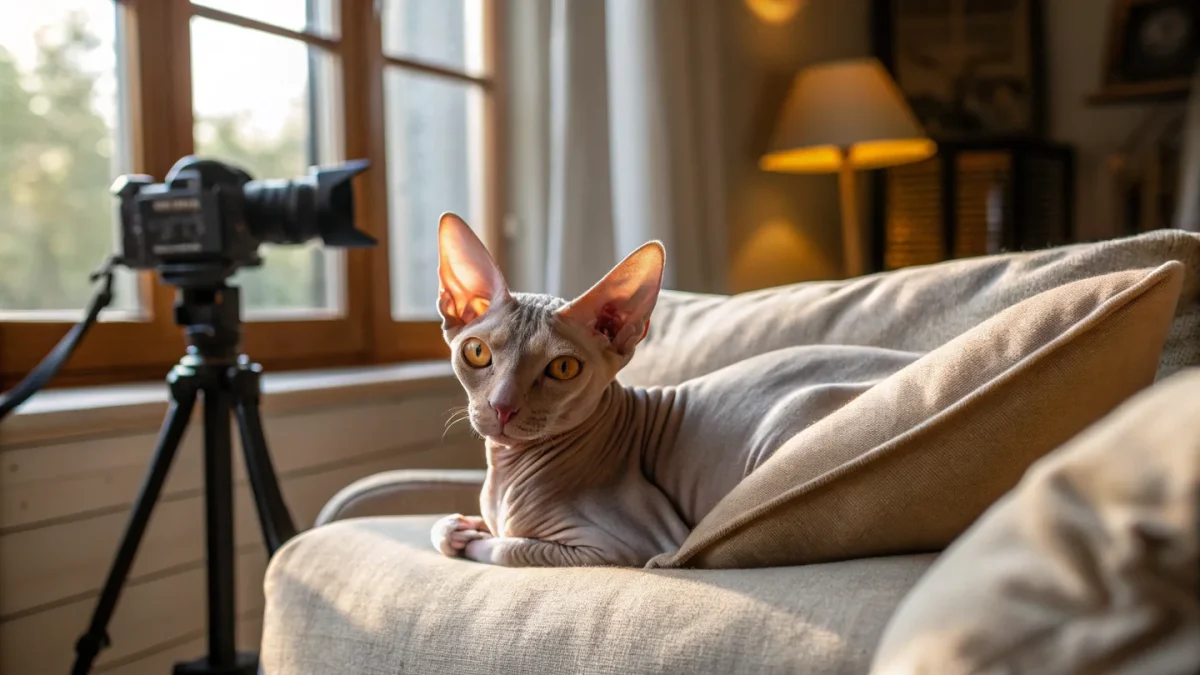
The clown comparison gets made frequently about the Sphynx, and it's accurate in the way good comparisons are — not because the cat is silly, but because it performs. A Sphynx cat in a room doesn't drift into the corner and watch. It investigates, inserts itself into whatever is happening, and does so with the cheerful confidence of something that has never once considered the possibility of being unwelcome.
Understanding the Sphynx temperament requires understanding that this behavior is not the result of bad training or unusual upbringing. It is the breed itself.
The Extrovert's Default Position
Most cats have a threshold to cross before they engage with you. They observe, assess, decide. The Sphynx's threshold is set at approximately zero. Many Sphynx owners describe the experience of bringing a kitten home and finding that by the end of the first day, the cat has already explored every inch of the available space and settled into the routine as if it built the house.
This is genuine extroversion at the breed level. The Sphynx is not simply friendly — it is constitutionally outward-facing, energized by interaction rather than depleted by it. New people entering the home are typically greeted with interest. Guests who expect a cat to hide under the bed will sometimes be startled when a warm, wrinkled face investigates their ankles instead.
The energy level is high. Sphynx cats remain kittenish in their play behavior deep into adulthood. They are athletic, quick, and inventive in how they entertain themselves — and they prefer to entertain themselves with you involved. A Sphynx that has discovered a toy it enjoys will bring it to you and wait for participation.
Physical Affection: The Heat-Seeking Reality
The Sphynx's physical affection isn't simply a personality trait — it has a biological component. Without insulating fur, Sphynx cats regulate their body temperature less efficiently than coated cats. They run warm (their skin temperature feels noticeably higher than a coated cat's) and they seek supplemental warmth actively.
What this means in practice: a Sphynx will choose the warmest available spot in every room. In winter, that spot is usually you. They will burrow under blankets, press against skin, and arrange themselves against necks and chests with the deliberate warmth-seeking behavior that makes them such compulsive cuddlers.
This is also why most Sphynx cats genuinely enjoy being held for extended periods — not simply tolerate it, but seek it out and stay once placed. Compare this to most cat breeds, where extended holding is either neutral tolerance or active escape. The Devon Rex is the closest parallel — another sparse-coated, people-dependent breed that seeks warmth and body contact with similar intensity.
Vocalization and Communication
The Sphynx is moderately vocal. Not the relentless commentary of a Siamese, but more communicative than many breeds. They use a range of sounds — trills, chirps, conversational burbles, and conventional meows — and most Sphynx owners find that the cat's communication is fairly readable once they know the individual.
Feeding time gets the most sustained vocal attention. A Sphynx who has decided that 6:00 AM is the correct breakfast hour and it is currently 6:02 will make this discrepancy known clearly. This is not aggressive vocalization — it's cheerful, persistent, and often difficult not to find charming.
Social Needs: The Critical Consideration
Here is where the Sphynx temperament assessment requires complete honesty: this breed cannot be understimulated without consequences.
A Sphynx left alone for long periods, or in a household without sufficient interaction, will develop behavioral problems. The specific manifestations vary — excessive vocalization, destructive behavior, anxious over-grooming despite having little to groom — but the root cause is the same. The breed's social circuitry is calibrated for frequent interaction, and when that interaction is absent, the system doesn't idle quietly.
This is not a breed for owners who want a companion that will be fine on its own from 8 AM to 7 PM, five days a week. A second cat — ideally another social breed rather than an independent one — mitigates this significantly, but doesn't eliminate the underlying need.
With Children and Other Pets
The Sphynx's combination of sociability, physical robustness, and play enthusiasm makes it generally excellent with children who understand appropriate handling. The breed doesn't typically provoke easily and approaches rough-housing with the same cheerful directness it applies to everything.
Supervision matters with very young children who haven't yet learned gentle handling — not because the Sphynx is fragile (it isn't) but because no cat should be subjected to handling that causes pain or distress.
With other cats, most Sphynx cats are genuinely social. They will attempt to engage other cats in play and in warmth-sharing. The receiving cat's tolerance varies. With dogs of compatible temperament, Sphynx cats often establish real relationships rather than simply tolerating coexistence.
The Daily Reality
Living with a Sphynx temperament means adjusting expectations about personal space. This is a cat that considers your laptop an invitation, your book a comfortable resting surface for its chin, and your dinner a subject of intense investigation. It will be present, persistently, in a way that owners of more reserved breeds find surprising.
For the right owner, this is exactly the point. A complete Sphynx breed guide covers the full picture — history, health, grooming requirements — but temperament is the defining characteristic that makes or breaks the match. If you want a cat that genuinely behaves more like a highly social, moderately intelligent small companion than a typically independent feline, the Sphynx delivers this consistently.
The breed is, in this sense, the extrovert's cat — and also the cat for the person who has always secretly wished cats were a bit more like dogs.