

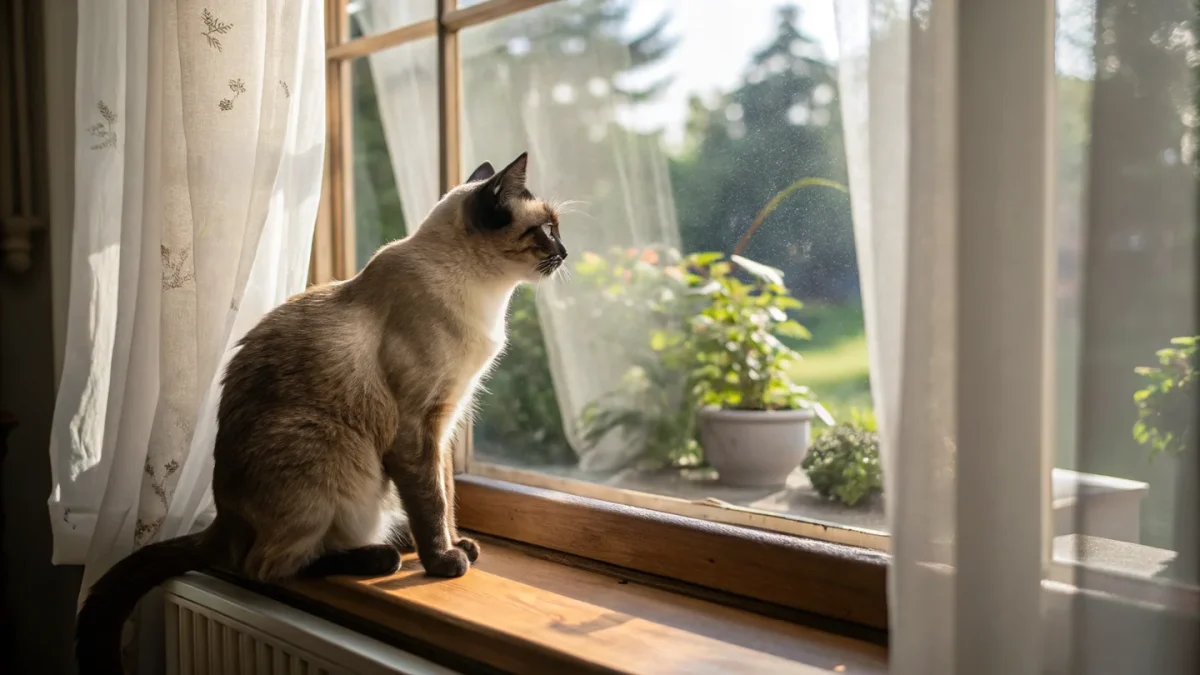
When the first Siamese cats arrived in England in 1884, gift from the Thai royal court to the British consul-general, they caused a sensation at the Crystal Palace cat show. People had simply never seen anything like them — those pale bodies marked with deep chocolate at the ears, face, paws, and tail, those unsettlingly blue eyes. One Victorian newspaper described them as "an unnatural nightmare of a cat." The breed has been making strong impressions ever since.
The Siamese cat is one of the world's oldest documented domestic cat breeds, with origins traced to the Kingdom of Siam — present-day Thailand — where manuscripts dating to the 14th century depict cats matching this description. Whether you find their appearance elegant or startling, their personality is unmistakable: loud, demanding, emotionally intense, and absolutely devoted to the people they choose.
The Siamese Personality: What You're Really Signing Up For
The Siamese is not a lap cat that tolerates your presence. It is a conversationalist, a supervisor, a shadow. They follow their owners from room to room, comment on everything with a raspy, surprisingly deep meow, and take genuine offense at being left alone for extended periods.
These cats rank among the most intelligent of domestic breeds. They solve puzzles, open cabinets, figure out routines, and manipulate their owners with a precision that can feel almost strategic. If a Siamese wants something — food, attention, access to a room — they will make their case loudly and persistently until results are achieved.
Their social nature is not just with humans. Siamese generally do well with other cats and can thrive alongside dogs with appropriate introductions. What they struggle with is solitude. A Siamese left alone all day without stimulation or companionship is a recipe for destructive behavior and stressed vocalizations that will concern neighbors. Research and veterinary behaviorists consistently identify Siamese among the breeds most susceptible to separation anxiety syndrome, attributing this to their strong human attachment and social dependency — a trait they share with Burmese but that distinguishes them from most other domestic breeds.
The Talking
Every Siamese owner knows the voice. It is not a typical domestic cat meow — it is something closer to a demanding human complaint, with volume and tonal variation that suggests actual intent. Siamese use different vocalizations for different situations. There is the "I'm hungry" yowl, the "you've been gone too long" reprimand, the "come look at this" summons, and the general running commentary on life.
This is not a behavior that can be trained away. It is built into the breed. If you want a quiet cat, the Siamese will exhaust you. If you want a cat that communicates, you will find their expressiveness one of the most engaging aspects of the relationship.
Siamese Cat History: From Temple Cats to Global Icons
The origin story of the Siamese cat contains more mythology than most breeds. Thai legend holds that Siamese cats guarded Buddhist temples and were believed to receive the souls of the deceased. Royal families kept them as symbols of prestige. The Cat Book Poems — a manuscript created in the ancient Thai capital of Ayutthaya, estimated to date somewhere between the 14th and 18th centuries — shows cats with color points that unmistakably match the Siamese.
The breed first appeared officially in the West in the 1870s and 1880s. The British consul-general Owen Gould brought two Siamese to England in 1884. They exhibited at the Crystal Palace show in 1885, where public reaction was polarized but fascinated. By the early 20th century, Siamese cats had become fashionable pets in both England and the United States.
The breed that reached the West in the 19th century looked quite different from the show Siamese of today. Original imports were more substantial in build — rounder heads, stockier bodies, slightly crossed eyes. Over the following century, selective breeding pushed toward extreme refinement: the head became wedge-shaped, the body increasingly elongated, the eyes almond-shaped and wide-set. This "modern" or "show" Siamese now looks markedly different from the "traditional" or "apple-head" Siamese, which more closely resembles the original import type.
Both types exist today, and both are true Siamese — the difference is entirely a product of selective breeding choices made in the 20th century.
Siamese Color Points: Understanding the Genetics
The Siamese color pattern is called "pointed" — darker pigmentation restricted to the extremities (face, ears, paws, tail) against a paler body. This pattern is controlled by a temperature-sensitive enzyme in the pigmentation pathway. The enzyme functions normally at lower temperatures — such as on the paws, ears, and face — but is inhibited at the higher core body temperature of the torso.
This is why newborn Siamese kittens are pure white. They've been in the warmth of the womb, where the enzyme is suppressed everywhere. As they cool after birth and their extremities register lower temperatures, the points develop. The final color deepens over months and, in some cases, continues to shift with age and body temperature changes — a Siamese living in a cold climate will often develop darker points than one living somewhere warm.
The four traditional point colors recognized by most cat registries are:
Seal point — deep, warm brown points against a pale fawn body. The most common and the classic Siamese look.
Blue point — slate gray-blue points against a pale gray-white body. A dilute of seal.
Chocolate point — warm milk-chocolate points against an ivory body. Lighter than seal, with a distinctly warm tone.
Lilac point — pale pinkish-gray points, sometimes called frost point, against a pure white body. The rarest of the four traditional colors.
Many registries also recognize additional point colors including flame/red, cream, tortie, and lynx (tabby) points, which were introduced by crossing with other breeds in the 20th century.
Physical Description
The modern show Siamese has a silhouette unlike any other domestic cat. The head forms a long, tapering wedge with no break at the muzzle. The ears are large and set wide on the skull, following the lines of the wedge. The eyes are almond-shaped, set at a slight slant, and always vivid blue — the intensity of which is unique among domestic breeds.
The body is long, lean, and muscular — the opposite of fluffy or substantial. Legs are long and fine, with small oval paws. The tail is long and tapering, almost whip-like. The overall impression is of angular elegance in motion.
The coat is short, fine, and lies flat against the body with almost no undercoat. This makes the Siamese very low-maintenance in terms of grooming — weekly brushing is generally sufficient to manage minimal shedding. The lack of insulating undercoat also means Siamese feel the cold more acutely than other breeds and tend to seek warmth aggressively.
The traditional Siamese — sometimes sold as "apple-head" or "Thai" Siamese — has a rounder head, more moderate facial structure, and a less extreme body type. The temperament and color genetics are identical; only the conformation differs.
Typical size: Males 3.5–5.5 kg (8–12 lbs); females 2–4 kg (6–8 lbs).
What Most People Get Wrong About Siamese Cats
The most persistent misconception is that Siamese are aggressive. They are not. They are demanding, opinionated, and occasionally theatrical — but those are personality traits, not behavioral problems. A Siamese that bites or scratches repeatedly is typically a Siamese that is understimulated, anxious, or responding to handling it has communicated it doesn't want.
The second misconception is that the crossed eyes associated with older Siamese lines are purely a cosmetic trait. The traditional Siamese eye muscle mutation that caused crossing was neurological — it allowed the brain to avoid the double vision that would otherwise result from their particular retinal structure. Modern selective breeding has largely eliminated crossed eyes from the show population, but the underlying neurological adaptation is still present. Research tracing back to Ray Guillery's work on Siamese visual pathways confirmed the mechanism: the same gene that suppresses pigment at warm body temperatures also miswires the optic nerve at the chiasm, and the squint is the brain's compensation for that miswiring, not an unrelated cosmetic quirk.
Third: many people assume Siamese are high-strung and fragile. They are energetic and emotionally expressive, but not fragile. They are physically robust cats that generally live long lives — 12 to 15 years is common, with many reaching their late teens.
Siamese Health: What to Know
The Siamese is one of the longer-lived domestic cat breeds on average, but they do carry some specific health predispositions that prospective owners should understand.
Progressive retinal atrophy (PRA): A hereditary condition causing gradual deterioration of the retina, leading to eventual blindness. Responsible breeders test breeding pairs. The condition itself is painless, and affected cats adapt well.
Amyloidosis: A condition in which amyloid proteins are deposited in organs, most commonly the liver. Can lead to liver failure. A 2020 study in The Veterinary Journal confirmed hereditary amyloidosis as a recognized, more-prevalent-than-average condition in Siamese and Oriental lines, typically showing up between one and seven years of age.
Respiratory issues: The wedge-head confirmation of modern show Siamese creates a flatter skull profile that can compress the airway. This is less extreme than in flat-faced (brachycephalic) breeds like Persians, but worth noting, particularly in very extreme show lines.
Dental issues: Siamese have a narrower jaw than many breeds, which can lead to crowding. Regular dental check-ups are advisable.
Sensitivity to anesthesia: Vets commonly treat Siamese as a breed to be cautious with under anesthesia. The isolated genetic mechanism that's been nailed down for a couple of breeds — greyhounds, with their slower propofol clearance, and collies, with the ABCB1 mutation — hasn't been demonstrated for Siamese specifically. Tell your vet the breed anyway. The caution is standard practice even without a pinned-down mechanism.
The lean body type that makes Siamese visually striking also means they can lose condition quickly when ill. They tend to show stress physically — notably through gastrointestinal sensitivity during major life changes like moves or new family members.
Siamese Cat Care
Feeding
Siamese have lean builds but active metabolisms. They need quality nutrition without excess caloric density, which can lead to weight gain that's harder to detect on their narrow frames. Because they're highly social cats, many Siamese enjoy eating near their owners and may be slower to eat when left alone — purely a behavioral trait.
Exercise and Enrichment
These are not cats that self-entertain reliably. Interactive play sessions — feather wands, puzzle feeders, anything requiring active engagement — should be a daily fixture. Two sessions of 15 minutes each is a reasonable minimum. Without adequate stimulation, Siamese channel their intelligence and energy into behaviors that owners find less endearing.
Cat trees, perches with views, and access to windows provide passive enrichment. Many Siamese learn to walk on leash harnesses and find the outdoor stimulation genuinely satisfying.
A second cat — ideally a similarly active, social breed — significantly improves quality of life for Siamese that spend time alone. This is not optional for owners with long workdays; it is a genuine welfare consideration. The Oriental Shorthair is genetically very close to the Siamese and makes a particularly compatible companion — similar activity level and social needs, without the colorpoint restriction.
Grooming
The short, close coat requires minimal attention. A rubber brush or damp cloth once a week removes loose hair and maintains coat condition. Nails should be trimmed regularly. Dental hygiene is particularly important given the breed's predisposition to dental crowding.
The Right Owner for a Siamese Cat
Be honest with yourself before acquiring a Siamese. This breed is extraordinary — genuinely one of the most engaging, personality-rich companions in the domestic cat world. But it is also genuinely demanding in ways that some people find overwhelming.
The right Siamese owner is home reasonably often, or has another animal companion in place for the cat's company. They enjoy a cat that communicates vocally and involves itself in everything. They want a relationship, not a pet that lives in the house — the Siamese needs genuine engagement, not just proximity.
If you travel frequently, work very long hours away from home, and want a cat that's largely self-sufficient, the Siamese will be miserable and will make its misery known. If you want a cat that greets you at the door, keeps you company in every room, and never stops having opinions, the Siamese delivers on all of it.
FAQ
Are Siamese cats good with children?
Generally yes, with appropriate introductions. Siamese are social and energetic, which suits children who want an interactive cat. Their sensitivity means they can become stressed by very chaotic or unpredictable handling, so the relationship works best with older children who can read feline body language.
Do Siamese cats meow more than other cats?
Yes, significantly. The Siamese is widely considered one of the most vocal domestic cat breeds. Their voice is loud, varied, and persistent. This is a fundamental breed characteristic, not something that diminishes with time or training.
Are Siamese cats hypoallergenic?
No cat breed is truly hypoallergenic — all cats produce the Fel d 1 protein that triggers most cat allergies. The Siamese has a short, low-shedding coat which may reduce the spread of allergens in the environment, but this is not the same as being hypoallergenic. People with cat allergies may react equally to Siamese as to other breeds.
How long do Siamese cats live?
Siamese typically live 12–15 years, with many individuals reaching 16–20. They are among the longer-lived domestic cat breeds. Providing proper nutrition, regular veterinary care, and avoiding obesity significantly supports longevity.
Should I get two Siamese cats?
For owners who work full days away from home, having two cats — Siamese or otherwise — is strongly advisable. Siamese in particular suffer from isolation. Two kittens raised together bond closely and provide each other company and stimulation in ways that significantly reduce stress-related behaviors.