

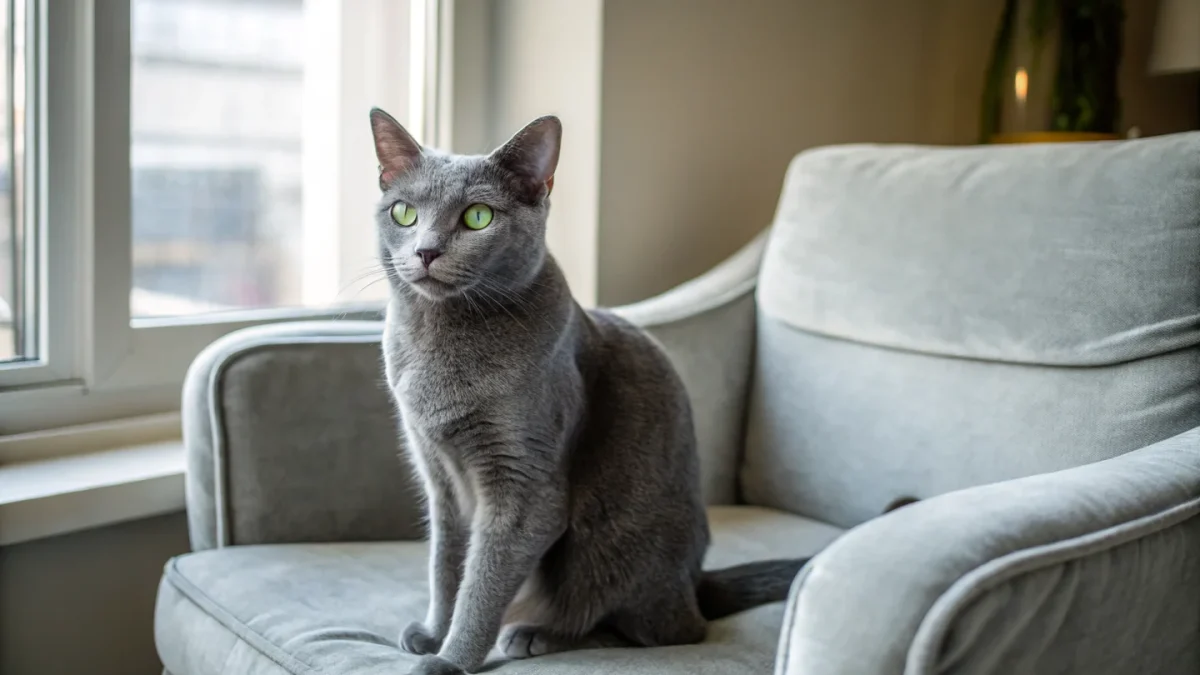
In the winter of 1893, a blue-grey cat arrived at London's Crystal Palace show from the Russian port city of Archangel — or so the story goes. Whether it was a single sailor's cat or a deliberate export from the Russian north, the Russian Blue had arrived in Britain, and within two decades it had acquired both a name and a devoted following that persists today.
The Russian Blue is not a cat that announces itself. It observes first. It decides second. Only then — sometimes weeks after meeting you — does it offer the quiet, unswerving loyalty that makes owners of this breed so consistently devoted to it.
Origins: From the Archangel to the Show Ring
The Russian Blue's documented history begins in the late 19th century in Britain, where cats described as "Archangel cats" or "Foreign Blues" were being shown alongside domestic shorthairs and other early pedigree breeds. These were cats that arrived, likely via trading ships, from the region around Arkhangelsk (Archangel) in northern Russia — a port city that had active maritime trade with Britain throughout the 19th century.
The breed as we know it today was substantially shaped by two world wars. Following World War II, the Russian Blue was nearly extinct in Europe. British and Scandinavian breeders worked to rebuild the breed, crossing Russian Blues with Siamese and British Shorthairs to restore genetic diversity. This produced some unwanted changes in type — particularly the introduction of Siamese influence, which shifted some lines toward a more elongated, oriental body type. The current show standard in most countries emphasizes a moderate build: medium-boned, lithe but not extreme, with the distinctive wedge-shaped head and large, upright ears.
The distinctive coat color — a blue-grey with silver tipping that gives each hair a luminescent quality — has been consistent throughout the breed's documented history. The double-coat structure is what creates the famous plush texture: a dense undercoat and a slightly longer guard coat that together give the fur its characteristic resistance to the hand when stroked.
Eye color in Russian Blues is vivid green in adults. Kittens are born with yellow eyes that gradually transition to the brilliant green through their first year of life.
Physical Characteristics
The Russian Blue is a medium-sized cat with a naturally athletic build that can be deceptive under all that fur. Adults typically weigh between 3.5 and 5.5 kilograms, with males on the higher end. The body is elegant rather than stocky — long lines, level back, fine-boned feet.
The coat is the breed's most discussed feature. The silver tipping on each blue-grey hair creates an almost luminescent shimmer — in good light, a Russian Blue seems to glow faintly. The double coat is dense enough that it holds a finger track when brushed against the grain, a characteristic look. It is also a coat that benefits from the breed's fastidious grooming habits; Russian Blues are among the tidier cats in terms of self-maintenance.
The face is a distinctive modified wedge with a flat top to the skull, prominent whisker pads, and a slight upward curve at the corners of the mouth that gives the breed its characteristic expression — often described as a "natural smile." The ears are large, wide-set, and translucent at the tips in younger cats.
Temperament: The Reserved Loyalist
Understanding the Russian Blue temperament requires separating its public and private personalities, because they are genuinely different.
In the presence of strangers, the Russian Blue retreats. Not aggressively — it simply becomes less visible. It will observe from a distance, determine whether the visitor is worth engaging, and usually conclude they are not. Guests who sit quietly and make no direct approach often eventually have a Russian Blue creep closer; guests who immediately reach for the cat will not see it again that visit.
With its own family, the Russian Blue is a different creature entirely. It selects a small inner circle — sometimes just one person, sometimes the whole household — and engages with those individuals with an attentiveness that surprises owners used to more casually affectionate breeds. A Russian Blue will follow you from room to room without the insistent vocalization of a Siamese or the physical demands of a Sphynx. It simply wants to be in the same space you're in.
Vocally, this is a quiet breed. Russian Blues communicate in soft, chirping sounds and the occasional low meow. They are not silent, but they are discreet — a significant consideration for apartment living or shared households.
The breed is intelligent and will learn its household's routines with remarkable accuracy. A Russian Blue fed at the same time each day will appear at your feet five minutes before the scheduled time. They remember patterns, and disruptions to those patterns visibly affect them.
Play behavior is moderate to active, particularly in younger cats. Russian Blues enjoy solo play with puzzle feeders and wand toys but typically do not demand interactive play with the persistence of more extroverted breeds. They are athletic climbers and appreciate vertical space.
What Most People Get Wrong About the Russian Blue
The hypoallergenic claim. This is the most widespread misconception about the breed. The claim that Russian Blues produce less of the Fel d 1 protein — the primary allergen affecting most cat-allergic people — circulates constantly online and in breed marketing materials. The truth is more complicated.
Some Russian Blue owners with mild cat allergies report better tolerance with this breed. There are plausible mechanisms: Russian Blues are fastidious groomers, potentially spreading allergen less widely; the dense double coat may trap allergens more than single-coated breeds; lower vocalization means less aerosol spread. But conclusive studies demonstrating categorically lower Fel d 1 production in Russian Blues compared to other breeds have not been established to the satisfaction of the allergology research community — the peer-reviewed genetic work on reduced Fel d 1 production exists for the Siberian, not the Russian Blue. The responsible guidance is: if you have cat allergies, spend time with individual cats of any breed before committing. Do not acquire a Russian Blue on the basis of this claim.
They're unfriendly. They're selective. There's a real difference. A Russian Blue that trusts you is a genuinely affectionate companion. The shyness is a feature of the breed's caution, not its emotional capacity.
They're low-maintenance. The coat, yes. The mind, no. Russian Blues are intelligent cats that can develop anxiety or behavioral issues if understimulated or if their environment becomes unpredictably chaotic. The low-key personality doesn't mean low-key needs.
Health Considerations
The Russian Blue is generally considered a robust, healthy breed without the extreme structural features that cause problems in some pedigree cats. Average lifespan is typically 15 to 20 years, which is genuinely long for a domestic cat.
The breed has some documented tendencies toward weight gain in middle age, particularly in indoor-only cats with unrestricted food access. The compact, athletic body should not become obese, and portion management matters.
Bladder stones (urolithiasis) appear in Russian Blues with somewhat higher frequency than the general cat population — the breed shows up in veterinary literature as having decreased risk for struvite stones specifically, which tracks with a relatively higher share of calcium oxalate stones, though breed-specific data for Russian Blues remains thinner than for more heavily studied breeds like the Persian.
No breed-defining single-gene disorders of the severity seen in some other breeds have been documented for the Russian Blue.
Grooming the Double Coat
Despite the density, the Russian Blue's coat is not high-maintenance. The absence of significant matting tendencies means grooming is primarily about managing shedding and maintaining coat health rather than preventing tangles.
Weekly brushing is sufficient during most of the year using a fine-toothed comb or a soft slicker brush. The breed has two noticeable shedding seasons — typically spring and autumn — during which daily brushing for a couple of weeks prevents the loose undercoat from distributing itself across your furniture.
The coat does not require trimming or bathing under normal circumstances. Russian Blues are exceptional self-groomers and maintain cleanliness well.
Ear cleaning (gentle, periodic), nail trimming, and dental hygiene are standard across all cats, and the Russian Blue is no exception.
Living With a Russian Blue
The Russian Blue adapts well to apartment living. The quiet disposition, moderate activity level, and tendency toward independent play make it a compatible city cat. It does not need outdoor access to thrive, and given the breed's cautious nature around unfamiliar environments and people, indoor living is generally appropriate.
Multi-pet households can work well with proper introductions, but the Russian Blue's preference for predictability and calm means it may struggle in extremely noisy, chaotic households with young children or very active dogs. It is not a cat that will tolerate rough handling graciously.
This breed does not cope well with sudden major changes — new home, new schedule, rehoming. Transitions require extra patience and should be managed carefully.
The Right Owner for a Russian Blue
The Russian Blue is, perhaps, the cat for people who aren't sure they want a cat in the traditional sense but actually want a quiet, intelligent, deeply loyal companion who respects their space.
It is ideal for: single-person households or quieter families, apartment dwellers, owners who work from home and want company that isn't intrusive, and anyone who values discretion and loyalty over theatrics.
It is not ideal for: households with very young children who can't be taught gentle handling, people who want immediate, universal friendliness toward guests, or anyone who will be regularly away for extended periods without another compatible companion pet.
If you want a cat that chooses you — genuinely, deliberately, without reservation once the decision is made — the Russian Blue rewards patience in ways that few other breeds do.
Frequently Asked Questions
Are Russian Blue cats really blue?
The color is technically a blue-grey — a diluted form of black pigmentation. Each hair is tipped with silver, creating a shimmering quality in good light. The coat can appear more intensely blue-grey or more silvery depending on lighting and the individual cat's pigmentation.
Do Russian Blue cats get along with other pets?
With careful introductions, yes. They tend to do best with other cats of similar temperament — calm, not boisterous. Very high-energy breeds or dogs may overwhelm a Russian Blue initially, but many individuals adapt over time. Rushed or forceful introductions typically backfire with this breed.
How vocal is the Russian Blue?
Quiet is the accurate word. Russian Blues have voices but use them selectively — a soft meow before meals, a chirp when they want attention. They are not a breed that vocalizes constantly or loudly, which makes them well-suited to apartments or homes where noise is a consideration.
At what age do Russian Blue eyes turn green?
Kittens are born with yellow or yellow-green eyes. The full adult green develops gradually over the first year of life. A very young kitten with yellow eyes is normal and expected.
How long do Russian Blue cats live?
The breed is known for longevity. 15 to 20 years is a realistic expectation for a well-cared-for Russian Blue, which places it among the longer-lived domestic cat breeds.