

When Romans arrived in Britain, they brought cats with them — working cats, tasked with protecting grain stores from rodents. Those cats interbred with local European wildcats over centuries, producing a hardy, adaptable, stocky working cat that became the foundation of what we now call the British Shorthair. The breed wasn't formalized until the late 19th century, when Harrison Weir organized Britain's first cat shows and created the standards that still define the breed today, but the cat itself is genuinely ancient. Weir, sometimes called the "Father of the Cat Fancy," is specifically credited with breeding and championing the British type — his Best in Show at the 1871 Crystal Palace exhibition went to a 14-year-old blue tabby Shorthair he owned himself.
That lineage matters for understanding the breed. The British Shorthair isn't a product of extreme selective breeding for exotic traits — it's a domestic cat that's been gradually refined rather than dramatically altered. The result is a breed that's constitutionally sound, temperamentally stable, and notably less prone to the health problems that plague breeds developed through more intensive inbreeding.
Origins and History
Harrison Weir's first cat show at Crystal Palace in London in 1871 featured British Shorthairs prominently, and Weir himself was an enthusiast of the breed. He wrote in his 1889 book "Our Cats and All About Them" of the British working cat's virtues — the dense coat, the sturdy build, the equable temperament. Weir also founded the National Cat Club in 1887, which remains active today.
After World War II, the breed's numbers had declined severely. British breeders crossed surviving British Shorthairs with Persians, Russian Blues, and French Chartreux to rebuild the population. The Persian crosses in particular contributed to the fuller face and denser coat seen in modern show British Shorthairs — traits that are now standard but weren't as pronounced in pre-war examples. Notably, these Persian crosses also introduced the longhair gene, which surfaces when two carriers are bred together and is the genetic origin of the British Longhair.
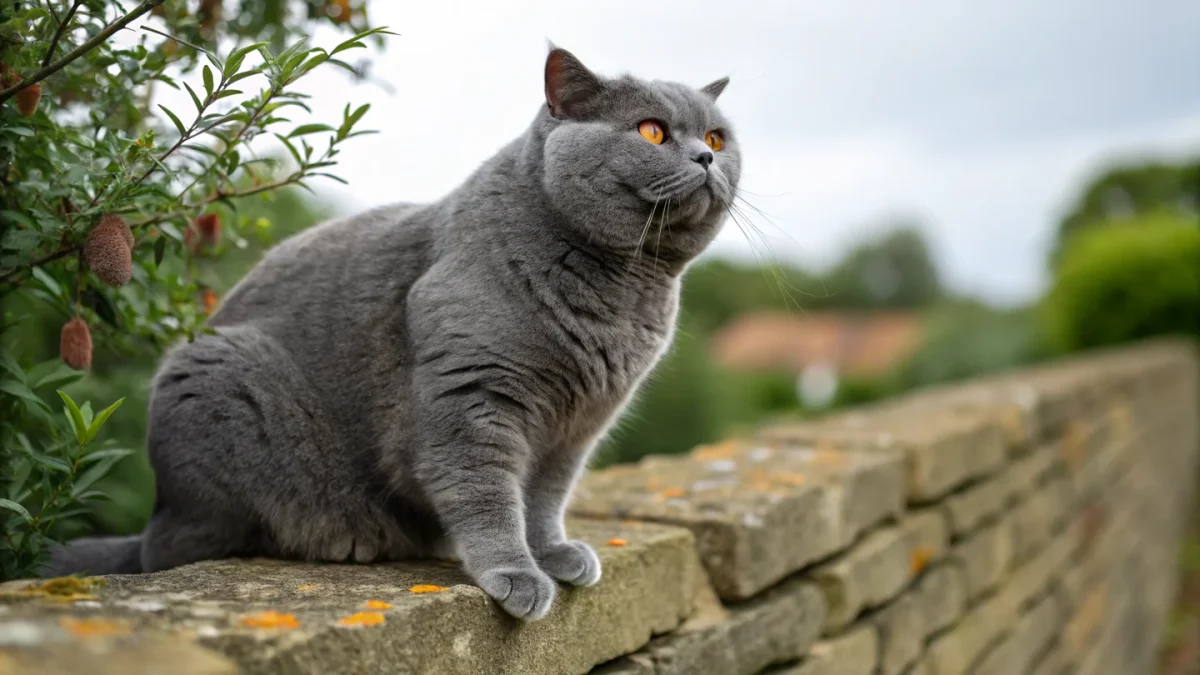
The blue coat (a dilute version of black, genetically speaking) became so associated with the breed that "British Blue" was used as an alternative name for decades. Today the breed is recognized in a wide range of colors and patterns, but the blue — a uniform gray-blue with copper or orange eyes — remains the most iconic.
The Cheshire Cat in Lewis Carroll's "Alice's Adventures in Wonderland" (1865) is often described as modeled on a British Shorthair, based on the breed's characteristic expression — round face, knowing look, slow-fading grin. This is charming but the origins of the Cheshire Cat are genuinely murky. Scholarship traces the "grin like a Cheshire Cat" phrase to sources predating Carroll — a sandstone carving of a grinning cat at St Wilfrid's Church near Carroll's birthplace in Daresbury is one proposed inspiration, cheese molds another. No direct link to the British Shorthair breed specifically has been established.
Physical Characteristics
The British Shorthair has a distinctive silhouette: round, everything round. Round head, round face, round eyes, rounded paws. The body is compact and cobby — broad chest, level back, substantial legs, and a thick tail that tapers to a rounded tip. This is not an elegant, angular cat. It's a deliberately stocky, solid breed.
Adults weigh 7–17 pounds, with males considerably heavier than females. The breed reaches full size relatively slowly — most sources place full adult weight at 3 to 5 years, with the broad chest and body mass continuing to develop well past the first year.
The coat is the breed's most distinctive feature after the face: dense, thick, and plush, with a hard texture compared to the silky coats of breeds like the Ragdoll. It stands away from the body rather than lying flat, giving the cat an almost toy-like roundness in person. The coat is short enough that matting is uncommon, but dense enough that it sheds substantially.
British Shorthairs come in a remarkable range of colors. The original and most recognized is solid blue (a cool gray-blue) with copper or orange eyes. Other solid colors include black, white, cream, chocolate, lilac, and cinnamon. Beyond solids: tabby patterns (classic, mackerel, spotted), tortoiseshell, colorpoint (recognized by some organizations), bicolor, and a range of golden and silver shaded patterns. The golden shaded variety — a warm creamy-gold coat with darker tipping and distinctive green eyes — has become one of the most sought-after variants; the color results from a combination of the inhibitor gene and a warm base pigment rather than the white base of silver-shaded cats.
Eye color in British Shorthairs follows the coat color genetics predictably: copper or orange eyes are standard across most solid colors; white cats may have blue eyes, copper eyes, or one of each (odd-eyed); golden and silver shaded cats characteristically have green eyes; colorpoint individuals have blue eyes. The CFA's British Shorthair breed page specifies these eye color expectations as part of the breed standard.
Temperament and Personality
The British Shorthair's personality is perhaps best described as self-possessed. They're affectionate, but they decide when affection happens. They're interested in people, but they maintain a sphere of personal space that commands respect. They're not lap cats in the insistent, always-there way of a Ragdoll or a Burmese — they're more likely to settle next to you than on you, to watch what you're doing with steady interest rather than demanding participation.
They're calm in a way that reads as dignified rather than passive. A British Shorthair in a well-functioning household has a quality of contented presence — you become aware of them without them requiring your constant attention.
They're quiet. British Shorthairs vocalize when they have something specific to say — hungry, wants out, object of curiosity requires commentary — but they're not chatty cats. In households where noise is a sensitivity, this is a genuine virtue.
The breed adapts well to being left alone. They're less prone to separation anxiety than some breeds, more capable of occupying themselves with independent activity, and less likely to remodel your furniture when bored. This makes them a reasonable choice for working households, though they still benefit from — and clearly enjoy — human company.
British Shorthairs get along well with other cats and with calm dogs. They're not typically aggressive. But they assert themselves: a British Shorthair won't be pushed around by a more dominant cat, and a new pet in the household will be assessed carefully before being accepted. They're not the quickest adapters to change in the animal kingdom, but they do adapt.
What Most People Get Wrong About This Breed
"They're just fat cats" — this is the most common dismissal, and it's wrong on multiple levels. The British Shorthair's stocky, round appearance is structural, not dietary. The broad chest, short legs, and dense coat create the compact silhouette that defines the breed. An obese British Shorthair looks different from a British Shorthair at a healthy weight for the breed, and the difference is recognizable once you've seen enough of them.
That said, British Shorthairs are genuinely prone to weight gain if their diet isn't managed. The combination of low-to-moderate activity level and a tendency toward food motivation makes portion control important — one veterinary nutrition resource notes the breed has a roughly 25% higher predisposition to weight gain compared to mixed-breed cats. An actual overweight British Shorthair is not healthy, and distinguishing breed-typical stockiness from genuine excess weight is worth learning.
The second misconception is that their independence means they don't need much. They're not high-maintenance in the sense of requiring constant engagement, but they do need consistent care, social interaction, and regular veterinary attention. "Independent" is not a synonym for "self-sufficient."
Third: some people assume British Shorthairs are suitable for children who want to roughhouse with a cat because they're sturdy and not easily startled. They will tolerate a great deal before reacting, but they have limits, and when they've reached their limit they'll exit the situation rather than endure it. Teaching children to respect those signals is important regardless of how patient the cat is.
Grooming and Coat Care
This is where the British Shorthair earns its reputation as a lower-maintenance breed. The short, dense coat doesn't mat easily and doesn't require daily grooming. A thorough weekly brushing with a firm bristle brush or rubber grooming glove removes dead fur and distributes skin oils, keeping the coat in good condition.
During shedding seasons — typically spring and fall — more frequent brushing (2-3 times weekly) significantly reduces the amount of fur that ends up on furniture and clothing. The plush coat sheds more than it might visually suggest, and the density means a single brushing session can remove a surprising volume of fur.
The breed's grooming simplicity compared to longhaired breeds is one of its genuine practical advantages. No mats, no daily brushing sessions, no emergency detangling. It's a coat that largely takes care of itself with minimal support.
Nails, ears, and dental care follow standard feline maintenance.
Living With a British Shorthair
British Shorthairs are among the most apartment-suitable of all medium-to-large cat breeds. They don't need outdoor access to be content — they're not climbers or hunters in the frantic sense, and the indoor environment suits them well. What they need is a stable routine, some regular play (particularly while young), and social interaction at a pace they control.
They're good in multi-cat households provided the other cats are respectful. They're generally good with dogs that don't chase cats. They're suitable for families with older children who understand feline boundaries. People sometimes compare British Shorthairs to the American Shorthair — the breeds look superficially similar but have distinct histories and differences in conformation that are worth understanding before choosing between them.
Where they're not ideal: households that want a physically affectionate, constantly available lap cat; households with young toddlers who want to carry the cat around; households where the owner travels constantly and leaves the cat alone for extended periods.
They settle into routines and visibly prefer them. Moving furniture, bringing in new animals, or changing feeding schedules all register. Not dramatically — they're not anxious cats — but their watchful expression when something's different tells you they noticed.
Is This Breed Right for You?
The British Shorthair is an excellent match for someone who wants a genuinely self-contained companion — a cat that has its own perspective on life and shares it with you on its own schedule. They're not cold, not aloof, not indifferent. They're simply cats that operate on their own terms rather than conforming to their owner's emotional needs at every moment.
The right British Shorthair owner appreciates that the cat's occasional dignified removal from a situation isn't rejection — it's self-knowledge. They give the cat space when it wants space and receive real affection when the cat decides to give it, and they find that reciprocal dynamic satisfying rather than frustrating.
For quieter households, working professionals, and people who don't want to be followed into the bathroom every morning, the British Shorthair is about as close to ideal as a domestic cat gets.
Frequently Asked Questions
Why do British Shorthairs look so round?
The breed's characteristic round appearance comes from its physical structure: a broad, flat skull, full cheeks, a compact cobby body, and a dense plush coat that stands away from the body. This is the intended breed standard, not a sign of obesity. British Shorthairs are genuinely stocky cats, but a truly overweight British Shorthair looks different — the roundness becomes less structured, and you can't feel the ribcage easily.
Are British Shorthairs affectionate?
Yes, but on their own schedule. They're not lap cats that demand constant physical contact. They're more likely to sit beside you than on you, and they express affection through presence and steady company rather than constant cuddling. Most owners find this dynamic satisfying rather than distant.
Do British Shorthairs get along with other cats?
Generally yes, though they're careful rather than immediately accepting. They'll assess a new animal before extending acceptance and won't tolerate being bullied. In multi-cat households with enough space and resources, British Shorthairs typically find their footing without serious conflict.
How much grooming do British Shorthairs need?
Weekly brushing is sufficient for most of the year, increasing to 2-3 times weekly during shedding seasons. The short, dense coat doesn't mat easily. Compared to longhaired breeds, the grooming commitment is minimal.
Are British Shorthairs good for apartments?
Yes. Their moderate activity level, low noise output, and preference for indoor life make them well-suited to apartment living. They're not climbers that need floor-to-ceiling cat trees, and they're content with a smaller living space provided they have some enrichment and consistent human company.