

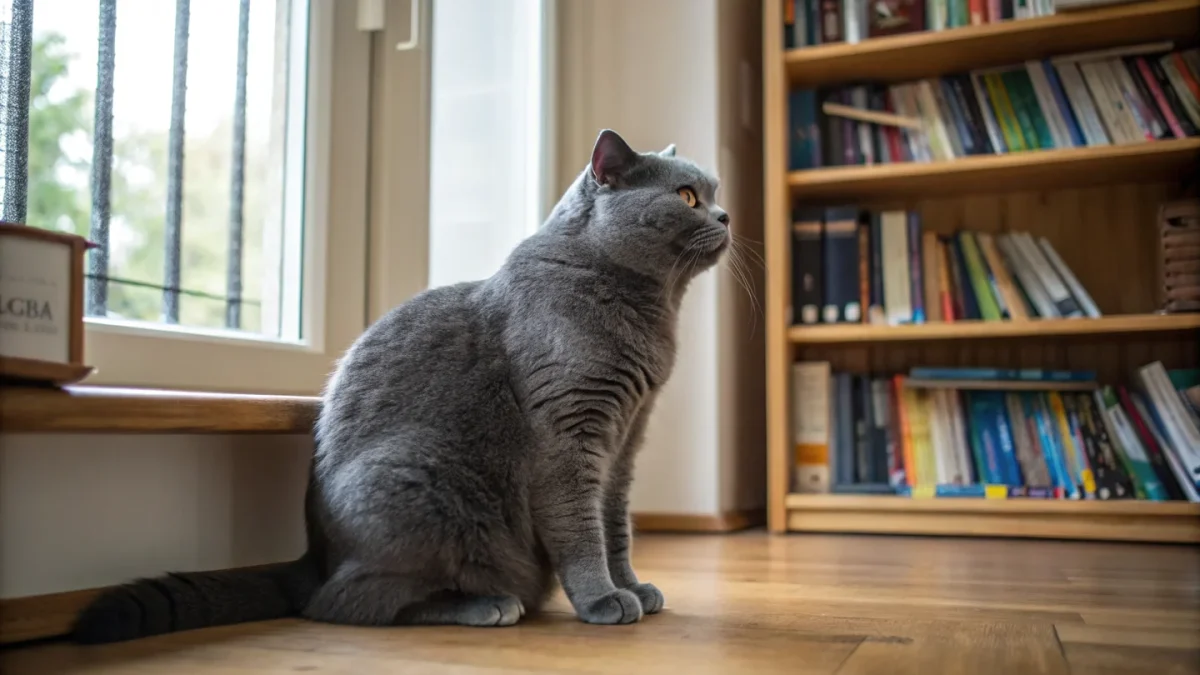
The British Shorthair is sometimes described as the "gentleman" of domestic cats — a label that captures something real about the breed's bearing even if it gets used too often. There's an air of composed self-possession in a good British Shorthair that's distinct from simple laziness or shyness. These cats are watchful. They're present. They've assessed the situation and decided everything is acceptable, and they project that conclusion with quiet authority.
That personality makes them one of the most genuinely adaptable indoor cat breeds — not because they're enthusiastic about everything, but because they have a stable emotional baseline that doesn't require constant conditions to be met.
For the complete overview of the breed, see the complete British Shorthair breed guide. This focuses on what daily life with their specific temperament actually looks like.
The Self-Contained Quality
British Shorthairs don't need to be the center of household attention. This is a meaningful trait, because many cats that seem "calm" are actually just slow to warm up — they're reserved rather than settled. The British Shorthair is genuinely comfortable in its own company.
This self-containment expresses itself in small ways. A British Shorthair in a room with activity will typically find a spot that gives them a good view of proceedings and occupy it with evident satisfaction — not demanding engagement, not retreating into another room, just watching. When they decide to enter the activity, they do it on their own schedule.
They're not aloof in the way the label sometimes implies. An aloof cat doesn't come find you when it's in the mood for company. A British Shorthair will absolutely come find you when it wants contact — it just wants contact on its own terms and at its own pace.
Affection: The British Shorthair Way
This is the part that consistently surprises owners who've read that British Shorthairs are affectionate. They are affectionate, but their mode of expressing it is beside, not on.
A British Shorthair will follow you to whatever room you're in and settle on the nearest comfortable surface. It'll sit beside you while you watch something in the evening. When it's in the mood for direct contact, it'll lean against you, accept head scratches with obvious pleasure, and slow-blink at you in the feline equivalent of "I find you tolerable and trust you."
What it won't typically do is climb into your lap uninvited, demand to be picked up, or drape itself across your keyboard in search of attention. The physical contact they want is usually a side-by-side arrangement rather than full body contact.
Some British Shorthairs are more lap-inclined than others — individual variation is substantial. Socialization as kittens influences this significantly. A kitten that was frequently and gently held by many different people is more likely to be physically affectionate as an adult than one that was handled by one person occasionally.
Activity Level and Stimulation Needs
British Shorthairs are calm adults. Kittens and young cats have the expected kitten energy, but by the time a British Shorthair is 2-3 years old, they've settled into what will be their adult pace: moderate activity, genuine interest in play but not frenetic need for it, long comfortable rest periods.
They're not cats that need constant entertainment. They won't develop destructive behaviors from being under-stimulated the way a Bengal or Somali would. But "low maintenance in terms of entertainment" is different from "doesn't benefit from play" — British Shorthairs enjoy interactive play, they just don't demand it at volume.
Short daily play sessions matter most for kittens and young adults. For older British Shorthairs, a few engaging sessions per week alongside environmental enrichment (a window bird feeder is extremely effective for this breed) keeps them mentally healthy.
With Children
British Shorthairs do well with children, but with a characteristic independence that parents need to manage. They're patient and not easily startled. Their response to handling they don't enjoy is to leave, not to react. Their physical sturdiness — the cobby build and dense coat — makes them less fragile-seeming than more delicate breeds.
The limitation is their self-determination. A British Shorthair will interact with children when it chooses to and will decisively end those interactions when it's done. A child who blocks the cat's exit, forces it to be held, or doesn't read the cat's signals will encounter a cat that's done tolerating the situation — and while British Shorthairs don't typically scratch, the message that the interaction is over will be delivered clearly.
This is actually healthy cat-child dynamics: children learning to read animal body language and respect animal agency. But it requires parents to teach those skills rather than assuming the cat will simply absorb everything.
Independence and Being Home Alone
British Shorthairs are among the better breeds for households where people work outside the home for normal hours. They're less prone to separation anxiety than highly social breeds. They occupy themselves adequately. They don't shred furniture when bored.
"Better than most" is not "perfectly fine alone indefinitely." A British Shorthair in a completely empty house for very long hours, day after day, will show the effects: increased sleep, decreased play initiative, possible overeating. The breed does better with consistent company than without it — just better than average at managing normal absence.
If extended alone time is unavoidable, a second cat is a worthwhile consideration. British Shorthairs can coexist peacefully with other calm cats, and having a feline companion noticeably changes the quality of their alone time. This doesn't eliminate all concerns, but it addresses them substantially.
What Throws Them Off
British Shorthairs are even-tempered, but they're not infinitely flexible. Change registers with them in ways that are worth knowing.
They're routine-oriented. Feeding schedule changes, furniture moves, new people in the home — these aren't crises, but a British Shorthair will spend a day or two recalibrating when something shifts. The watchful expression you'll see during that recalibration isn't anxiety exactly; it's watchful assessment. Once they've determined everything is acceptably fine, they return to their settled state.
They take time to accept new animals. A British Shorthair won't immediately welcome a new cat or dog with enthusiasm. A proper slow introduction — scent first, visual contact with a barrier, then supervised coexistence — gives the resident British Shorthair time to assess and accept rather than feel invaded.
They don't love being rushed or startled. They're not fragile about it, but a home with frequent sudden loud noises or chaotic movement produces a British Shorthair that spends more time in quieter rooms than it otherwise would.
The Long View
British Shorthair temperament is not particularly exciting to describe, which is part of the point. They're steady. They're reliably pleasant to live with. They don't create drama and they don't require it. Over the course of a 14-year relationship with a British Shorthair, what you get is a calm, present, self-contained companion who shows genuine affection when it feels like it and who never demands more than you have to give.
That description will appeal strongly to some people and read as flat to others. The former group will probably have a very good time with this breed. If you're drawn to the self-contained, reserved-but-loyal temperament type, the Russian Blue is another breed in this family worth comparing — quieter still, and with a similarly thoughtful relationship to its chosen household.