

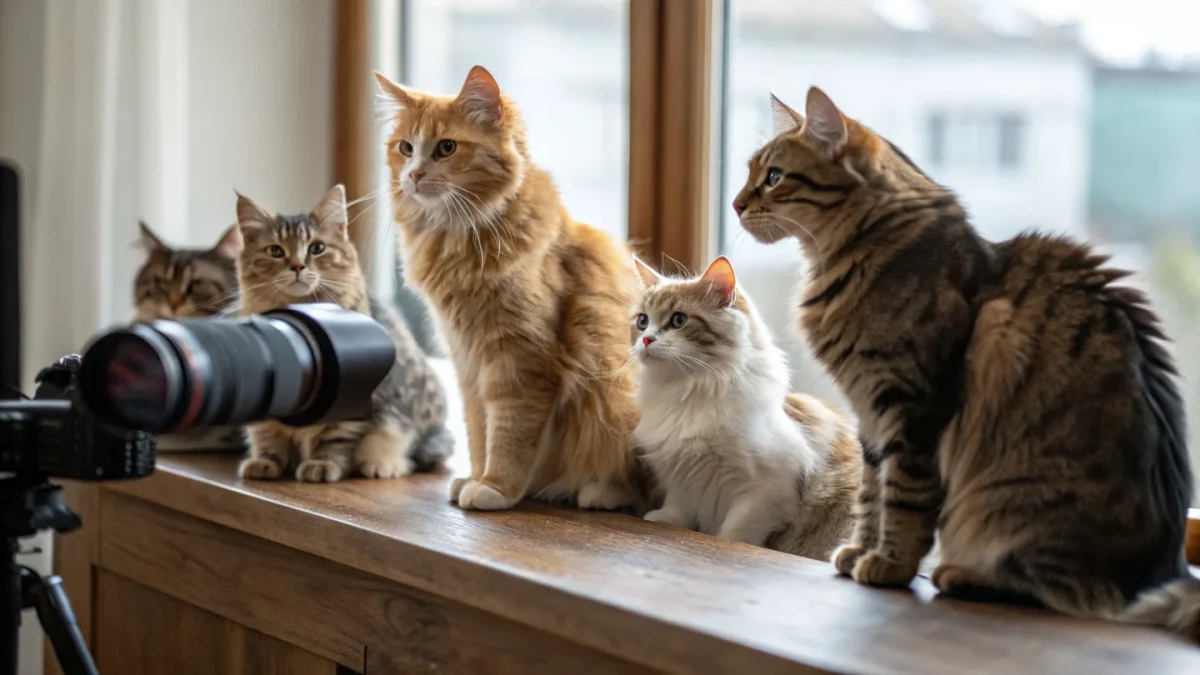
There are approximately 70-100 recognized cat breeds worldwide, depending on which registry you consult — a number that seems small compared to the 300-plus dog breeds but still represents meaningful variation in appearance, temperament, coat type, and health profile.
Unlike dog breed classification, which often follows working-group categories (herding, sporting, terrier, etc.), cat breed classification uses several overlapping systems simultaneously. Understanding these systems helps you navigate breed research and find what you're actually looking for. Once you have a category in mind, choosing the right cat breed covers the practical matching variables — energy, grooming, solitude tolerance — that should inform the final decision.
Coat-Based Categories
The most commonly used and immediately useful classification is coat type, which directly affects grooming requirements.
Longhaired Breeds
Cats with coats of 5 cm or more, requiring regular grooming to prevent matting. The quintessential examples: Persian, Maine Coon, Norwegian Forest Cat, Siberian, and Turkish Angora.
Within longhaired breeds, the texture matters: the Persian's dense, double coat mats more easily than the Maine Coon's layered, water-resistant coat or the Norwegian Forest Cat's similar weather-resistant structure. "Longhaired" as a category tells you to expect a brushing routine; the specific breed tells you how intensive.
Semi-Longhaired Breeds
A middle category covering breeds with flowing coats that are less prone to matting than full longhaired breeds: Ragdoll, Birman, Himalayan, Somali, Ragamuffin. Grooming is still important, but the time investment is generally less than for full longhaired breeds.
Shorthaired Breeds
The largest category by number of breeds. Includes everything from the British Shorthair's extremely dense plush coat to the Siamese's minimal, lying-flat coat to the Bengal's short, iridescent spotted fur. "Shorthaired" spans from almost-zero grooming to a weekly maintenance routine.
Rex (Curly) Coat Breeds
A specific sub-category caused by genetic mutations affecting hair shaft structure: Cornish Rex, Devon Rex, LaPerm, Selkirk Rex. The mutations are independent of each other — a Cornish Rex and Devon Rex crossed produce normal-coated kittens because their mutations are on different gene loci. Each rex mutation produces a different coat texture.
Hairless and Near-Hairless Breeds
Sphynx, Peterbald, Donskoy (also called Don Sphynx). Hairlessness in these breeds comes from different genetic mutations. The Sphynx's hairlessness traces to a recessive mutation in the KRT71 gene — the same gene behind the Devon Rex's curl, just a different allele, confirmed by a 2010 genetic study in Mammalian Genome. The Donskoy's hairlessness is a completely different, dominant mutation, first documented in a cat rescued in Rostov-on-Don in 1987; the Peterbald picked it up through Donskoy crosses a few years later.
Body Type Categories
Coat aside, cat registries classify body types on a spectrum from "cobby" to "foreign."
Cobby: Round, compact, heavily built. Persian, British Shorthair, Exotic Shorthair. Low to ground, broad head.
Semi-cobby: Slightly less compact but still substantial. American Shorthair, Burmese.
Semi-foreign: Intermediate build. Maine Coon, Norwegian Forest Cat, Abyssinian — longer limbs and body than cobby breeds but not extreme.
Foreign: Long, lean, fine-boned. Siamese, Oriental Shorthair, Russian Blue. Elegant and angular.
Oriental: Extreme foreign — very slender, long limbs, very long tail. Modern Siamese show cats are sometimes described in this way.
Origin-Based Classification
Natural breeds: Developed over centuries without deliberate human selection programs — the environment and local cat populations shaped them. Norwegian Forest Cat, Siberian, Turkish Angora, Maine Coon, Turkish Van. These tend to be robust, healthy breeds with broad genetic bases.
Developed breeds: Created through deliberate crossing programs with specific traits in mind. Ragdoll, Bengal, Tonkinese, Burmese (modern western type). More predictable in appearance and personality, sometimes with narrower genetic bases.
Mutation breeds: Founded on a specific spontaneous genetic mutation that was then selectively bred. Cornish Rex (rex mutation), Scottish Fold (ear fold mutation), Polydactyl/Hemingway cats (extra toes), Manx (taillessness). The mutation is the defining characteristic; other traits were introduced through outcrossing.
Genetic Trait Categories
Some breed distinctions cut across the coat and body classifications:
Colorpoint: Any breed expressing the point pattern (darker extremities from temperature-sensitive enzyme expression). Siamese, Himalayan, Birman, Ragdoll, Balinese — despite different registries and different body types, all share this genetic characteristic.
Ticked tabby: The agouti gene expression that creates the distinctive salt-and-pepper ticking of the Abyssinian and Somali. Each hair is banded rather than creating visible stripes.
Brachycephalic: Breeds selectively bred for compressed skull structure. Persian, Exotic Shorthair, Himalayan, Scottish Fold. Carries structural health implications.
Hybrid origins: Breeds created through domestic-wild cat crosses: Bengal (Asian leopard cat), Savannah (serval), Chausie (jungle cat).
Registry Differences
Major cat registries — including CFA, TICA, FIFe, and GCCF — don't all recognize the same breeds or use identical classification systems, and the gap can be sizable: CFA currently recognizes 45 breeds, while TICA recognizes around 71. A breed recognized in one registry may not be recognized in another — sometimes it's a straightforward miss, sometimes one registry folds a breed into an existing one's color division instead of giving it standalone status. This affects shows, titles, and the availability of registered kittens in different regions.
For the average cat owner rather than exhibitor, the registry classification matters less than the practical characteristics of the breed. The categories in this article are useful for navigation; the individual breed profiles tell you what life with a specific cat actually looks like. When two breeds from the same category seem equally suitable, comparing cat breeds head to head provides a structured framework for working through the tradeoffs.
FAQ
How many cat breeds are there?
Approximately 70-100 recognized breeds depending on the registry, with some breeds recognized by one major registry but not others. The number continues to evolve as new breeds are created and gain recognition.
Are natural breeds healthier than developed breeds?
Generally, breeds with broader genetic diversity and longer development history tend to have fewer breed-specific health issues. However, this is a generalization — some developed breeds are quite healthy, and some natural breeds have specific health predispositions. Individual genetics and responsible breeding practices matter.
What is a "landrace" cat?
A landrace cat is a population of cats that developed in geographic isolation over generations, developing consistent regional traits without formal breeding programs. The Turkish Van and Turkish Angora from the Lake Van region are examples. Different from purebred — the cats are genetically consistent due to geographic isolation, not deliberate selection.
Why do some breeds appear in multiple categories?
Because cat breed classification systems are overlapping rather than exclusive. A Ragdoll is semi-longhaired AND colorpoint AND developed breed — those categories don't conflict. Different classification systems serve different purposes.