

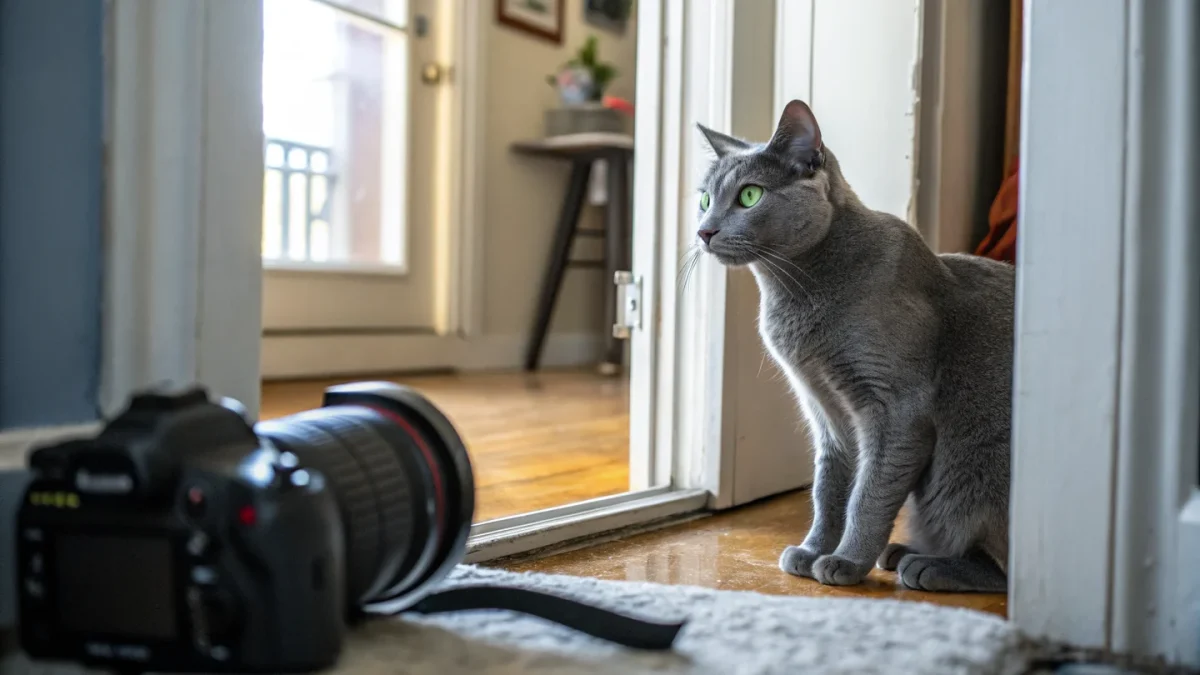
A Russian Blue at a cat show does not make the same impression the Sphynx makes. Where the Sphynx investigates every judge, handler, and spectator with cheerful persistence, the Russian Blue — if it's a typical specimen of the breed — watches from the back of its enclosure. Not anxiously. Just privately. A visitor who interprets this as shyness is correct, but only half-right. What they're seeing is also patience, and discernment, and a profound preference for quality over quantity in its social relationships.
Two Different Cats, Same Animal
The Russian Blue's temperament has two modes that look so different that owners sometimes wonder if they're seeing the same breed.
In public — at shows, with guests, in new environments — the Russian Blue retreats. It doesn't hide in the dramatic, fearful way a very anxious cat might. It simply creates distance, observes carefully, and waits for whatever is happening to be over or to prove itself worth engaging with. Most visitors will not be worth the Russian Blue's engagement. The cat reaches this conclusion quickly and efficiently.
At home, with its own people, the Russian Blue is a different creature. It will follow its person through the house — not with the insistent vocalization of a Siamese or the physical demands of a Sphynx, but with quiet, consistent companionship. It will be in whatever room you occupy. It will settle at the appropriate distance (chosen by the cat) and be present. The closeness tends to increase as trust deepens over time. A Russian Blue that has lived with the same person for several years is meaningfully more demonstrative than the same cat was in its first year.
Choosing Its People
The Russian Blue selects. This is perhaps its most defining behavioral trait.
Some Russian Blues attach to one person most intensely and extend more moderate affection to others in the household. Some attach more evenly to a small family group. The selection seems to involve assessment of temperament — Russian Blues tend to prefer quieter, more predictable people and are frequently reported to gravitate toward the least cat-focused person in a group of visitors, which is their way of identifying who is making the fewest social demands.
Once the selection is made, the cat is genuinely, consistently loyal. It is not a Russian Blue trait to withdraw from its inner circle. The shyness is directional: outward-facing toward the unfamiliar, inward-facing toward the trusted.
Intelligence and Routine
The Russian Blue is a notably intelligent breed, and its intelligence expresses itself primarily through pattern recognition. These cats learn their household's schedule with remarkable accuracy. They understand routines before they're established as such — a Russian Blue will often start appearing at the kitchen at the usual mealtime before the owner has consciously noticed they feed at the same time each day.
This intelligence also means they notice when patterns break. A change in schedule, a disruption to the household routine, a piece of furniture moved to an unexpected location — the Russian Blue observes these changes and reacts to them. Not with dramatic upset in most cases, but with visible concern and a period of reassessment. They need time with change.
Interactive toys that require problem-solving engage them well. Puzzle feeders suit the Russian Blue particularly well, combining the intellectual engagement it benefits from with the feeding schedule it tracks so carefully anyway.
Vocal Behavior
The Russian Blue is quiet. Not silent — it will communicate — but it uses its voice selectively and at relatively low volume. A soft chirp before meals. A questioning trill when investigating something new. An occasional gentle meow to indicate it wants attention.
The contrast with Siamese-type cats is stark. The Russian Blue's near-quiet makes it suited to apartments or households where continuous noise would be problematic.
Interestingly, some Russian Blues become more vocal with owners who respond to their vocalizations. The cat learns what gets attention and uses it accordingly — but the baseline volume is still well below many other breeds.
Play and Activity
The Russian Blue has moderate-to-active play drive, particularly in its first few years. Wand toys, solo play with rolling balls, and puzzle feeders all see genuine engagement. The breed doesn't have the constant-motion athleticism of a Bengal or Abyssinian, but it's not a sedentary cat either.
As the Russian Blue ages, its play drive mellows into something more considered — selective engagement with preferred toys, brief but enthusiastic sessions, and more time simply observing from a high point. The breed is a good climber and tends to prefer elevated resting positions.
One thing to note: Russian Blues often play alone competently and contentedly. They don't have the Sphynx's need for you to be involved in every game. This doesn't mean they don't benefit from interactive play — they do — but they handle solo entertainment better than many breeds.
With Other Pets
The Russian Blue's cautious nature means introductions to other animals should be managed slowly and respectfully. Rushed introductions into a multi-pet household can set back the process significantly.
With cats of compatible temperament — calm, not boisterous — Russian Blues can coexist comfortably and sometimes develop real companionship. Very high-energy breeds that won't accept the Russian Blue's need for personal space can be stressful for them — a Burmese cat, with its insistent social drive, makes a challenging housemate for a cat that values quiet on its own terms.
Dogs are possible but require careful matching. The Russian Blue needs confidence that the dog won't be intrusive or threatening, and this confidence takes time to establish.
The Temperament in Practice
Living with a Russian Blue means accepting its social terms. You cannot accelerate the trust-building. You cannot introduce it to strangers and expect sociability on demand. You cannot force proximity — a Russian Blue that doesn't want to sit in your lap won't, no matter how often you arrange it.
What you can do is be consistently present, predictable, and patient. A cat that chooses its person with genuine deliberateness, and then offers that person consistent, quiet, loyal companionship is a specific kind of reward. The complete Russian Blue breed guide covers the full picture of this breed — origins, coat care, health — but the temperament is the center of the Russian Blue experience.
For the right owner, the Russian Blue's reserve is not a problem to solve. It's the quality they were looking for.