

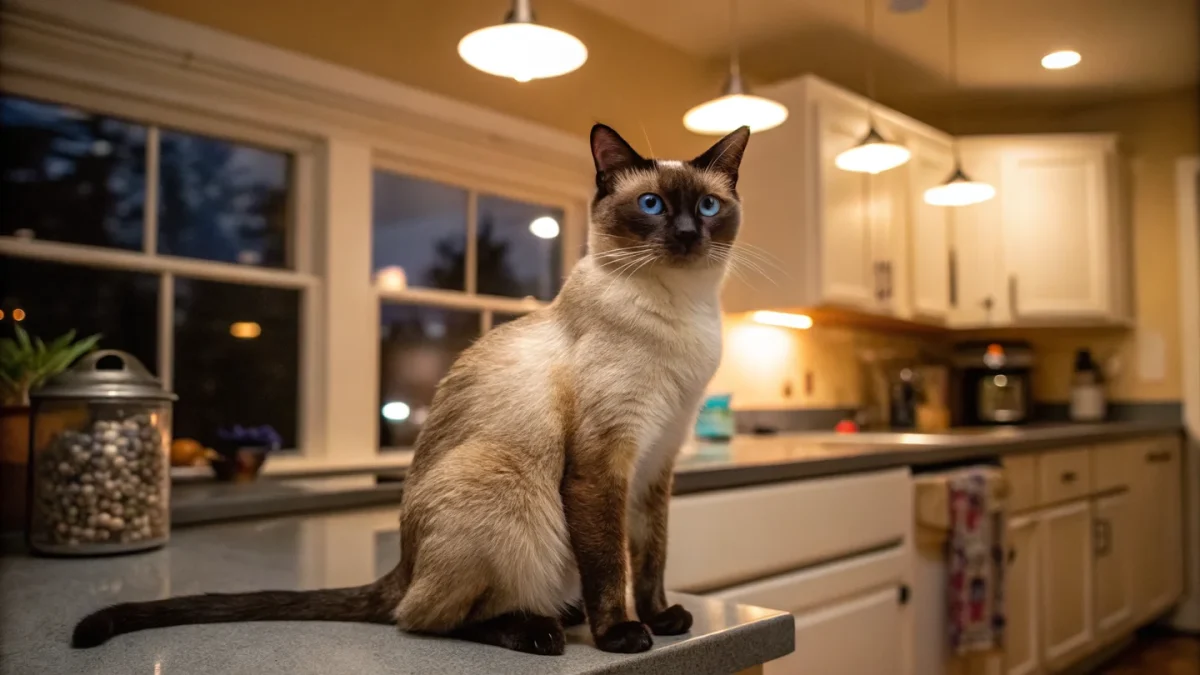
There is a specific moment that every Siamese owner recognizes: you are working at your desk, or cooking, or doing something completely ordinary, and your cat positions itself directly in your line of sight and delivers a single, decisive vocalization that makes absolutely clear it has opinions about your current activity. The Siamese does not lurk or silently supervise. It announces.
Understanding the Siamese temperament means understanding that these are not typical domestic cats that have simply learned to tolerate humans. They are cats that have developed, over centuries, a personality that runs parallel to human social structure in unusual ways. The vocalizations, the bonding intensity, the intelligence — all of it emerges from the same root: a cat that is genuinely oriented toward other beings.
The Voice: What the Talking Actually Means
The Siamese voice is famous and divisive. It is louder than most breeds, more varied in pitch and tone, and deployed with what can only be described as deliberate intent. People describe it as sounding like a baby crying, a demanding human, or a very opinionated commentator. All of these descriptions contain some truth.
What most owners come to recognize is that the vocalizations are not random noise. Siamese develop distinct calls for distinct situations. There is a particular sound for hunger — usually urgent and repeated — and a different one for wanting attention, which tends to be more conversational. There is a complaint sound for when their routine is disrupted, and a specific greeting vocalization for when their person comes home.
This is not a behavior that can be trained away or reduced through consistent responses. It is structural to the breed. A Siamese that stops vocalizing is often a Siamese that has become depressed or unwell — the silence, paradoxically, should concern you more than the noise.
The volume and persistence of the voice is calibrated somewhat by individual personality and by how responsive owners are. A Siamese that has learned that vocalizing at a particular pitch gets a specific result will use that sound reliably. They are, in this sense, training their owners just as much as owners train them.
Bonding: The Siamese Selects Its People
Siamese cats form strong bonds, but they are selective about it. Most Siamese have one or two primary people — the ones whose routines they track, whose moods they monitor, whose laps they prefer. With these people, a Siamese can be extraordinarily affectionate. With others, particularly strangers, they may be reserved or simply uninterested.
This selectivity is sometimes mistaken for aloofness or for aggressive temperament when a Siamese rebuffs an unfamiliar person. It is neither. It is preference. A Siamese that has decided you are its person is as attached as domestic cats get — which is to say, very.
The shadow behavior is worth describing specifically because it surprises people who expect cats to be more independent. A Siamese will follow its preferred person through the house, track their schedule, wait outside closed doors, and greet them at the entrance with what can only be called relief. This is not trained behavior. Kittens from good socialization environments arrive already wired this way.
Intelligence and the Problem of Boredom
The Siamese is considered one of the more intelligent domestic cat breeds, which is a genuinely double-edged quality. An intelligent cat that is properly stimulated is endlessly entertaining. An intelligent cat that is bored becomes a creative problem.
Siamese in understimulated environments learn to open handles, dismantle objects, scatter things for the satisfaction of watching them fall, and develop routines specifically designed to generate owner response — positive or otherwise. The underlying motivation is engagement, not malice. They want something to happen.
This intelligence makes them highly trainable relative to most cat breeds. Siamese can learn to walk on leash, respond to their name reliably, play fetch in a sustained way, and even learn simple cue sequences. The training relationship itself — structured interaction with clear feedback — engages them in a way that pure play doesn't always achieve.
Interactive puzzle feeders provide mental stimulation that matters. A food puzzle that takes ten minutes to solve does more cognitive work than ten minutes of passive eating and leaves a Siamese genuinely satisfied in a different way than simply filling its stomach.
What Most People Get Wrong About Siamese Temperament
The loudness is what most people predict. What catches them off guard is the emotional depth.
Siamese pick up on owner stress, illness, and emotional states with unusual sensitivity. Owners recovering from illness often report that their Siamese modified their behavior — staying closer, being less demanding, maintaining quiet proximity. Whether this is true empathy, learned association, or something else is genuinely uncertain, but the behavior itself is widely reported and consistent enough across owners to be worth noting.
The opposite is also true. A Siamese in a stressed household — loud arguments, disrupted routine, major change — often develops physical symptoms: gastrointestinal upset, over-grooming, behavioral changes. This is not fragility; it is responsiveness. They are wired to attend to the social environment, and that wiring means the environment affects them.
The other common misconception is that Siamese temperament makes them good apartment cats because they're small. They are manageable in apartments — but size is not the limiting factor. The limiting factor is activity and social engagement. A Siamese in a small apartment with a highly engaged owner who works from home can thrive. The same cat with an owner gone twelve hours a day in a large house will struggle.
The Siamese With Other Pets
Siamese are generally social with other cats. They often prefer feline company to solitude and commonly establish close bonds with a second cat — grooming partnerships, sleeping together, coordinated attention-seeking. The Oriental Shorthair, which shares Siamese genetics and an equally social temperament, is often cited as the most naturally compatible companion breed for a Siamese. This is not guaranteed with all individual Siamese or all pairings, but the breed's social orientation generally extends to other animals.
With dogs, Siamese adapt more variably. A confident Siamese with early dog exposure often becomes comfortable with calm or familiar dogs. An anxious Siamese or a very prey-driven dog creates obvious problems. Introductions should be managed carefully regardless of either animal's breed reputation.
Living With the Siamese Temperament
Living with a Siamese is different from living with most cats. It requires more active engagement, more noise tolerance, and a genuine interest in a relationship rather than a decorative companion. In exchange, the Siamese delivers something relatively rare in the cat world: a cat that knows you, tracks you, misses you, and has a genuine and persistent opinion about your life.
For the Siamese cat breed specifically, temperament is inseparable from the rest of the ownership experience. You do not get the striking appearance and the historic lineage without the talking, the following, the emotional intensity. They come as a package, and the personality is arguably the most defining feature.
Whether that package sounds like an extraordinary companion or an exhausting responsibility depends entirely on what you want from a cat. Both answers are legitimate.