

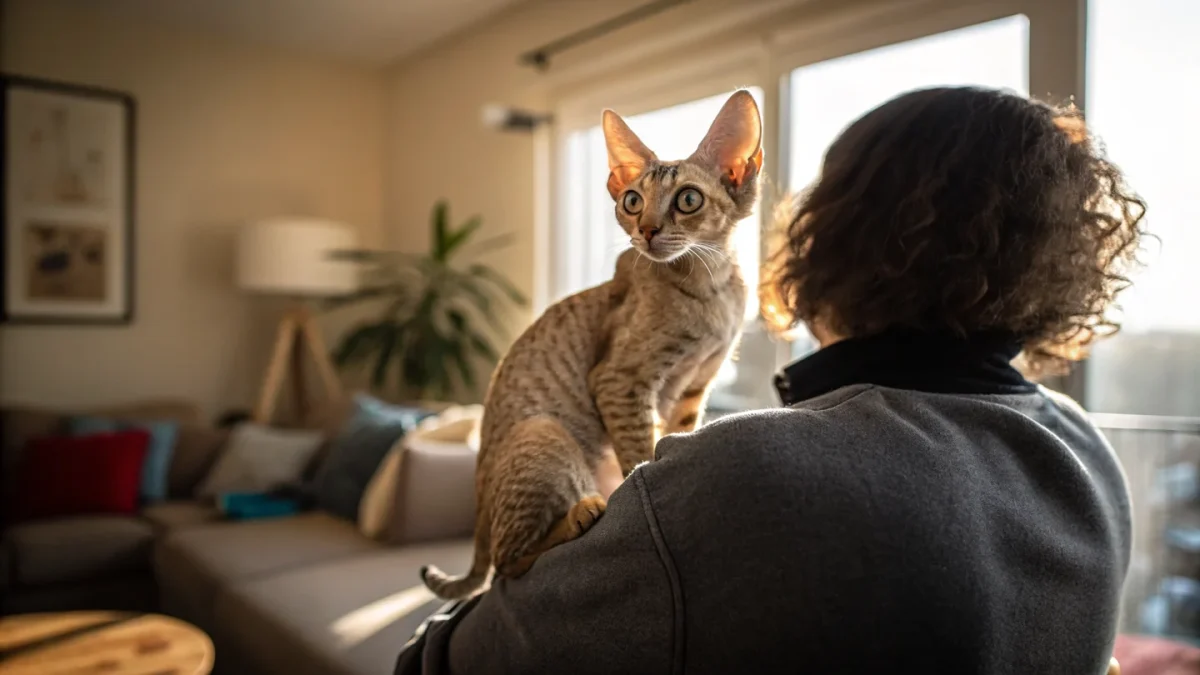
The Devon Rex earned the "part cat, part dog, part monkey" description somewhere along its brief history, and the accuracy is difficult to argue with. For a full introduction to the breed's origins and physical characteristics, the Devon Rex breed history and care essentials lays the foundation. This article is about what living with that personality actually involves — not just the charming highlights, but the full behavioral picture.
The Devon Rex temperament is genuinely unusual in the cat world. Most cats maintain some psychological distance from their humans, by choice rather than circumstance. The Devon Rex apparently never received this memo.
The Dog-Like Quality: What It Actually Means
When Devon Rex owners say their cats act like dogs, they're describing something specific: the consistent, reliable orientation toward human activity.
Most cats will follow their people to some rooms some of the time. Devon Rex cats follow their people to all rooms nearly all of the time. Bathroom trips, kitchen excursions, work sessions, exercise — the Devon Rex considers itself invited to all of it and participates accordingly. This isn't separation anxiety in the clinical sense; it's the baseline expression of a breed that simply doesn't experience solitude as neutral. For them, wherever their person is, that's where things are happening.
The greeting behavior reinforces this. Devon Rex cats greet arrivals at the door — reliably, with the kind of enthusiasm that in a dog would involve tail-wagging. They recognize the sounds of their owner's return (a specific car, a key in a specific lock, a footstep pattern on stairs) and are at the door before it opens. This sounds like anecdote; Devon Rex owners will tell you it's pattern.
Fetch is perhaps the most concentrated expression of the dog-like quality. Many Devon Rex cats carry toys to their people, drop them, and wait — repeatedly — expecting the toy to be thrown. This behavior isn't trained. It emerges spontaneously in enough individuals that it's considered a breed characteristic rather than an unusual individual trait. Some Devon Rex are more consistent fetchers than many dogs.
Intelligence and Problem-Solving
The Devon Rex's intelligence is the context for both its best and most frustrating qualities.
On the positive side: they learn quickly. Their own names are recognized early. They understand the patterns of household life — feeding schedules, owner schedules, which sounds precede which events — and respond to them. They're responsive to their owner's emotional state in a way that feels attentive rather than coincidental.
On the complicating side: intelligent cats with high activity drives and no sufficient outlet are creative in their entertainment. Devon Rex cats that are bored will find activities. Cabinets get opened. Food gets investigated from unconventional angles. Items get relocated. The specific content of their self-directed entertainment is difficult to predict and often involves at least mild inconvenience to the owner.
The solution is engagement, not restriction. Puzzle feeders occupy their problem-solving drive productively. Rotating toys maintain novelty. Play sessions that genuinely tire them out (hard to achieve, but possible with sustained wand toy play) create the mental satisfaction that empty house exploration doesn't.
Social Intensity and Bonding
Devon Rex cats bond to their families as a group but often identify a primary person with particular clarity — usually the one who feeds them, plays with them most, or simply spends the most time at home. The primary bond is intense: shoulder-riding, chest-sleeping, and sustained physical proximity throughout the day.
This attachment is not passive seeking-of-warmth. Devon Rex cats actively initiate interaction — they'll bring toys, demand attention with a chirp or a gentle paw-tap, and position themselves in the physical center of whatever their person is doing. Reading a book: the cat sits on it. Writing: the cat investigates the pen. Watching television: the cat sits between the viewer and the screen, then relocates to the lap.
It reads as demanding to people who didn't expect it. For people who wanted an interactive cat and found most cats insufficiently interactive, it's precisely what they were looking for.
The social drive extends beyond the primary person. Devon Rex cats are generally good with strangers — more curious and engaged than cautious — and with children. Their tolerance for handling is above average for cats, partly because they were handled extensively as kittens (early socialization in this breed makes a measurable difference) and partly because the breed's baseline disposition runs toward engagement rather than avoidance.
The Mischief Quotient
Devon Rex owners regularly describe their cats as "troublemakers" with the warmth of a parent describing a particularly creative child. The mischief is real, but it's worth understanding its source: curiosity combined with intelligence combined with high drive.
A Devon Rex that opens kitchen cabinets isn't being malicious. It's investigating a previously closed space with the same methodical interest it brings to everything else. A Devon Rex that steals food from a plate isn't being disrespectful. It's responding to a highly interesting stimulus (food smell, close proximity) with its natural behavior pattern (investigate and acquire).
The approach that works is management plus enrichment. Cabinet latches prevent the cabinet-opening. Feeding the cat before human meals reduces food theft attempts. Puzzle feeders redirect the investigation drive toward an appropriate target. None of these require correction of behavior that isn't really bad behavior — they're environmental adjustments that align the cat's natural tendencies with the owner's preferences.
Energy Level Through Life Stages
Devon Rex kittens are chaotic in a way that is delightful to the prepared and alarming to the unprepared. The energy, the leaping, the climbing, the play solicitation — all of it is concentrated in the 6-month to 2-year period. This is not the time to own this breed if you want peace in your home.
Adult Devon Rex (2-7 years) settle into a more manageable rhythm — still active, still interactive, still prone to mischief — but with greater capacity for rest periods and less all-consuming play drive. The ceiling comes down; the floor stays largely the same.
Senior Devon Rex (8+ years) slow down genuinely, and many owners find that this is when the lap-cat quality becomes most prominent. The cat that spent its prime years agitating for play will often spend its senior years providing warm, purring companionship with considerable generosity.
What the Devon Rex Needs From a Household
Time. This is the non-negotiable. A Devon Rex left alone for 9-10 hours regularly, with no companion animal, will not be a happy cat. The behavior problems that develop — excessive vocalization, destructive behavior, stress grooming — are predictable and preventable.
A companion animal. Two Devon Rex cats together is common advice for a reason. A second cat of comparable energy level covers the social gap during working hours in a way that enrichment alone doesn't. The Cornish Rex is a natural pairing — different gene mutation, similar play drive and social energy.
Daily active play. Not occasional play. Daily, sustained play that genuinely engages the prey drive — wand toys that mimic bird or mouse movement, interactive feeders, fetch if the individual takes to it.
Warm sleeping spaces. The sparse coat isn't just aesthetically distinctive; it's functionally minimal insulation. Devon Rex cats seek warm spots with urgency. Heated cat beds, blankets, sleeping access to warm humans — these matter more for this breed than for most.
Tolerance for chaos. Some. The Devon Rex household where the countertops are immaculate and no objects are ever moved is not a realistic Devon Rex household. Some reorganization of space to accommodate a curious, agile cat is the practical commitment.
The Right Kind of Relationship
What the Devon Rex temperament amounts to is a cat that wants a partnership. Not a cat that shares space with a human but a cat that participates in human life — in the specific, active, relentless way that the breed's personality makes possible.
For the right owner, this is extraordinary. The Devon Rex is the cat that learns your schedule, anticipates your moods, greets your guests with curiosity rather than retreat, plays fetch on a Saturday morning, and spends the evenings purring on your chest with an apparent contentment that's genuine rather than performative.
The breed that most reliably delivers that particular experience is the Devon Rex.