

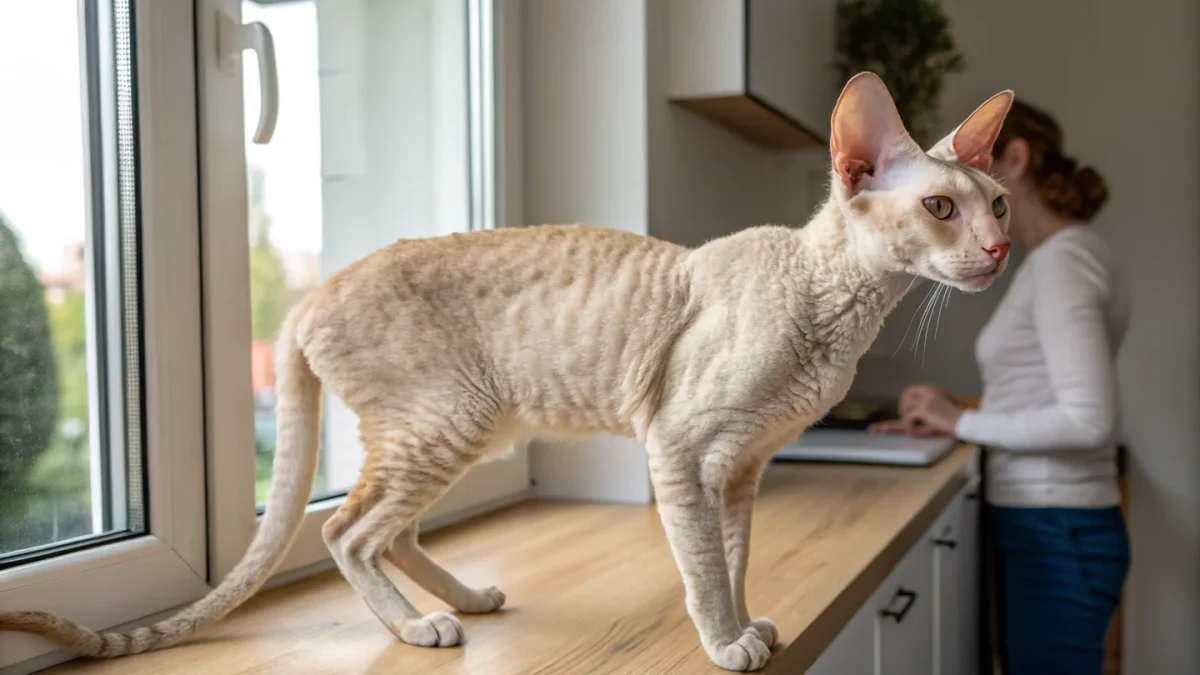
In the summer of 1950, a farm cat named Serena delivered a litter of kittens in a barn in Cornwall, England. One of them, a cream-colored male named Kallibunker, looked different from the moment he opened his eyes — not just his unusually large ears and alien-slender body, but his coat. Where his siblings had normal fur, Kallibunker had tight, uniform waves that rippled across his entire body. His owner, Nina Ennismore, recognized she was looking at something genuinely new, and wrote to a geneticist for guidance. That single kitten became the foundation of the entire Cornish Rex breed.
The Cornish Rex is no ordinary cat. They're what you'd get if someone crossed a racing greyhound with a circus performer and then gave the result opinions about everything you're doing. If that sounds like a lot — it can be. But for the right person, there is no more engaging or devoted companion in the cat world.
What Makes the Cornish Rex Unique
The signature wavy coat comes from a recessive genetic mutation affecting all three hair types in the normal cat coat — the outer guard hairs are either absent or significantly reduced, leaving only the soft, crimped down coat. The result is a coat that feels remarkably like velvet or warm suede against your hand. It's also shorter and less insulating than most cats' coats, which partly explains why Cornish Rex cats are notorious heat-seekers.
Physically, the breed is built on extremes. Their skull is oval-shaped with a distinctively curved Roman profile. Their ears are enormous relative to head size. Their legs are long and whippet-lean. They carry almost no body fat — a healthy adult Cornish Rex feels lighter than you expect when you pick one up. They move with a quick, arched-back gallop that gives them an immediately recognizable silhouette.
The coat appears in virtually every color and pattern recognized in domestic cats: solid, tabby, bicolor, tortoiseshell, and pointed variations all occur. Breeders have worked to establish a wide genetic base following the early years of close breeding that were necessary to establish the recessive trait.
Temperament: The Athlete Who Lives Inside
What most people get wrong about the Cornish Rex is assuming the wavy coat is the defining feature. It's not. The defining feature is the personality — one of the most demanding, entertaining, and relentlessly engaged temperaments in the entire cat world.
Cornish Rex cats are active well past the age when most breeds settle into dignified adulthood. A five-year-old Cornish Rex will still knock things off your desk to see what happens. They will retrieve toys. They will learn to open cabinet doors. They will follow you from room to room and vocalize strong opinions about closed doors. Their intelligence is quick and practical, not abstract — they solve real problems they find interesting, like how to extract a treat from a puzzle feeder or how to open the particular type of latch on the treat cabinet.
The attachment style runs deep. This is a breed that bonds intensely with its people, sometimes showing a preference for one person while remaining friendly with others. They are not lap cats in the passive sense — they don't drape contentedly across your lap while you work. They are participants. They want to be involved in what you're doing, positioned at the center of activity, contributing their commentary.
With other pets, Cornish Rex generally integrate well, particularly if introduced thoughtfully. Their high activity level makes them good matches for similarly energetic cats or sociable dogs. They are not suited to being left alone for long stretches; a second cat is often genuinely beneficial for their wellbeing.
Children who can match their energy and handle an active cat respectfully tend to get along extremely well with Cornish Rex. The breed is not fragile, but their slight build means rough handling is a real concern with very young children.
The Wavy Coat: Care and Considerations
Here's something that surprises people: the Cornish Rex coat doesn't require extensive grooming, but it does require some thought. The waves can become oily over time because the reduced coat doesn't distribute skin oils the way a standard coat does. Most Cornish Rex benefit from occasional baths — more frequently than most breeds — to keep the coat looking its best and to manage oil buildup.
The coat is also less protective than a typical cat's coat. Cornish Rex cats feel the cold more acutely than most and will actively seek warmth: heating vents, radiators, your laptop, the sun patch on the floor, and more specifically, you. This heat-seeking behavior is one of the breed's endearing traits but means the cat genuinely shouldn't be left in cold environments.
Shedding is minimal compared to most cats. The lack of guard hairs means far less loose hair on furniture, which some owners assume makes the breed better for allergy sufferers. This is not accurate — the primary cat allergen, Fel d 1, is a protein found in cat saliva and skin secretions, not in the fur itself.
History: From Cornwall to Cat Shows
Following Kallibunker's discovery, geneticist A.C. Jude and breeder Brian Stirling-Webb worked to establish the breed through outcrossing with domestic shorthairs and several other breeds, including the Burmese. The initial gene pool was necessarily small, and early breeders worked carefully to maintain genetic diversity while fixing the rex mutation.
The breed came to North America in the early 1960s — CFA accepted it for registration in 1962 and advanced it to championship status in 1964. Around the same time, the Devon Rex — a separate mutation discovered in Devon just years later — had emerged in England, looking superficially similar but carrying a completely different genetic mutation, making the two breeds genetically distinct.
By the 1970s and 1980s, the breed had gained a devoted following, particularly among people who appreciated the unusual look combined with the highly social personality. The Cornish Rex remains a moderately popular breed rather than a mass-market one — they tend to find their way to owners who specifically seek them out rather than stumbling into homes by chance.
What the Cornish Rex Needs
Activity and stimulation: This breed demands interactive play at least once daily. Wand toys, fetch games, food puzzles, and training sessions (yes, they can learn tricks) are all appropriate outlets. A bored Cornish Rex will find their own entertainment, which may not align with your preferences.
Company: They don't do well as only pets in a home where no one is present for eight or more hours a day. A second cat, particularly a similarly active one, improves their quality of life considerably.
Warmth: Sunlit rooms, heated beds, blankets, and a warm lap are not luxuries for this breed — they are necessities.
Bathing: Plan for an occasional bath, perhaps every four to six weeks, to manage coat oils. Cats introduced to baths gradually as kittens adapt readily. Adults introduced to baths suddenly do not.
The Right Owner for a Cornish Rex
Be honest about what you want from a cat before committing to a Cornish Rex. If your vision involves a serene creature who decorates your home gracefully and asks for little beyond food and an occasional scratch, this is not your breed. The Cornish Rex will be in your business, on your keyboard, vocalizing at 6 a.m., and reorganizing your priorities around their activity schedule.
The ideal Cornish Rex owner actively enjoys an interactive, expressive, ever-present companion. They have time for daily play, don't mind occasional baths, live in a warm enough environment, and won't resent the fact that their cat will absolutely attempt to steal their breakfast. They probably have more than one cat or work from home. They find the relentless personality charming rather than exhausting.
Get this right and the Cornish Rex will be one of the most genuinely engaging animals you've ever shared your life with. Get it wrong and you'll spend five years in a low-grade standoff with a very determined, very waggy-coated creature who is absolutely winning.
FAQ
Do Cornish Rex cats shed a lot?
No — their reduced coat means minimal shedding compared to most breeds. Furniture will accumulate significantly less cat hair. However, they do require occasional bathing to manage coat oil buildup, which sheds more or less balances out in terms of maintenance effort.
Are Cornish Rex cats good for allergy sufferers?
Not necessarily. The common assumption is that less fur means fewer allergens, but the primary cat allergen (Fel d 1 protein) is produced in skin secretions and saliva, not in the coat itself. Some individuals with cat allergies may tolerate a Cornish Rex better, but there are no guarantees.
How long do Cornish Rex cats live?
The Cornish Rex is generally a long-lived breed. Lifespans of 12 to 16 years are typical, with some individuals reaching their late teens. Their lean build and active metabolism tend to support good health longevity, though like all breeds, they have some specific predispositions worth knowing about — hypertrophic cardiomyopathy and patellar luxation are the two documented most often, which is why breeding cats should get a cardiac screening before anyone puts them in a breeding program.
Can Cornish Rex cats go outside?
They can, but the breed's reduced coat, slight build, and fearless personality create real safety concerns outdoors. Most experienced Cornish Rex owners keep them as indoor-only cats, supplemented by supervised outdoor access (such as a catio or harness walks) where possible.