

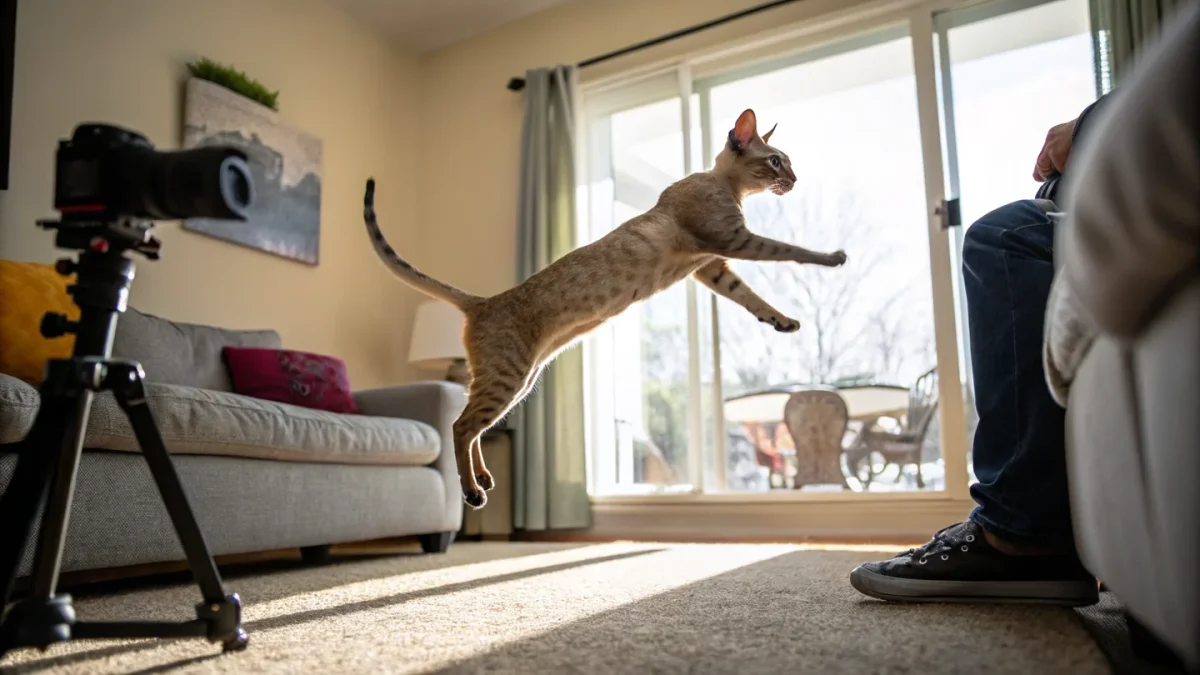
There's a phrase in the Cornish Rex community: "they never grow up." Said with affection by some, mild exasperation by others, it captures something genuinely true about the breed's personality. Most cats gradually transition from kitten chaos to adult serenity somewhere around age two or three. The Cornish Rex acknowledges this life milestone and elects to ignore it.
The breed's character is inseparable from its athletic build. That long-legged, wavy-coated body isn't just unusual looking — it's built for movement, and the Cornish Rex uses it constantly. Understanding the temperament means understanding the body, because the two are the same thing: perpetual motion with strong opinions.
For a complete Cornish Rex breed overview, including coat care and history, the breed guide covers the full picture. This article focuses specifically on the personality and what life with this breed actually looks like day-to-day.
The Social Contract
Cornish Rex cats are not independent. This needs to be said clearly before anything else, because it is the most important thing to understand about them. They require company — human company, another cat's company, or ideally both.
The breed was shaped partly by the genetics of its early outcrossing program, which included Burmese cats known for their people-focused temperament. The Devon Rex temperament — a similar social intensity from a different mutation — is worth comparing directly, as the two breeds are frequently confused but have measurably different personalities despite the superficial coat resemblance. Whether or not that's the direct cause, the result is a cat that tracks your movements through the house, positions itself at the center of activity, and treats closed doors as small personal betrayals.
This attachment shows up in specific behaviors: following you room to room, greeting you at the door, inserting themselves into conversations (they will position themselves between you and anyone you're talking to, apparently believing their contribution is needed), and sleeping pressed against you at night. It is warm and sometimes hilarious and can occasionally feel suffocating if you value a cat that maintains a respectful physical distance.
Active Intelligence
The Cornish Rex sits among the more intelligent domestic cat breeds, and their intelligence is practical rather than abstract. They figure things out in service of what they want. This means learning to open lever-style door handles, identifying which drawer the treats are in, understanding which person in the household is most likely to feed them early if woken at 5 a.m., and retaining this information reliably.
They are among the more trainable cat breeds. Many Cornish Rex owners teach them to retrieve small toys — the cat will bring the toy back, drop it at your feet, and look at you expectantly. Some learn a handful of verbal cues. The training works best with food motivation and kept in short, playful sessions. Extended training that becomes repetitive quickly loses their interest.
The flip side of this intelligence is that a bored Cornish Rex invents its own activities. Countertop exploration. Reorganizing items near the edge of shelves. Investigating any bag or box left unattended. Opening cabinet doors. The breed requires enrichment not as a luxury but as basic maintenance.
Energy Levels and Play
Play drive in the Cornish Rex runs high, and it doesn't diminish predictably with age the way it does in most breeds. A two-year-old and a seven-year-old Cornish Rex may look quite similar in terms of activity — both will respond enthusiastically to a wand toy. Both will find their own entertainment if none is provided.
Interactive play works better than leaving toys out. The breed particularly enjoys anything that moves unpredictably: feather wands, da Bird style toys, small crinkle balls they can carry and drop. Many enjoy fetch. The key is unpredictable movement — they will quickly lose interest in a toy that just sits there, no matter how expensive.
An adult Cornish Rex needs at least one good interactive play session daily. Two shorter ones is better. Without this outlet, excess energy tends to redirect toward attention-seeking behaviors: vocalization, knocking things over, 3 a.m. zoomies through the bedroom.
What Most People Get Wrong About the Cornish Rex Temperament
The assumption is usually that this is a "demanding" breed in a negative sense — requiring constant management. That framing misses the point. The Cornish Rex is not demanding in the way a difficult child is demanding. They're engaging in the way a clever, affectionate, always-up-for-something friend is engaging.
The people who find the temperament overwhelming tend to have expected a more typical cat experience: an animal that appreciates attention on its own schedule, retreats to quiet corners, and requires relatively little from you. The Cornish Rex simply does not operate this way.
The people who love the temperament have usually stopped thinking of the cat as a background presence in their home and started thinking of them as an active participant in the household. The expectations match the reality.
With Other Animals and Children
Cornish Rex generally integrate well in multi-pet households. Their social drive means another cat's company is genuinely beneficial — the two breeds that tend to work best as companions are similarly active breeds or relaxed sociable cats who won't be overwhelmed by the Rex's energy. Very territorial or shy cats sometimes find a Cornish Rex's persistent friendliness stressful.
With dogs, the relevant variable is the dog's temperament rather than the cat's. A Cornish Rex will often approach a dog with interest, not fear. Whether that goes well depends entirely on the dog.
Children who respect animals and match the cat's energy level typically get along very well with Cornish Rex. The caveat is the breed's slight build — they are not as physically robust as, say, a Maine Coon or British Shorthair, and handling by very young children needs supervision.
FAQ
Are Cornish Rex cats good for people who work long hours?
They're one of the worse choices for owners who are away from home for eight or more hours daily. The breed's social needs are real, and extended solitude leads to stress behaviors. If your schedule involves long work days, either adopting two cats together or choosing a less people-dependent breed makes more sense.
Do Cornish Rex cats meow a lot?
More than average. They're not as persistently vocal as Siamese or Oriental Shorthairs, but they communicate clearly and will tell you when they're hungry, bored, or have opinions about something you're doing. Some individuals are quieter than others, but a silent Cornish Rex is unusual.
At what age does a Cornish Rex calm down?
"Calm down" is perhaps too optimistic a phrase. Most mature slightly between ages three and five, meaning they may wait until 6 a.m. rather than 4 a.m. before demanding breakfast. The fundamental personality — active, social, engaged — doesn't change substantially. This is a breed whose personality remains consistent for its entire life.