

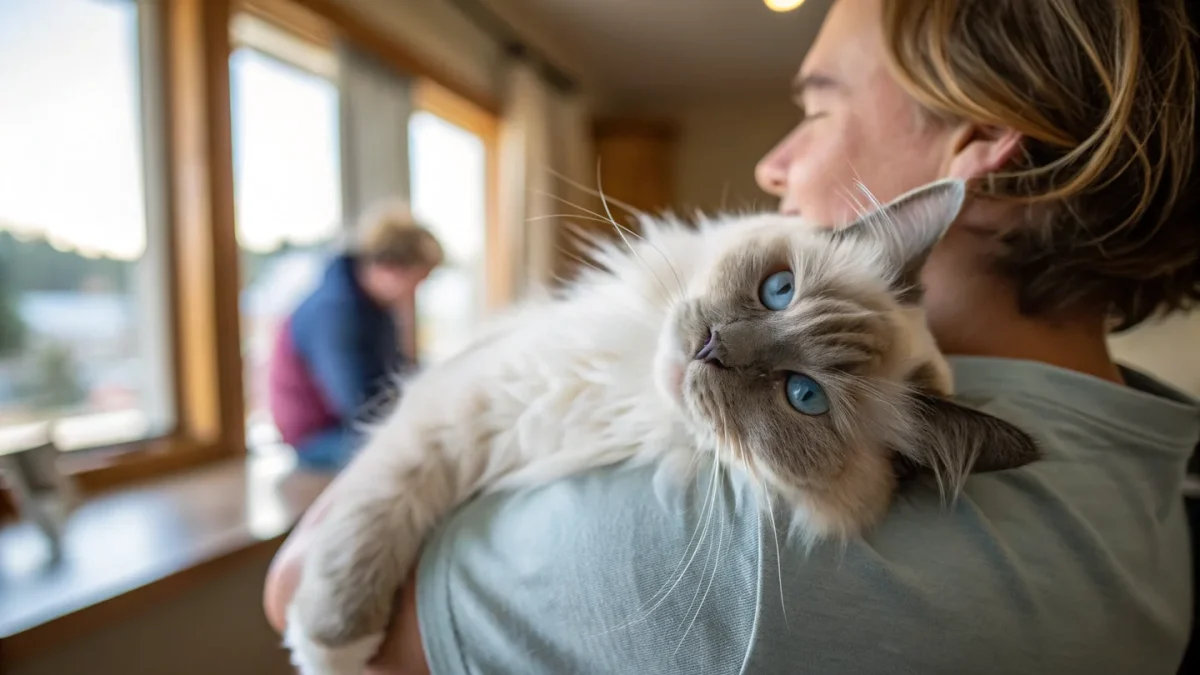
Pick up a relaxed Ragdoll and the cat will reorganize itself in your arms — not tense up the way most cats do, not struggle for purchase the way a cat that doesn't want to be held does. It genuinely softens. The limbs hang loose, the head drops, and for a moment you're holding what feels like a very warm, very large, very content bag of sand.
This trait — the thing that gave the breed its name — is consistently one of the most surprising things first-time Ragdoll owners experience. Most people intellectually know the breed is meant to be calm, but knowing and feeling a 15-pound cat go completely limp in your arms are different things.
The full breed profile is covered in the complete Ragdoll breed guide. Here I want to focus specifically on the temperament question: what's actually happening, what it means for daily life, and the realistic nuances that get lost in the breed's reputation.
What's Actually Happening When They Go Limp
Ann Baker, the Ragdoll's creator, claimed the trait was caused by genetic changes from a car accident. That's mythology. The real explanation is considerably more interesting from a genetics standpoint.
Docility — the tendency toward low reactive aggression and relaxed muscle tone in handling — is a heritable trait in domestic cats. Research on feline breed differences in heritable behavior traits, published in PLOS ONE in 2019, found moderate heritability estimates (0.4 to 0.53) for seven behavioral traits in a study that included Ragdolls, confirming that temperament characteristics are meaningfully genetic rather than purely environmental. Baker appears to have observed this trait in Josephine's line and consistently selected for it in subsequent generations. That sustained selection for docility is the most plausible explanation for the trait's consistency across the breed.
The limpness itself is a physical expression of low muscle tension under conditions the cat perceives as safe. A well-socialized Ragdoll held by someone it trusts relaxes its postural muscles in a way most cats don't. This is unusual enough to be immediately noticeable but physiologically straightforward.
Not every Ragdoll does it equally dramatically. Individual variation matters, and socialization influences how much any particular cat expresses the trait. A Ragdoll that wasn't handled frequently as a kitten is less likely to perform the signature limpness than one that grew up being regularly picked up by multiple people.
Gentleness as a Character Trait
The limpness is a surface expression of a deeper temperament quality: genuine, heritable gentleness. Ragdolls are slow to aggress, slow to escalate conflict, and — crucially — tend to withdraw from uncomfortable situations rather than defend their position.
This is meaningfully different from just "doesn't scratch." A lot of cats don't scratch because they've learned scratching has bad consequences. Ragdolls tend not to scratch because their default response to an uncomfortable situation is "leave," not "defend." The difference is visible in how they carry themselves: there's less coiled watchfulness, less startle, less reactive edge.
This makes them one of the genuinely safest breeds in households with children, other animals, or simply a lot of people moving through. The risk of an unexpected scratch is lower with a Ragdoll than with most breeds.
Day-to-Day Social Behavior
Ragdolls are people-oriented without being people-dependent. They want to be near you — and they usually are near you, following from room to room with mild curiosity — but they don't develop the kind of separation anxiety that makes some highly social breeds genuinely difficult to own. This gentle, companion-oriented quality is something they share with the Birman cat, which also contributed to the Ragdoll's foundational genetics and carries a similar calm disposition.
They're quiet. Ragdolls vocalize with soft, chirp-like sounds and occasional gentle meows. They're not silent, but they're not noisy cats. This is one of the reasons they're particularly good apartment cats.
They're floor-level cats more than vertical cats. Unlike Maine Coons or Bengals, which are climbers, Ragdolls tend to settle on mid-level furniture and floors. They'll use a cat tree if you provide one, but they're not climbing to the ceiling — they'd rather be on the same level as the people in the room.
They play, but with a lower frenetic energy than high-activity breeds. A Ragdoll kitten is playful and charming; a 3-year-old Ragdoll will still chase a toy with interest, but the sessions are calmer and shorter. They're not going to tear up the house when bored, and they're not going to demand entertainment with frantic behavior.
With Children
Ragdolls are excellent family cats, and this is one area where the reputation is genuinely accurate. The combination of size (big enough to tolerate energetic handling better than a small cat), gentleness, and the tendency to exit rather than retaliate makes them among the most child-compatible breeds available.
Children can pick them up — and they'll go limp, which children find endlessly delightful. Children can pet them with the enthusiasm of children, and Ragdolls accept it with more patience than most cats. They'll walk away when they've had enough, but the threshold is high.
Age still matters. Toddlers who haven't learned to read feline body language or moderate their handling should be supervised with any cat. A Ragdoll will tolerate more before reacting, but "more" still has a limit. Teaching children how to interact with cats — how to approach, how to handle, how to recognize when the cat wants to leave — produces better outcomes than relying entirely on the breed's patience.
With Other Pets
Ragdolls are among the better breeds for multi-pet households. They're non-aggressive with other cats and typically tolerant of calm dogs. Their low defensive edge means they don't escalate situations that a more territorial cat might turn into conflicts.
The relationship works best when the other animals have compatible energy levels. A Ragdoll and another calm cat — another Ragdoll, a British Shorthair, an older settled cat — will often become genuine companions. A Ragdoll and a high-energy kitten is more work: the Ragdoll will engage up to a point and then retreat when it's had enough.
Dogs depend on temperament and prior socialization. A dog that reliably respects cats, that was socialized with cats as a puppy, will get along fine with a Ragdoll. A prey-driven dog or one that doesn't understand cat signals is a different story.
What "Calm" Doesn't Mean
Ragdolls aren't passive. They have preferences, and they express them — they'll let you know when they want something, when they're not comfortable with something, when they're ready for attention. The difference from a more reactive breed is how they express it: more politely, more quietly, with less dramatic escalation.
They also aren't incapable of play or energy. Ragdolls caught in a full play mood — particularly kittens — are active, engaged, and acrobatic. The baseline is calm; but pushed with a feather toy, they reveal the cat beneath the dignified exterior.
And they're not independent. Calm is not the same as self-sufficient. Ragdolls need consistent human presence, regular social engagement, and ideally a companion (feline or human) for the hours the household is empty. Left completely alone for extended periods regularly, they become lethargic and, in some cases, visibly sad in a way that's hard to miss.
Matching Temperament to Lifestyle
The Ragdoll temperament is a remarkable thing when it's in the right setting: a calm, quiet home with consistent people, enough presence to keep the cat company, and the kind of gentle daily interaction that suits both a person who wants a lap cat and a cat that genuinely wants to be in laps.
Where it becomes a mismatch: in households that are genuinely chaotic, that are empty for 10+ hours daily without a companion animal, or with owners who want the engagement and interactive energy of a more active breed. The Ragdoll's gentleness is also its limitation — it's not a cat that thrives on stimulation, novelty, and variety. It thrives on consistency, warmth, and safety.
Get those conditions right and you'll have a cat that seems impossibly well-suited to human domestication.