

Every breed has a creation myth, but the Birman's is among the most elaborately beautiful in the cat fancy. White cats with sapphire eyes, a dying priest, a golden goddess, and a miraculous transformation — the story of the "Sacred Cat of Burma" has been told so many times and in so many versions that it feels like something that must be true. But here is the honest reality that separates Marco's job from the storyteller's: the legend is mythology. What we actually know about the Birman's origins begins in France in the 1920s, not in a Burmese temple.
That doesn't diminish the Birman as a breed. What these cats are — as living companions, as animals with a specific physical type and a recognizable personality — is completely independent of whether a goddess touched their paws in ancient Burma.
Origins: What Legend Says, What History Shows
The legend, briefly: In ancient Burma, white temple cats with golden eyes served as guardians at the temple of Lao-Tsun. When the head priest Mun-Ha died during a raid, his cat Sinh placed its paws on the priest's body, and through the goddess Tsun-Kyan-Kse, was transformed — the cat's fur turned golden, its eyes became sapphire, and its white paws where they touched the priest remained eternally pure. The other temple cats transformed similarly. This, the legend says, is the origin of the Birman.
The documented history is more modest. The first Birmans on record appeared in France around 1919-1920. Early cat-fancy archives name a foundation female — Poupée de Maldapour, born in Nice around 1920 — and a stud, Dieu d'Arakan, who became something of a type standard after a 1930 photograph. The exact chronology shifts a little depending on which archive you check, which tracks with the era: consistent contemporaneous registration wasn't standard practice yet. The precise origin of these cats before they arrived in France is not established. The claim that they were brought from Burma by a Western adventurer or colonialist has been repeated widely but lacks corroborated historical documentation.
The breed was nearly annihilated during World War II — by most accounts, only one breeding pair survived in France. The breed was reconstructed in the postwar period through deliberate outcrossing to Persians and Siamese, and by the early 1950s pure Birman litters were being produced again, before the breed was reestablished to its current type.
Formal recognition in France came in 1925, before the war disrupted everything. British recognition followed in the 1960s, and North American registries accepted the breed during the same era.
Physical Characteristics
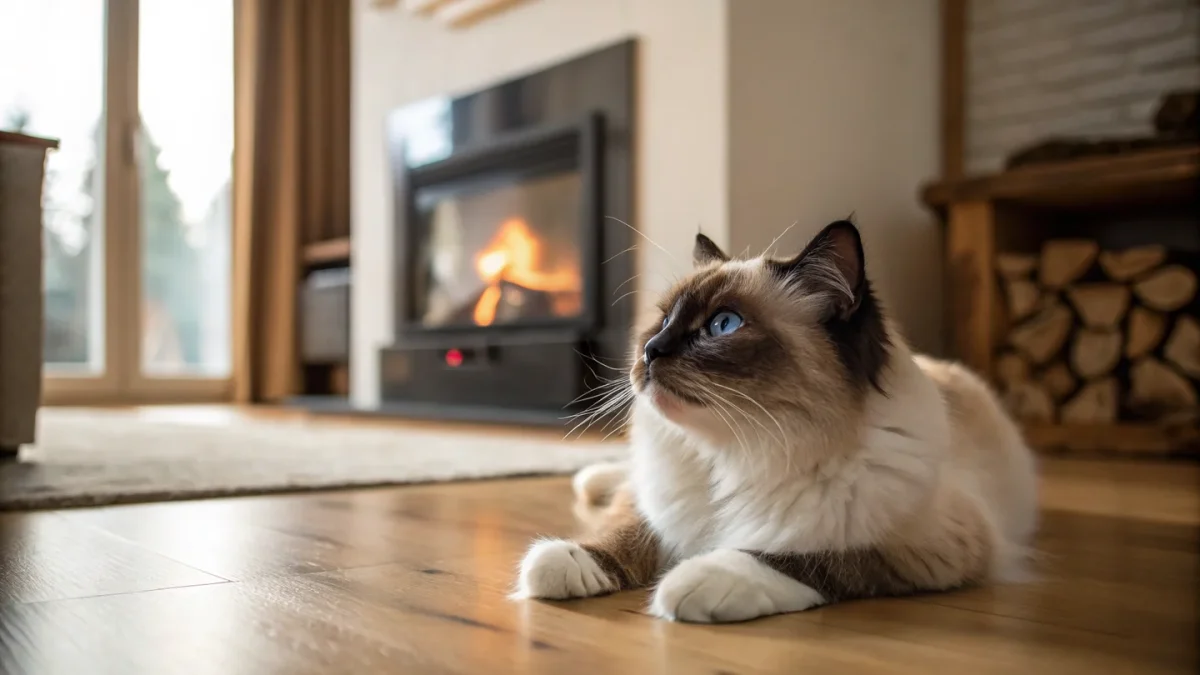
The Birman has a distinctive look that is genuinely recognizable once seen: a semi-longhaired body with point coloration (darker face mask, ears, legs, and tail against a lighter body), deep blue eyes, and the breed's most defining feature — four pure white paws. The white "gloves" on the front feet are symmetrical, and the hind feet have white "gauntlets" that ideally end in a point up the back of the leg.
Getting those gloves right is one of the ongoing challenges in Birman breeding. The genetics of white spotting are complex, and perfect symmetrical gloves in the right position are not easy to achieve consistently. Show-quality gloving is prized; pet-quality Birmans may have asymmetrical or imperfect gloves, which doesn't affect their value as companions at all.
The coat is silky and semi-long with a natural tendency not to mat. This is one of the qualities that distinguishes the Birman from longer-coated breeds that require more intensive grooming. The fur lacks the dense undercoat of a Persian and lies flatter, which means tangles develop less readily.
Body type is substantial — medium to large, broad chest, strong legs, rounded head. The Birman is not as massive as a Maine Coon or as compact as a Persian; it occupies a sturdy, rounded middle ground.
Point colors include seal, blue, chocolate, lilac, red, cream, and various tortie and tabby (lynx) point patterns in registries that accept those extensions. Seal point is the most traditional and historically associated with the breed.
Temperament: The Gentle Observer
The Birman occupies an interesting middle position in the cat personality spectrum. It is more sociable than a Russian Blue but less demanding than a Burmese. More interactive than a Persian but less vocal than a Siamese. This moderate, balanced temperament is part of why the breed has developed a reputation as an excellent family cat.
Birmans are people-oriented without being clingy. They will seek out their family members and prefer to be in occupied rooms, but they are not likely to physically demand your attention with the insistence of a Sphynx or Burmese. They'll settle near you, acknowledge your presence, and be quietly content.
Vocally, the Birman uses a soft voice. They communicate their wants — particularly around feeding time — but are not continuously chatty. The voice, when used, is gentle and melodic.
Play drive is moderate. Birmans enjoy interactive toys and will engage reliably with wand toys and puzzle feeders, but they are not the intensely athletic, acrobatic cats that breeds like the Abyssinian or Devon Rex represent. As they age, many Birmans become increasingly sedate — in a comfortable, contented way rather than a sedentary one.
The breed generally handles multi-pet households well. Birmans tend to get along with other cats and with gentle dogs, particularly when introductions happen gradually. They extend their characteristic gentleness to other animals.
What Most People Get Wrong About the Birman
The temple origin is documented history. It isn't. The "Sacred Cat of Burma" narrative is mythology — a charming, beautifully elaborated legend — but not documented historical fact. The breed's actual pre-France origin is unknown. This distinction matters not because the legend is bad, but because presenting myth as history misleads buyers about what they're actually getting.
The Birman and Burmese are related. They share a name and a general geographic reference in their mythology, but the Birman and the Burmese cat are completely separate breeds with different body types, coat types, temperaments, and genetic histories. They are no more closely related than their shared name suggests.
The coat is as demanding as a Persian. It isn't. The Birman coat is semi-long with a silky texture that resists matting much better than the dense undercoat of a Persian or Himalayan. Weekly grooming is typically sufficient, compared to the daily requirement of a properly maintained Persian.
They're essentially decorative cats. The gentle, quiet persona can create the impression of a cat that simply sits beautifully. Birmans are genuinely interactive — they want company, they observe everything, and they develop real relationships with their people.
Health Considerations
The Birman is generally considered a robust, healthy breed without the extreme structural concerns of brachycephalic breeds or the specific genetic disorders that affect some other pedigrees.
That said, Birmans carry a well-documented hereditary quirk called Birman neutrophil granulation anomaly — an autosomal recessive trait that gives neutrophils an unusually granular appearance under the microscope, sometimes mistaken for immature cells. Here's the thing that surprises people: it's cosmetic, not functional. Studies have found the affected neutrophils fight infection exactly as well as normal ones — no elevated infection risk, no treatment needed. It usually turns up as an incidental finding on routine bloodwork rather than through any clinical sign.
Feline infectious peritonitis (FIP) is sometimes cited in connection with Birmans, and this one isn't just breed lore — a genome-wide study of Birmans in Denmark and the US found the breed had a significantly higher FIP prevalence than mixed-breed cats, and identified several candidate genes tied to the increased susceptibility. FIP can affect any cat, but Birmans carry more inherited risk than most breeds do.
Congenital hypotrichosis (a hair loss condition) has appeared occasionally in Birman lines but is rare.
General cat health concerns — dental disease, obesity, age-related kidney disease — apply to Birmans as to all cats.
Grooming the Silky Coat
The Birman coat is more manageable than its semi-long description might suggest. Weekly combing with a wide-toothed comb prevents any developing tangles, removes loose fur, and keeps the coat lying flat and smooth. During seasonal shedding periods, more frequent attention — two or three times a week — prevents loose hair from accumulating on furniture.
Pay particular attention to the underarms, the collar area, and behind the ears, where friction and movement create the highest risk of small knots forming. These are best addressed when small; large mats in any cat's fur are uncomfortable to remove.
The coat does not require bathing under normal circumstances, though some breeders recommend the occasional bath particularly before shows or if the cat has gotten into something messy. Birmans generally tolerate bathing reasonably well when introduced to it gradually.
Routine care: nail trimming every couple of weeks, gentle ear cleaning as needed, and regular dental hygiene (tooth brushing is ideal, with enzymatic dental treats as a supporting measure).
Living With a Birman
The Birman is particularly well-suited to households that want an interactive but not demanding companion. It handles the regular routines of family life — varied schedules, children who understand gentle handling, other pets — with equanimity.
Pure indoor living works well for the Birman. The semi-long coat, while not as dramatically impractical as a Persian's in outdoor conditions, is better maintained indoors. More importantly, the Birman's moderate energy level and indoor-focused personality mean it doesn't demonstrate the frustrated restlessness that confines indoor-only cats with very high outdoor drive.
Birmans can be sensitive to significant household disruptions — moves, new babies, loss of a companion pet. The transitions are manageable but should be acknowledged and handled thoughtfully.
The Right Owner for a Birman
The Birman is, genuinely, one of the more broadly suitable pedigree cats — which is precisely why it has been popular with families for decades. It doesn't demand the specialist knowledge of a Sphynx owner, the commitment to daily grooming that a Persian requires, or the high-stimulation environment that suits a Bengal or Abyssinian.
It suits: families with children who can be taught respectful handling, multi-pet households where a gentle personality won't be overwhelmed, people who want a cat that engages genuinely without being intrusive, and anyone who finds the glamour of the semi-long coat appealing without wanting full Persian maintenance.
It may not suit: people who want a highly energetic, acrobatic companion, those who want a cat that socializes easily with strangers (the Birman can be reserved at first meeting, though less so than the Russian Blue), or people wanting a cat that needs minimal attention.
The Birman chooses affection in a considered, gentle way. For the right household, that kind of quiet loyalty is exactly what they were looking for.
Frequently Asked Questions
Is the Birman cat really from Burma?
The breed's pre-France origins are genuinely unknown. The "Sacred Cat of Burma" legend is a mythology that developed around the breed, not documented historical fact. The earliest verified records of Birmans appear in France in the 1920s. What, if anything, existed before that point in the breed's development remains unestablished.
What's the difference between a Birman and a Ragdoll?
Both are large, semi-longhaired, blue-eyed, pointed cats — but they are distinct breeds. The Ragdoll is typically larger, has a more extreme tendency to go limp when held (the trait its name refers to), and was developed in the United States in the 1960s. Birmans are older as a formal breed, have the distinctive white gloves as a breed standard requirement, and tend to be somewhat more active and less dramatically placid than Ragdolls.
Do Birman cats shed a lot?
Moderate shedding, with heavier seasonal periods. The coat's silky, relatively tangle-resistant texture means the shed fur is less likely to form mats on the cat, but it will accumulate on furniture and clothing. Regular weekly combing manages this well.
Are Birmans good with kids?
Generally yes, provided the children understand appropriate handling. The breed's gentle disposition and moderate energy make it compatible with families, though very young children who can't yet control their handling should always be supervised with any cat.
What is the typical lifespan of a Birman?
Birmans typically live 12 to 16 years, with some individuals reaching 18 or more. As with all cats, genetics, diet, veterinary care, and indoor vs. outdoor status all influence longevity significantly.