

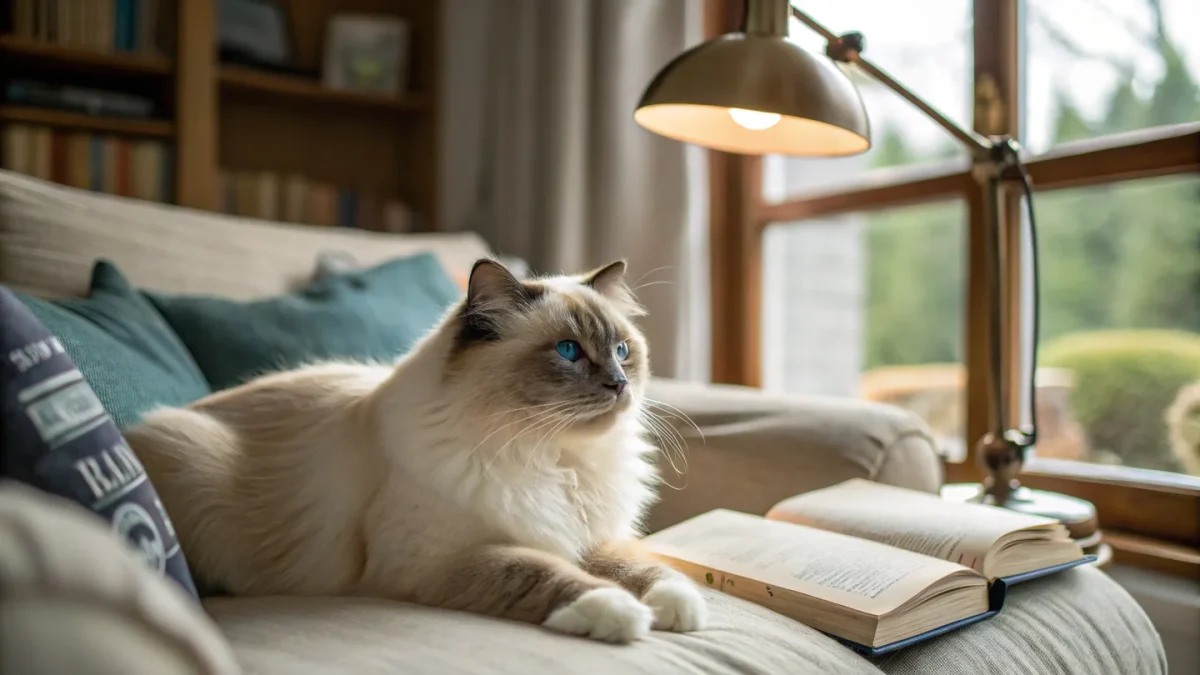
There is a certain quality in the Birman temperament that I would describe as considered. This is not the impulsive warmth of a Burmese, which follows you everywhere immediately. It is not the careful reserve of a Russian Blue, which holds its trust in a closed fist until it's decided to open it. The Birman is somewhere between: a cat that chooses engagement on reasonable terms and almost always finds them.
The breed's reputation as a family cat is earned — not by marketing, but by the actual daily experience of owners who find the Birman reliably pleasant across a wide range of household circumstances.
The Middle Position
The Birman occupies a specific point on the cat temperament spectrum that makes it distinctively accessible. Consider the poles:
At one end: the highly independent cat — Persian, perhaps, or Chartreux — which is affectionate in a passive, settled way and comfortable with significant periods of solitude.
At the other: the people-dependent cat — Burmese, Sphynx, Tonkinese — which follows you constantly, physically insists on proximity, and experiences real distress when under-stimulated socially.
The Birman is neither. It wants company. It gravitates toward occupied rooms. It will settle near its people and invite petting with a soft, purposeful presence. But it doesn't need to be on you, and it handles reasonable periods of solitude without exhibiting the anxious behaviors that affect more socially dependent breeds.
This balance is practically significant. The Birman can share a household with people who have varied schedules, who work outside the home, who have different levels of engagement with the cat depending on the day. The Birman adapts.
How Birmans Interact
The Birman's approach to interaction is gentle and direct. When it wants attention, it approaches — not vocally demanding, but physically present. It will sit beside you and wait. It will put a paw on your arm in a gesture so light it barely qualifies as contact. If you respond, it will settle in. If you don't, it will move on without drama.
This makes the Birman one of those breeds that unobtrusively becomes part of the household's daily texture. Owners often notice, after some time, that the Birman was simply always there — without having been forceful about it.
Vocally, the Birman uses a soft, melodic voice. Feeding time generates the most sustained commentary. Otherwise, they communicate situationally — a soft chirp when curious, a quiet meow at the door when they'd like access — rather than maintaining a continuous running commentary.
With Children
The Birman's combination of gentleness and robustness makes it particularly compatible with family households that include children. The breed doesn't startle easily, doesn't escalate confrontations, and has enough physical substance that the accidental roughness of young children's handling is less likely to hurt or alarm it.
This doesn't mean any level of handling is appropriate — no cat should be subjected to rough treatment, and even the most tolerant breed will eventually react if repeatedly made uncomfortable. The Birman is patient, not infinitely so.
Older children who understand appropriate handling typically find the Birman an excellent companion: responsive, gentle, willing to engage in quiet games and calm play, and uncomplaining about being incorporated into whatever the child is doing.
With Other Pets
The Birman extends its characteristic gentleness to other animals. It tends to integrate into multi-pet households without the territorial drama that more assertive breeds can generate.
With other cats, Birmans typically approach interactions slowly and without aggression. They don't establish dominance through force. They find a comfortable position in the household social hierarchy through patience and non-confrontation.
With dogs of compatible temperament, Birmans can develop real relationships. The breed's confidence — it is not a fearful cat — means it handles the presence of dogs better than some smaller, more anxious breeds might.
Play and Mental Engagement
The Birman's play drive is moderate. Younger cats engage enthusiastically with wand toys, feather teasers, and puzzle feeders. As they age, the sessions become shorter and less athletic, but the interest in engagement doesn't disappear — it matures into something calmer.
The breed is intelligent enough to benefit from variety in its toy selection. The same toy presented indefinitely loses its appeal. Rotating toys, introducing new puzzle feeders periodically, and varying the type of interactive play maintains engagement better than repetition.
Birmans are not great climbers compared to the Norwegian Forest Cat or Maine Coon, but they appreciate higher resting positions. A cat tree or accessible shelving satisfies this without requiring the engineering commitment of the breeds that will reach the highest point available regardless of what's in the way. In terms of gentle temperament and calm companion energy, Birmans are often compared to the Ragdoll — though the Ragdoll tends toward more pronounced limpness when held and a somewhat larger build.
Handling Change
The Birman adapts to household changes with relative equanimity — more than breeds with high anxiety sensitivity. Moving homes, schedule changes, new furniture, and visiting guests are handled as new information to assess rather than as threats.
That said, the Birman forms genuine attachments to its household and its people. A significant disruption — rehoming, loss of a companion animal, long absence of a primary attachment figure — does affect the cat noticeably. The adaptation is not instant.
The Temperament in Practice
Living with a Birman temperament is, for most households, pleasant without drama. The cat contributes to the household atmosphere in a quietly positive way — present, engaged when you are, settled when you aren't.
The complete Birman breed guide addresses origins, coat care, and health considerations across the full picture of the breed. But temperament is where the Birman's family-cat reputation has its foundation. The gentleness and the sociable balance are real, and they're consistent.
The Birman doesn't ask for very much. What it gives in return is proportional, reliable, and genuine.