

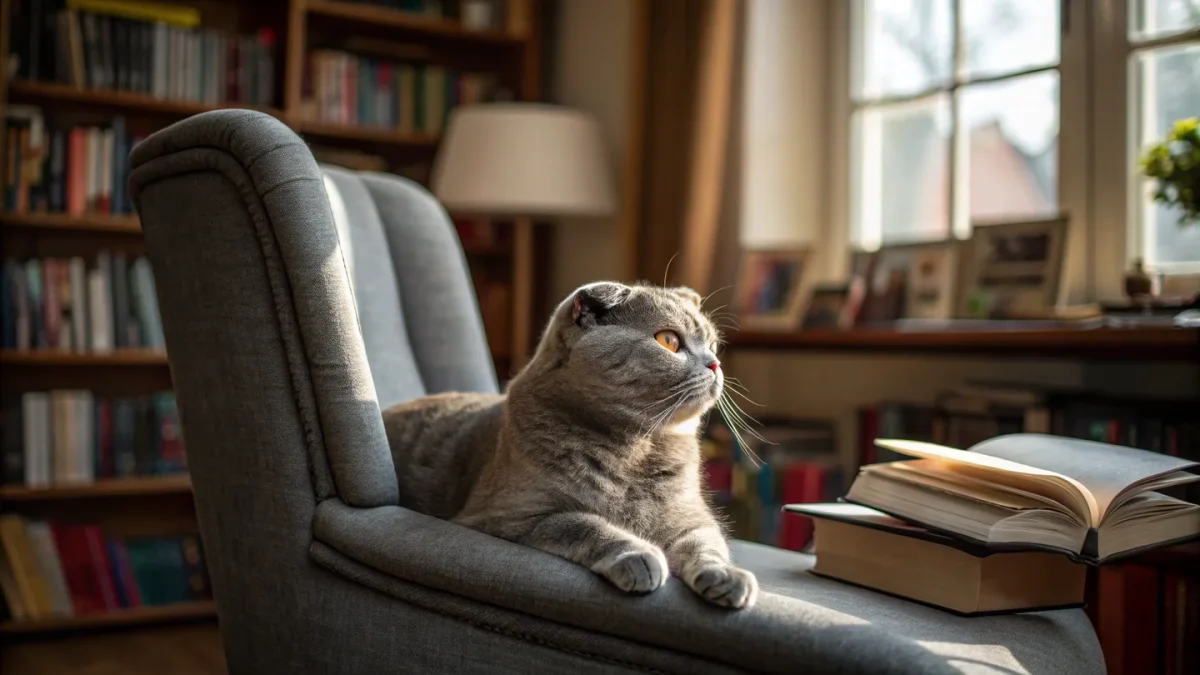
The Scottish Fold sits differently from other cats. Literally — the breed has a characteristic posture, particularly when relaxed, where the cat sits up with its back legs extended forward and its paws resting on the floor in front, looking something like a small, round person waiting patiently for something. Owners call it the "Buddha sit" or the "Fold sit." It's peculiar and charming, and it encapsulates something about the breed's general bearing: there's an equanimity about Scottish Folds that distinguishes them from more reactive or high-demand breeds.
Understanding the temperament requires engaging with one complexity: a calm, pain-tolerant animal doesn't always show discomfort in obvious ways. The Scottish Fold's genetic predisposition to osteochondrodysplasia (OCD) means that reading the temperament honestly includes understanding what behavioral changes should prompt concern, not just what the normal baseline looks like.
The Baseline Personality
The Scottish Fold breed and its health context is anchored by a temperament that most descriptions get approximately right: calm, adaptable, and social.
These are not cats that bounce off walls or require sustained intensive engagement to remain stable. They're social in the sense of wanting company and proximity, but not in the sense of demanding constant interaction. A Scottish Fold in a household that's busy but not hectic will typically find a comfortable perch, watch what's happening, and integrate into the household rhythm without creating drama.
The adaptability is genuine and notable. Scottish Folds accommodate varied household compositions — other cats, dogs, children — more readily than many breeds. The lack of high reactivity means they don't escalate situations the way anxious or high-drive cats might.
Bonding and Affection
Scottish Folds bond with their families and show affection in a quiet way. They tend toward proximity more than physical insistence — they prefer to be in the same room as their person, may sit near or lightly against them, and track routines in a way that shows genuine attentiveness.
The bonding is often broader across a household than in single-person attachment breeds. Where a Siamese might select one primary person and be conspicuously cooler to others, a Fold tends to distribute its social engagement more evenly across household members. This makes them particularly suited to families.
Lap behavior varies by individual. Some Folds are persistent lap cats; others prefer adjacent proximity. Either way, the affection isn't theatrical — it's the low-key consistency of a cat that wants to be near you without making a production of it.
Intelligence and Engagement
Scottish Folds are reasonably intelligent cats and engage appropriately with enrichment. They enjoy puzzle feeders, appreciate interactive play, and respond to their names. They're not the problem-solving acrobats that Bengals or Abyssinians are, and they don't have the verbal insistence of the Siamese — but describing them as passive would be misleading.
A well-stimulated Fold is an engaged, curious companion that initiates play and interacts with the environment actively. What they don't do is escalate their requests when those needs aren't met in the way higher-drive breeds do. This can read as contentment when it's sometimes merely acceptance.
The Behavioral Complexity: Pain Versus Personality
Here is where honest discussion of Scottish Fold temperament becomes more complicated than for most breeds.
OCD — osteochondrodysplasia, the skeletal condition that affects all folded cats — often causes joint pain and stiffness. Pain in cats frequently presents as behavioral changes: reduced activity, withdrawal, less interest in play, reluctance to jump or be touched in affected areas, and a general passivity that, in a breed already described as "calm," can be invisible to owners who aren't watching specifically for it.
The behaviors that would prompt concern in other breeds — reduced jumping, less engagement with play, reluctance to interact — can be attributed to "natural Fold temperament" when they're actually early indicators of OCD progression. This is the specific challenge: the breed's genuine calm personality provides cover for pain-driven behavioral changes.
Some behavioral signals worth noting in any Fold:
- Tail carriage and flexibility: A Fold that carries its tail stiffly or resists having its tail gently moved should be evaluated. Tail rigidity is one of the early OCD indicators.
- Jumping behavior: A previously confident jumper that becomes reluctant may be experiencing joint discomfort.
- Hind leg gait: A shortened stride, stiff movement, or bunny-hopping gait suggests hind limb OCD.
- Response to touch along the back and hips: Pain response to gentle pressure suggests joint involvement.
- The sit position: The "Buddha sit" in a young cat that maintains this posture very frequently may reflect hip or stifle discomfort rather than relaxed posture.
None of these alone are diagnostic, but any persistent change from a cat's baseline warrants veterinary evaluation. The Fold's temperament tends toward stoicism in the face of discomfort — they're not typically cats that vocalize about pain. Behavioral changes are often the first and most reliable signal.
Living with a Scottish Fold
With appropriate veterinary monitoring and awareness, a Scottish Fold's temperament delivers what many people want from a cat: a calm, genuinely affectionate companion that integrates into household life without high maintenance demands. They're good company without being high-drama. They suit people who work from home, quieter households, and situations where a very active cat would be overwhelming.
The honest synthesis of Scottish Fold temperament includes both the genuine charm of the personality and the responsibility that the breed's health situation creates. These are not separable things. The same breed produces both the appealing owl-faced calm and the genetic condition that requires attentive monitoring. Understanding both is what informed ownership of this breed looks like. If the calm, self-contained temperament profile appeals but the OCD concern gives you pause, the British Shorthair temperament occupies a very similar personality niche without the fold gene's skeletal implications.