

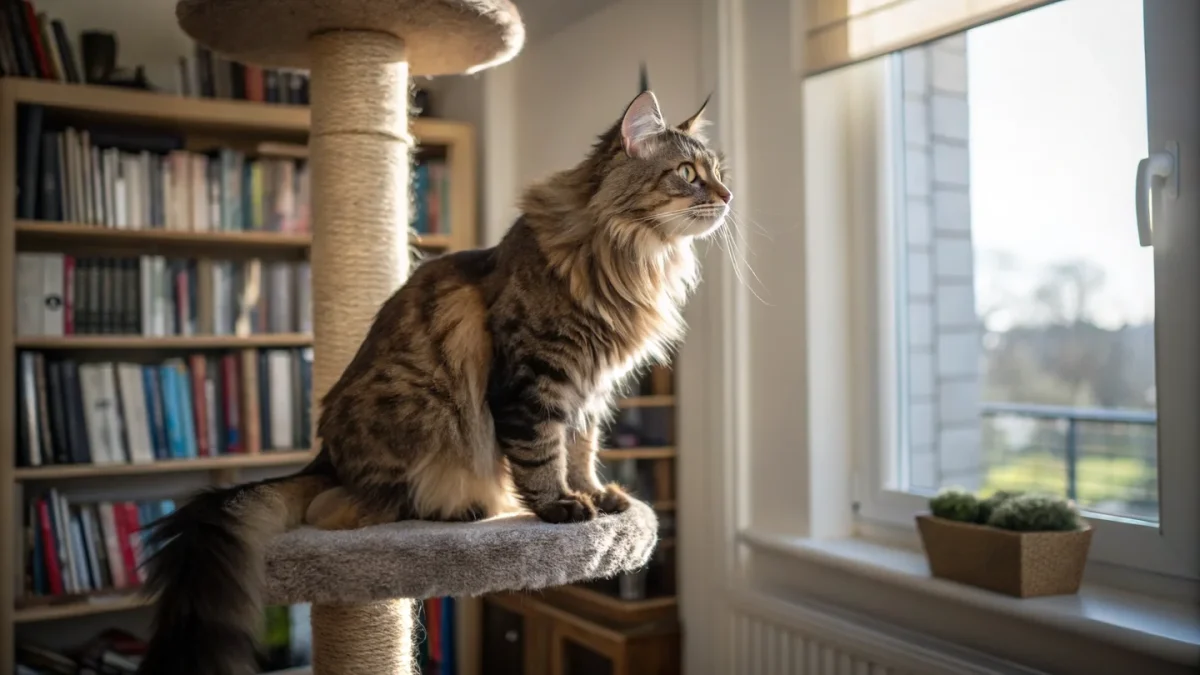
The Maine Coon is consistently one of the most popular domestic cat breeds globally, which means a lot of people acquire one based on photos of enormous, majestic-looking cats and a general sense that they'd be wonderful to have. Many of those people are absolutely right. Some of them discover — a year in — that they've misjudged the match.
Being honest about this particular breed requires talking about what it actually asks of you. For the full breed profile, see the complete Maine Coon breed guide and an overview of Maine Coon temperament. This piece is specifically the honest reckoning.
What a Maine Coon Actually Requires
Time and presence. This is the non-negotiable. Maine Coons are social animals that do poorly with extended isolation. If your household is empty for 9-10 hours daily, five days a week, and there's no second pet for company, a Maine Coon will not be at its best. It might develop behavioral quirks, excessive sleeping, or reduced engagement with the household when you're home.
That doesn't mean you must work from home. A Maine Coon in a household with another cat — or even a calm, cat-socialized dog — does fine. The social need can be met by another animal. What doesn't work is complete daily solitude.
Grooming commitment. Two to three sessions per week with a wide-toothed comb is the minimum for avoiding mats. During spring shedding season, daily combing is advisable. If this sounds like something you'll do consistently and perhaps even enjoy, excellent. If it sounds like something you'll do until you get busy, then let slide for two weeks — you'll end up with a matted cat that requires a more complicated fix.
Space and enrichment. Maine Coons are large, active cats. They don't need a mansion, but they need vertical space, room to move, and environmental enrichment to occupy their curiosity. A small apartment with no cat trees, no perches, and nothing to do produces a bored Maine Coon. A small apartment with a good cat tree, window access, rotating toys, and regular play produces a fine Maine Coon.
Financial planning. Large cats have larger veterinary costs. Maine Coons have breed-specific health predispositions — most importantly, hypertrophic cardiomyopathy (HCM). Veterinary cardiologists recommend that Maine Coons at risk for HCM — particularly those with positive genetic test results — undergo echocardiographic screening at least annually, as a single normal result doesn't rule out future disease onset. NC State's veterinary cardiology program notes that most affected male Maine Coons show evidence of disease by age 2, and females by age 3, though onset has been documented as late as 7 years. This isn't a reason not to get one, but it should be factored into your realistic assessment of ongoing costs.
Who Does Well With a Maine Coon
Families with children. Maine Coons are among the genuinely patient breeds with respectful children, and the dog-like social orientation makes them engaging family members rather than cats that hide from everyone.
Multi-pet households. Maine Coons typically adapt well to other cats and cat-friendly dogs. If you already have a reasonably social pet and want to add a cat that will actually integrate into the household rather than maintaining permanent territorial hostility, a Maine Coon is a good candidate.
People who like interactive pets. If the appeal of a cat is specifically that it does its own thing and you occasionally get to pet it, you'll find a Maine Coon more than you bargained for. If you actually want an engaged, present, curious companion that's interested in everything you do, you'll find exactly that.
Working-from-home professionals. Having a Maine Coon in a home office is genuinely pleasant for people who like ambient animal company. They're present without demanding active attention every moment, they're interesting to have around, and they appreciate the human presence.
Who Should Think Carefully
People who travel frequently and don't have reliable pet care. A Maine Coon left with a cat-sitter it doesn't know, in a house full of unfamiliar sounds and schedules, for two weeks at a time, will tell you about it when you get back.
People who are strongly opposed to fur on furniture and clothing. A Maine Coon's shedding, even with excellent grooming management, will deposit fur on surfaces. This is reducible with grooming and HEPA filtration but not eliminable.
People who want a low-maintenance, independent cat. Maine Coons are not demanding in an irritating way, but they are genuinely present and genuinely engaged. "Easy going" is accurate; "requires minimal attention" is not.
People in very small spaces with no enrichment solutions. A 400-square-foot apartment with no cat tree, no window perches, and nothing to do is not a good environment for any large active cat, including a Maine Coon. The solution is enrichment, not a different apartment — but it requires proactive action.
The Honest Summary
Maine Coons are wonderful cats. The "dog-like" personality isn't marketing copy — it's a real thing that most Maine Coon owners experience and genuinely value. The commitment they require is real too, and it's worth going in with clear eyes.
The grooming is the main functional barrier. If you can genuinely commit to regular brushing sessions — and if you can frame them as bonding time rather than a chore — you'll have a genuinely rewarding experience with this breed. If the grooming sounds like something you'll intend to do rather than actually do, a short-coated breed will serve everyone better.
Everything else about the Maine Coon — the size, the personality, the social demands — tends to work out for most people who were drawn to the breed in the first place. The grooming is where the honest self-assessment has to happen. If you're still weighing the decision, how to choose a cat breed offers a framework for matching breed traits to your actual daily life.