

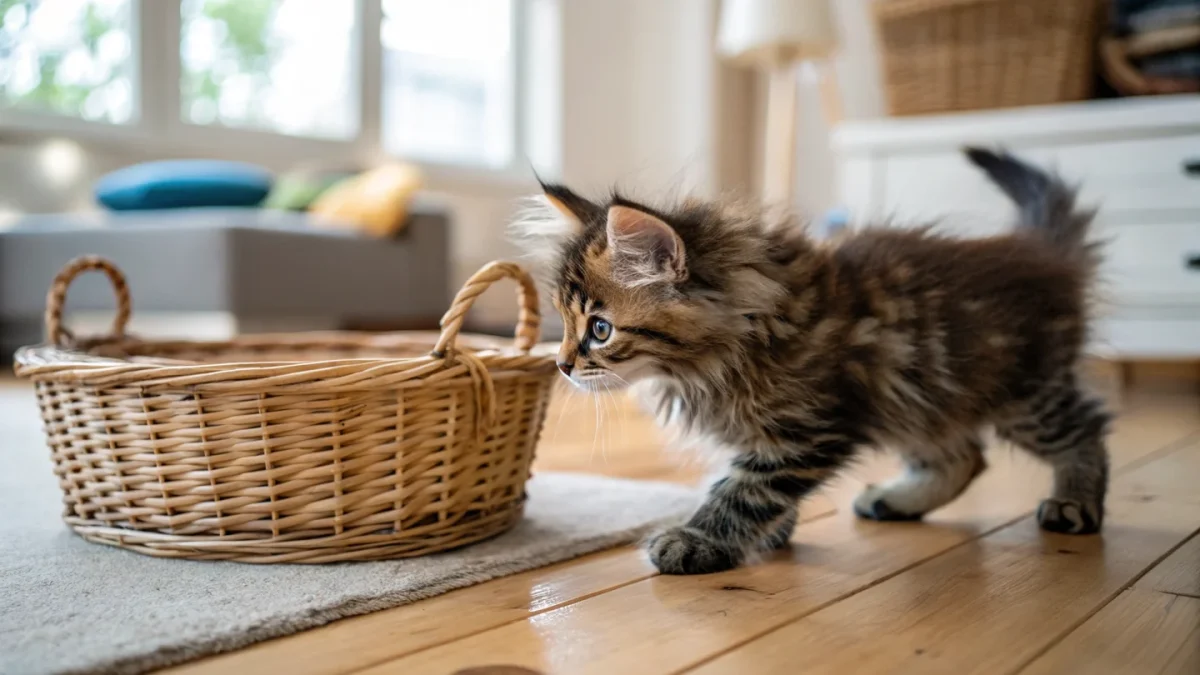
Maine Coon kittens are among the most charming creatures in domestic animal ownership. They're also genuinely capable of surprising people who thought they knew what they were getting into.
The extended growth curve alone catches people off guard: a Maine Coon that looks like a small adult at 10 months is a cat that will continue putting on size for another 2-4 years. The kitten phase lasts longer. The energy lasts longer. And that semi-long kitten coat, already demanding some maintenance, will eventually become a full adult coat requiring regular attention. For the complete breed profile, see the complete Maine Coon breed guide.
Before They Come Home
Equipment sizing. The litter box, food bowls, and cat tree that are appropriate for an adult Maine Coon are much larger than the ones that seem right for a tiny kitten. Buy for where the cat is going — particularly the litter box, which should be large enough for a 15-20 pound cat. A kitten using an oversized litter box is fine; an adult using an undersized one is inconvenient.
Cat-proofing. Maine Coon kittens are curious and manual in the extreme. They paw at things, investigate cabinet contents, and find routes to places you hadn't considered accessible. Standard kitten-proofing applies here with extra attention: lever door handles are interesting to them, cabinets that aren't latched will be opened.
Vertical space. Cat trees, wall shelves, or at minimum window perches should be in place before the kitten arrives. Maine Coons are climbers, and establishing good vertical territory early prevents them from deciding the top of the refrigerator or the bookshelf is the appropriate high point.
A companion. Not required, but Maine Coon kittens benefit significantly from having another young cat to grow up with. The social energy and play drive of this breed is genuinely high — they want interactive play for hours in a way that can be exhausting for the human household members alone.
The First Weeks
A new Maine Coon kitten should be confined to a smaller area initially rather than having access to the full home. This is standard advice for all kittens, but it particularly helps a Maine Coon kitten feel secure rather than overwhelmed. A single room with food, water, litter box, hiding spots, and toys lets them establish comfort before exploring further.
They'll be ready to explore the rest of the home faster than many breeds — typically within a few days to a week, depending on the individual kitten's confidence. Maine Coons are curious by nature and generally not shy, but rushing the introduction produces skittish behavior that can persist.
Starting Grooming Early
This is the highest-priority kitten investment for a Maine Coon owner: establishing a positive association with grooming before it becomes necessary. A kitten that grows up associating the comb with calm, positive attention will be a dramatically easier adult to groom than one that wasn't handled this way.
Start with short sessions — a few minutes, while the kitten is already calm and relaxed. Handle the paws (nail trimming preparation), look in the ears, touch the face. Introduce the comb gently through the softest, least tangle-prone parts of the coat first.
The goal isn't to maintain the coat (kitten coats are simpler than adult coats). The goal is to establish that grooming is normal, pleasant, and associated with attention and treats. This investment pays off for the entire 15-year lifespan of the cat. See Maine Coon grooming for the full adult approach.
Growth Timeline
Maine Coon kittens look like regular kittens at 8-10 weeks — perhaps slightly larger than average, with somewhat larger paws and a slightly more ruffled coat. The size differential from other breeds is not yet dramatic.
The growth divergence becomes noticeable around 6 months, more pronounced at 1 year, and continues until 3-5 years. Many Maine Coon owners are surprised to watch their cat continue visibly growing past the age when they expected growth to have stopped.
The practical implication: don't buy too many items sized for the kitten. The cat tree appropriate for a 3-pound kitten will be inadequate for a 16-pound adult.
What to Expect from Kitten Behavior
Maine Coon kittens are active. Very active, in the kitten phase. They have all the energy that the adult breed eventually moderates, without the moderation. Budget for play sessions — interactive toys rather than static toys, which hold their attention far longer.
The social curiosity is already present: Maine Coon kittens approach new people, new objects, and new experiences with more confidence than most kittens. They're less likely to hide under the bed when someone new comes over and more likely to investigate the newcomer.
The chirping and trilling vocalizations appear in kittens. Many Maine Coon owners first notice the characteristic trill sound when the kitten is commenting on something interesting through a window.
Finding a Responsible Breeder
Maine Coons from reputable breeders have parents tested for HCM (hypertrophic cardiomyopathy) via cardiac ultrasound, and the breeding pair should have been tested within the last year or two. A breeder who can't produce evidence of current cardiac testing is a breeder to approach with significant caution.
Kittens should not be adopted before 12 weeks minimum; 16 weeks is preferable for proper socialization. Early adoption — before 8 weeks — is broadly documented to produce behavioral issues across domestic cat breeds: kittens separated too early tend to show higher aggression, poorer bite inhibition, and weaker social confidence, because the 8–12 week window is when littermate play teaches coordination and behavioral boundaries. Maine Coons, as a slower-maturing breed, benefit particularly from the extended socialization period.