

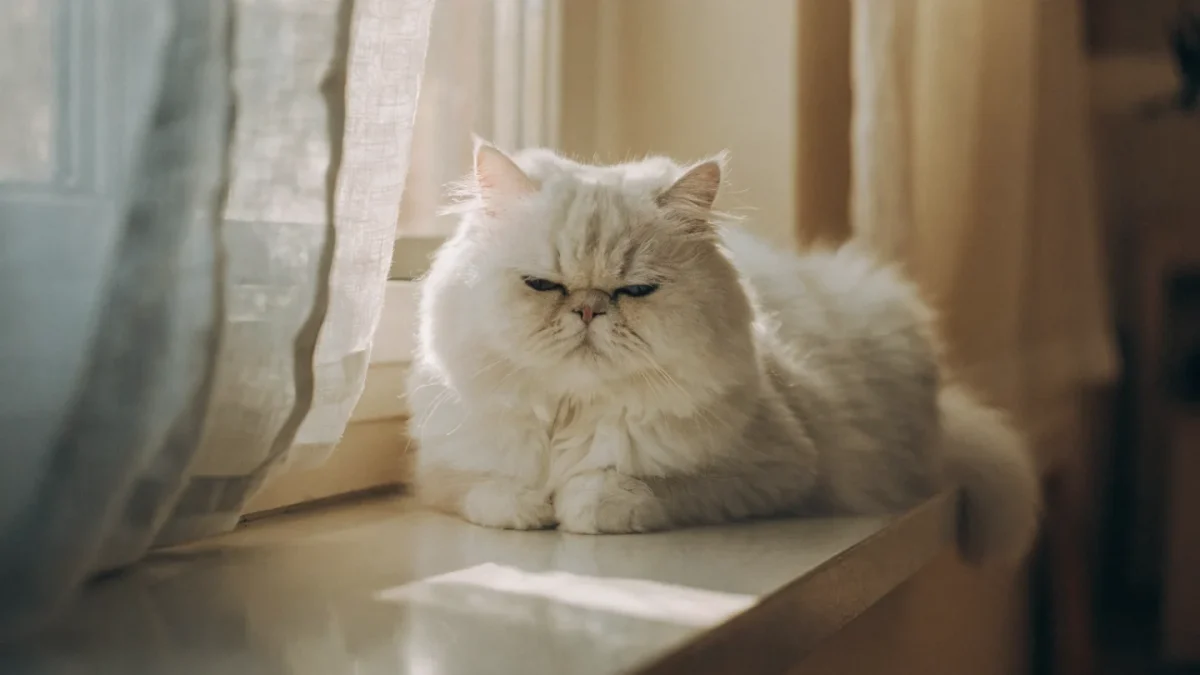
There's a reason Persian cats became the dominant indoor cat in the 20th century — a position they held for decades before breeds with more outwardly interactive personalities started competing seriously for that spot. It wasn't just the coat. It was the temperament: genuinely, consistently, almost remarkably calm.
Not all cat calm is equal. Some breeds appear calm because they're slow to warm up, or because they've learned that the household isn't safe enough to relax in. Persian calm is different — it's constitutional. These cats are at peace with existence in a way that reads clearly to anyone who's spent time around them.
For the full overview of the breed, see the complete Persian cat breed guide. Here I want to dig specifically into what that temperament actually means in daily life.
The Texture of Persian Calm
Persians don't tear around the house at 2 AM. They don't knock things off countertops with the systematic deliberation of a bored Maine Coon. They don't howl at you from three rooms away because you walked in without acknowledging them.
What they do: they settle. They find the warm patches of sun in the house and occupy them. They position themselves near you — on the same sofa, the same floor, the same room — and remain there with an air of absolute contentment. When they decide they want affection, they'll walk over and make it clear without theatrics. When they're done, they'll relocate.
A Persian in a home it trusts is one of the more visibly content animals you'll encounter. The slightly flattened expression (a structural artifact of the breed's face) can make them look perpetually unimpressed to people who don't know them, but read the body language instead: relaxed posture, half-closed eyes, slow blinking. They're fine.
Activity Level and Play
Persians are categorized as low-to-moderate activity cats. This is accurate, but "low activity" sometimes gets interpreted as "doesn't need play or enrichment," which isn't correct.
Persian kittens play enthusiastically. Adult Persians play, just with more selectivity about when and for how long. A feather wand or a simple toy dragged across the floor will produce genuine chasing behavior. The play sessions are shorter and less frantic than you'd see from a Bengal or Abyssinian, but they're real.
What's accurate is that Persians have the lowest "demand for entertainment" of probably any domestic cat breed. They're not going to agitate you with boredom behavior. They won't develop destructive habits from under-stimulation the way some high-drive breeds do. But they still benefit from daily play as kittens and a few sessions per week as adults — both for physical health and for the social bonding value of interactive play.
Affection: How It Works With Persians
The Persian affection style puzzles people who expect cats to perform affection on demand. Persians don't work that way. They're affectionate when they decide to be, and their decision schedule is more internal than responsive to human initiation.
What this looks like: your Persian will come find you when it wants contact. It'll climb into your lap on a slow afternoon, sit beside you while you work, or ask for a head scratch by positioning itself near your hand with an expectant expression. These moments are real and warm.
What it doesn't look like: a Persian that drops everything and comes running when called, or one that'll let you pick it up and cuddle it whenever you want. The impulse-initiated cuddle generally produces a cat that tolerates the contact briefly before performing a dignified exit.
This is a meaningful personality distinction from breeds like Ragdolls or Maine Coons, which are more actively people-seeking — the Maine Coon temperament in particular leans toward near-constant human engagement that's quite the opposite of Persian self-containment. Persian affection is real — it just operates on the cat's schedule rather than yours. For the right owner, this is actually appealing rather than frustrating: the contact you get is authentic rather than trained compliance.
Sensitivity and Environmental Needs
The trait that most surprises new Persian owners is how strongly this breed responds to household disruption. Persians read as so calm that people expect them to be resilient. They're calm, but they're not resilient in the same way a more adaptable breed might be.
Change registers visibly with a Persian. Move the furniture and they'll spend a full day eyeing the new arrangement with evident suspicion before accepting it. Bring in a new pet, even temporarily, and expect increased hiding and decreased appetite while the Persian processes. A house full of unfamiliar guests produces a Persian that's simply absent — they find somewhere quiet and wait out the chaos.
This sensitivity isn't pathological. It's part of the same personality that makes Persians so settled and content in stable conditions. They're deeply oriented toward their established environment. The stability they provide — that calm presence — requires stability around them in return.
For households with consistent routines and limited disruption, this is a non-issue. For households that travel frequently, host constantly, or have very young children producing unpredictable noise and movement, the Persian's sensitivity is worth factoring into the decision.
With Children
Persians do well with children who've been taught how to interact with cats. They're gentle and non-aggressive — their response to uncomfortable situations is to leave, not to scratch. They have more patience with gentle children than their delicate appearance might suggest.
The word "gentle" is load-bearing in that sentence. Persians are not the right cats for households with toddlers who haven't learned cat-handling basics, or for kids who want to carry the cat around or engage in rough play. The combination of sensitivity to disruption and the daily grooming the coat requires means a rough-playing child is incompatible with a well-maintained, emotionally secure Persian.
Families with children aged 7 and up who've been raised around respectful animal interaction do well with Persians. Younger children need careful supervision, and the household should have clear rules about how the cat is handled.
With Other Cats and Pets
Persians generally coexist peacefully with other calm cats. They're not territorial in the aggressive sense, and they don't typically start conflict. The more relevant question is whether the other cat is equally placid: pair a Persian with a high-energy, boundary-pushing breed and you'll have a Persian that spends a lot of time in the bedroom avoiding the chaos.
The ideal Persian companion, if a second cat is wanted, is another Persian or a breed with a similar low-key energy: a British Shorthair, another sedentary indoor cat.
Dogs depend entirely on the individual dog. A calm, cat-socialized dog can work. An excitable retriever-type will be exhausting for a Persian regardless of the dog's good intentions.
What Calm Actually Requires
The Persian's temperament is one of its most appealing attributes, but it doesn't exist in isolation. These cats produce their best version of that calm in conditions that support it: daily grooming (the coat directly affects how comfortable and happy the cat is), consistent routine, a relatively quiet household, and a person who's home enough to provide the stable presence the breed does best with.
A Persian in a chaotic household, infrequently groomed, with irregular feeding and unfamiliar people cycling through constantly, will not be a calm and contented Persian. The temperament is real, but it's also a response to conditions. The same cat that's perfectly placid in a stable home can be visibly anxious in a disruptive one.
Matching a Persian to your actual lifestyle — not your idealized version of it — is the most important thing you can do for both of you.