

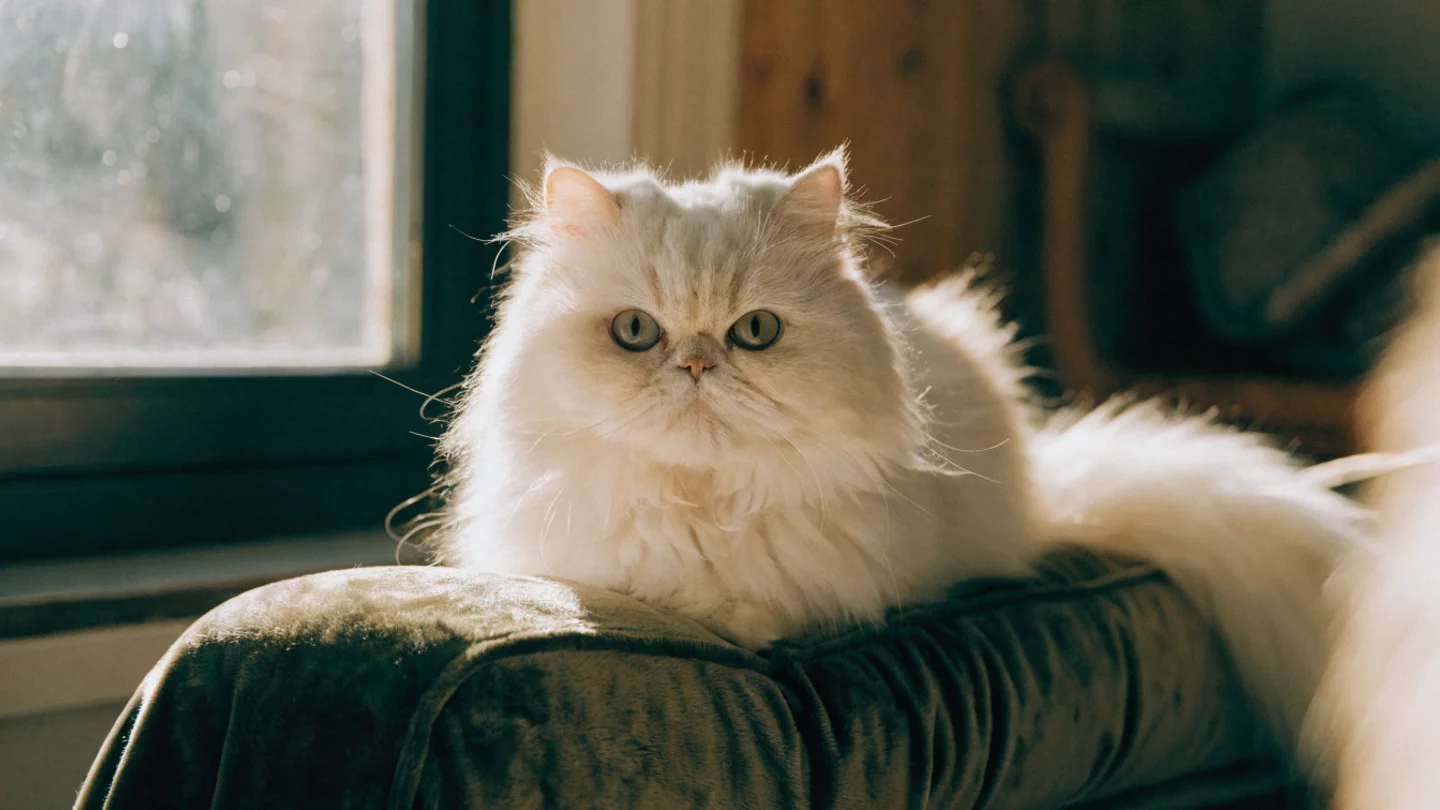
Everyone thinks the Persian is a decorative cat. A living throw pillow — beautiful, soft, and basically inert. I thought that too, honestly, until I spent an afternoon at a breeder's cattery outside Denver in 2019 and watched a silver shaded Persian named Duchess methodically open a cabinet, extract a feather toy she'd stashed in there, and carry it across the room to drop at my feet. Then sit back down with that utterly composed expression, like she'd done nothing unusual. That cat had more quiet intentionality than most dogs I've met.
Persians are unmistakable: flat face, enormous eyes, coat that seems constitutionally opposed to fitting under the cat, and an air of profound indoor-cat contentment. They're not the right cat for everyone — daily grooming is genuinely mandatory, not optional — but for the person whose lifestyle matches what the Persian needs, they're one of the most rewarding companion animals you can share a home with.
Four Centuries of Selective Breeding
This is a breed with one of the longest documented histories in cat fancy, and the trajectory from "exotic import" to "most extreme flat face a judging panel will reward" is genuinely fascinating.
The earliest documented import of long-haired cats from Persia and the region now called Turkey dates to the early 1600s. Pietro della Valle wrote in 1620 of his intention to bring long-haired cats from Khorasan back to Europe; Angora-type cats from the Ottoman Empire also arrived in Europe around the same period. For much of the 17th and 18th centuries, "Persian" and "Angora" were used somewhat interchangeably for any long-haired cat from the Eastern Mediterranean or Central Asia — a conflation that makes precise early breed history difficult to untangle.
The distinction became sharper as selective breeding programs developed in Britain in the 19th century. British breeders favored a more compact, cobby body type and the denser coat texture we associate with Persians today. By the late Victorian era, the Persian had a distinct standard separate from the Turkish Angora, and British cat shows featured them as a prestigious category.
Here's where it gets interesting — and where I start having opinions. The extremely flat face — what breeders call "ultra-typed" or "peke-face" — is a 20th-century development, not an ancient trait. Traditional Persians had a more moderate facial structure. The extreme brachycephalic form became fashionable in American show breeding in the mid-20th century and has since generated significant welfare discussion. A 2018 study published in the Journal of the American Veterinary Medical Association examining 50 purebred brachycephalic Persians and Exotics found malocclusion in 72% and periodontal disease in 88%, and respiratory research documents audible breathing in a substantial proportion of extreme flat-face individuals.
Four hundred years of continuous selective breeding. And the breed community is still actively debating what the face should look like. I've talked to breeders on both sides of this at shows — the ones breeding for the flattest possible profile and the ones deliberately selecting for a more moderate structure — and the disagreement is real and deeply felt. But I'm getting off track. The point is that the Persian you see on a show bench today and the long-haired cat della Valle brought back from Persia are connected by a very long, very deliberate thread of human decision-making.
The Exotic Shorthair, essentially a short-haired Persian, was developed in the mid-20th century by crossing Persians with American Shorthairs — a breed specifically developed for people who wanted the Persian personality without the coat maintenance.
The Extreme Face and Everything That Comes With It
The modern show Persian is built on extreme traits: extremely flat face, extremely dense coat, extremely compact and low-to-the-ground body. The head is round, broad, and set on a short, thick neck. The nose is flat enough that the nostrils are positioned near the level of the eyes. The eyes are large, round, and prominent — set wide apart on the flat face.
The body is what breeders call "cobby": short, deep, heavily boned, and low on the legs. Both CFA and TICA breed standards describe this compact, substantial type. Adult males weigh 9–13 pounds; females 7–10 pounds — not large cats by absolute weight, but dense and substantially built relative to their frame.
I have strong feelings about the face question, so I'll state them plainly. I've handled traditional-face Persians and extreme flat-face Persians side by side at shows, and the difference in breathing is audible. My Maine Coon breeder friend once showed me a traditional Persian she'd taken in — a retired breeder cat — next to photos of the cat's show-quality grandkittens, and the facial structure divergence in just two generations was striking. The traditional cat breathed silently, had clear eyes, and ate without difficulty. That's worth knowing when you're choosing a breeder.
The coat is the defining physical feature. It's long, thick, and has a dense undercoat that mats if you look at it wrong. Persian fur requires daily attention. The coat comes in an extraordinary range of colors and patterns; both CFA and TICA recognize solid colors, tabby patterns, colorpoint (Himalayan pattern), smoke, shaded silver, golden shaded, bicolor, and particolor divisions — among the most extensive color classifications of any breed in cat fancy.
Traditional or "doll-face" Persians have a more moderate facial structure that resembles what the breed looked like before the extreme selection for flatness. They have the same coat, body type, and temperament but significantly fewer of the respiratory and ocular problems associated with extreme brachycephaly.
Calm Is Not the Same as Empty
This is the section where I push back hardest on the Persian's reputation. Yes, they're calm. Not just calm for a cat — calm by the standards of nearly any animal. But calm and boring are not the same thing, and people confuse the two constantly.
Persians are observant. They process their environment quietly, and if you live with one long enough, you start noticing how much they're actually tracking. That cattery visit in Denver taught me this — the breeder told me to just sit and watch for twenty minutes instead of trying to interact with the cats directly. And she was right. The Persians positioned themselves with clear sightlines, watched each other and the humans, and made deliberate choices about who to approach and when. There was a whole social calculus happening behind those enormous eyes.
They're affectionate, but on their own terms. A Persian will settle beside you, sleep on the same surface, follow you from room to room with quiet curiosity — but they're rarely the cats that climb your leg, wake you up at 5 AM for breakfast, or knock everything off your desk. They save their vocalizations for when they actually want something; they're not chatty cats.
This calm demeanor makes them excellent apartment cats. They're not climbers in the way active breeds are, not particularly destructive when bored (they're not easily bored — they're genuinely content to observe), and their activity level is low enough that a modest space suits them well.
Persians are sensitive. Changes in routine, new pets, or household upheaval affect them more visibly than it affects more resilient breeds. They do best in stable environments. A Persian in a chaotic household with constantly shifting schedules, frequent guests, or a young toddler who hasn't learned to respect the cat's personal space will be a noticeably stressed Persian.
A friend who fosters cats tried placing a young Persian with a family that had two Siamese. Lasted about three weeks. The Persian just… withdrew. Stopped eating in the main rooms, spent entire days behind the couch. Moved her to a retired couple's house and within a week she was sprawled across the man's lap while he read, completely at ease. Same cat. Completely different behavior based on the environment. That's the sensitivity in action — they don't act out, they retreat.
They're gentle with children who are old enough to understand gentle interaction, but they're not the right cat for very young children who want to carry them around.
The Misconceptions That Actually Hurt This Breed
The biggest misconception about Persians is that "low energy" means low maintenance. The calm personality doesn't translate to low grooming requirements. A Persian cat's coat requires daily combing — not weekly, not when it looks like it needs it, but daily. The coat will mat in problem areas within days of neglected grooming, and mats in long-coated cats are genuinely uncomfortable and, when severe, require professional grooming to remove.
The second is about their intelligence. People see a Persian sitting quietly and assume there's not much going on. I've addressed this already, but it bears repeating: Persians are situationally aware cats. They simply don't broadcast it with hyperactive behavior.
Third is the assumption that all Persians look the same. The difference between a traditional (doll-face) Persian and an extreme flat-face show Persian is substantial — not just cosmetically but in terms of day-to-day health management. Traditional Persians have significantly fewer breathing and eye issues. If you're acquiring a Persian from a breeder, asking specifically about the breeder's goals regarding facial structure is worthwhile.
And here's one that doesn't get said enough: the idea that Persians are "easy first cats." They're not. The grooming commitment alone makes them an intermediate-level breed. A first-time cat owner who doesn't realize what daily combing actually means — and what happens when you skip it — is going to have a bad time, and so is the cat.
Daily Grooming: The Contract You're Signing
Wide-toothed metal comb, every day, entire coat. Start from the bottom layer and work up. Problem areas: the armpits where the front legs meet the chest, behind the ears, and the "pantaloons" on the hind legs. Those mat fastest.
Many Persian owners also schedule professional grooming every 6–8 weeks — not because the cat can't be maintained at home, but because a professional bath, blow-dry, and trim (particularly a "sanitary trim" of the fur around the hindquarters) keeps the cat more comfortable and the home grooming more manageable.
Eye cleaning is a daily reality for most Persians. The flat facial structure causes tears to overflow rather than draining normally, leaving reddish-brown staining on the facial fur below the eyes. Gently wiping with a damp cloth or a product designed for this purpose keeps the face clean and prevents skin irritation.
Dental care is particularly important for Persians because the shortened jaw can cause dental crowding and alignment issues.
The Household a Persian Needs
Persians are the ideal cat for people who are home frequently and want a quiet, beautiful companion rather than an interactive activity partner. They don't need a large home. They don't need outdoor access. They don't need elaborate cat trees. What they need is calm, consistent care, daily grooming, and someone home enough that the house doesn't feel empty.
They're not suited to highly active households, households with very young children, or households where the owner travels frequently. They're also not a good fit for people who find daily grooming burdensome — if it feels like a chore, both the owner and cat will be miserable.
Multi-cat households can work well with Persians if the other cats are equally calm. A Persian paired with a very active, attention-seeking breed often results in a Persian that withdraws from the chaos.
The Honest Question
The Persian is right for you if you want a genuinely elegant, calm, devoted companion and you're honest with yourself about committing to the grooming. That's the filtering question. If the daily brushing sounds like something you'll enjoy — a quiet, bonding part of the routine — then a Persian will repay that care with years of calm company.
If daily grooming sounds like something you'll eventually let slide, consider the Exotic Shorthair instead. Same temperament, same rounded face (if that's what you want), but the short plush coat requires only weekly brushing rather than daily combing.
Retirees, work-from-home professionals, and people in quiet, stable living situations are the Persian's natural audience. And if you're choosing a breeder, ask about the face. The traditional-face breeders are out there, and for a pet owner who wants the Persian experience without the respiratory compromise, that's a conversation worth having.
Frequently Asked Questions
How much grooming does a Persian cat need?
Daily combing with a wide-toothed metal comb. No exceptions. The armpits, behind the ears, and hindquarters mat fastest. Most owners add professional grooming every 6–8 weeks, and eye cleaning for facial discharge should be daily or every other day.
Are Persians good with children?
With calm, older children who know how to handle a cat gently — yes. With toddlers who grab and carry? No. Persians don't snap or scratch easily, but they withdraw, and a withdrawn Persian is a stressed Persian.
What's the difference between a traditional and a flat-face Persian?
Traditional (or "doll-face") Persians have a visible muzzle, normally positioned nostrils, and eyes that don't protrude. Extreme flat-face Persians have been selectively bred for maximum facial flattening, which causes respiratory difficulties and constant eye discharge in many individuals. Same coat, same temperament — the difference is the face and the health consequences that come with it.
Do Persians like to be held?
On their terms. They'll climb into laps and position themselves near you, but being picked up and carried — especially suddenly — isn't their preference.
How long do Persian cats live?
A UK study using VetCompass Programme data found a median longevity of 13.5 years, with renal disease as the most common cause of death. Traditional-faced Persians generally have fewer chronic health issues than extreme flat-face individuals. With attentive care, 12–17 years is a reasonable range.