

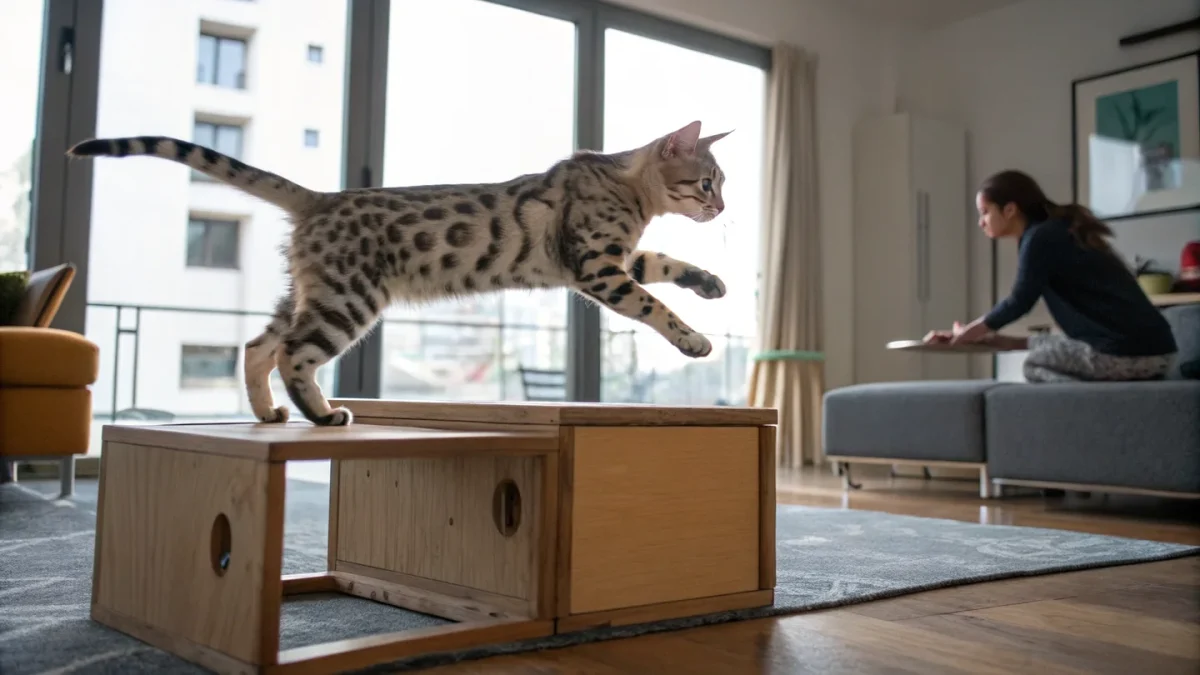
Bengals are sometimes described as "dog-like," and the comparison is more accurate than most cat-breed clichés. Like a dog, a Bengal knows when you're home. It follows. It fetches, sometimes. It wants to be in whatever is happening and makes its wants known through activity rather than meows. Unlike a dog, it can reach the top of the refrigerator from a standing start, and it has strong opinions about the fish tank.
Understanding Bengal temperament requires separating what the breed is from what people project onto it. The wild ancestry creates expectations of aggression or danger that the modern SBT Bengal doesn't warrant. The spectacular coat creates expectations of a show animal that's admired from afar. Neither expectation survives actual contact with a Bengal.
The Activity Level: Take It Seriously
When breeders say Bengals are active, they mean it in a way that's different from saying a Labrador is active. A Labrador retriever goes for a run and then sleeps comfortably for several hours. A Bengal doesn't wind down the same way.
In a well-managed Bengal household, the energy cycles through play and exploration and then rest. What it doesn't do is stay contained. Bengals are vertical animals — they think in three dimensions in a way that flatfooted breeds don't. A Bengal without vertical space is a Bengal that's using whatever vertical space you happen to have, including things you'd prefer it didn't climb.
The athleticism is remarkable. Bengals are muscular cats for their size, with explosive jumping ability and remarkable coordination. Watching a well-conditioned Bengal navigate an enriched environment — making precise leaps, moving through elevated spaces with confidence, engaging with puzzle toys with focused persistence — is genuinely impressive.
Two structured play sessions daily, each 20–30 minutes, are a real need, not an optional enhancement. Interactive toys that simulate prey movement — things that dart, flutter, skitter, or bounce unpredictably — engage the prey drive in ways that simple toys don't. The engagement is qualitatively different from the passive batting at a toy that a less prey-driven cat might manage.
Intelligence: The Double Edge
For the Bengal cat breed overall, intelligence is listed as a feature. Living with it daily requires some calibration.
A Bengal figures out your routine faster than you realize. It knows what time you typically feed it, which behaviors reliably generate attention, how to manipulate the toy you're using in an interactive session, and — frequently — how to open things. Cabinet handles that push down are a known vulnerability. Doors with lever handles are not secure from a determined Bengal.
This intelligence makes Bengals trainable in ways that other cat breeds are not. They respond to clicker training reliably. They learn their names early and consistently. Many Bengals walk on leash harnesses and some sustain genuine recall training. The training relationship engages them in a way that pure play doesn't fully satisfy — there's a cognitive component to structured learning that seems to meet something the Bengal needs.
The intelligence also means consequences for failure to engage. Boredom in a Bengal is not passive. It expresses as investigation, destruction, manipulation of every item in the environment, and behavioral escalation until something interesting happens. The cat is not being malicious. It is simply an intelligent animal applying itself to available stimuli.
Prey Drive and Household Compatibility
The Bengal's prey drive is a characteristic that requires honest consideration before acquisition.
Bengals are intense hunters. They stalk, they ambush, they respond to rapid movement with focused attention that culminates in a grab. This plays out with toys, which is wonderful. It plays out with small household animals — birds, fish, hamsters, guinea pigs — which is a genuine welfare concern for those animals.
Households with birds or rodents as existing pets should think carefully about Bengal acquisition. The drive is not trainable away; it is a core behavioral tendency with roots in the wild ancestry. Coexistence can sometimes be managed with physical separation, but the vigilance required is sustained and absolute.
Cats and dogs, introduced correctly, are generally manageable — the Bengal's active social engagement means many adapt to canine housemates reasonably well, provided the dog is not a breed with strong prey drive toward cats.
Water: The Unusual Affinity
This comes up in almost every discussion of Bengal temperament and is worth addressing specifically: Bengals have a genuine affinity for water that exceeds most domestic breeds.
The behavior is varied — some Bengals play in their water bowl, some investigate running taps, some wade in shallow water, and some simply watch water with unusual focus. A few learn to turn taps on. The Asian leopard cat hunts near waterways and is not averse to water, and this characteristic has carried through generations of domestication.
This is not a problem, exactly, but it is something to accommodate. Water bowl placement matters — a bowl that's easy for the cat to splash out will be splashed out. Some Bengal owners use weighted dishes or corner-positioned bowls for exactly this reason.
The Social Bengal
Bengals are not typically aloof cats. They're genuinely interested in their people, though the nature of the interest differs from, say, a Siamese's constant verbal commentary. The Bengal's social engagement tends to be physical — presence, following, play initiation, rather than sustained vocal demands.
They do notice absence. A Bengal alone all day without another animal for company tends to redirect its energy into the environment in ways that owners would prefer it didn't. A second cat — ideally similarly active — significantly improves outcomes for Bengals in households where people work full days.
The relationship with "their person" can be very close. Bengals frequently select a primary person and are more demonstrably affectionate with them. This is not guaranteed — individuals vary — but the breed has a pattern of strong directional bonding. If the Bengal's domestic-hybrid background is part of the appeal, the Savannah cat represents a similar concept taken further — serval ancestry, even taller frames, and an activity level that makes the Bengal look moderate by comparison.
What Most People Get Wrong
The most common mistake is assuming that Bengal temperament makes them difficult or dangerous. SBT Bengals that are appropriately socialized and well-stimulated are not aggressive animals. They are demanding, active, and high-drive — but these are personality characteristics, not behavioral problems.
The actual difficulty lies elsewhere: in the sustained commitment required. Daily interactive engagement, adequate vertical and spatial enrichment, thoughtful household management. These are not complicated requirements. They are ongoing ones. Bengals that end up in rescue situations are overwhelmingly there because their owners didn't anticipate the maintenance commitment, not because the cats are inherently unmanageable.
A Bengal in the right environment — with active owners, appropriate enrichment, and compatible household animals or company — is one of the most rewarding companion animals available. The wild coat, the intelligent eyes, the athletic displays — these are features that remain impressive years into ownership in a way that mere novelty doesn't explain.