

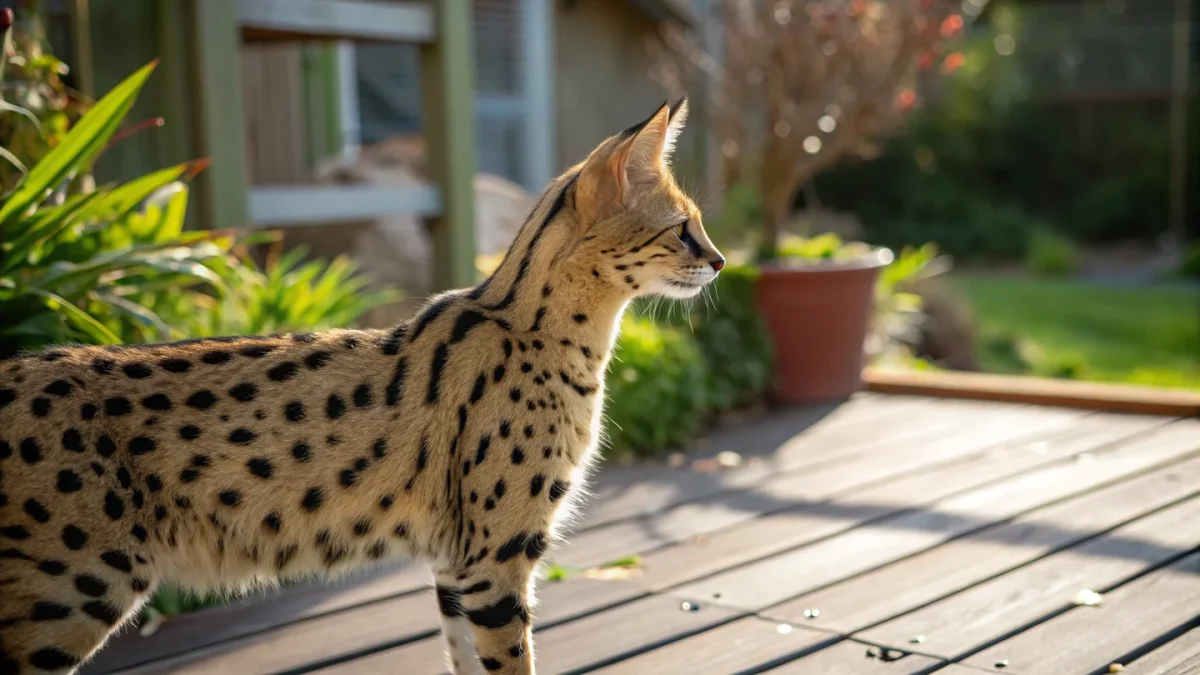
When a Virginia breeder named Judee Frank documented the first-ever serval-domestic cat hybrid in 1986, she named the kitten "Savannah." She had no idea she'd just launched one of the most controversial and captivating breeds in modern cat history.
The Savannah cat is domesticated by paperwork but wild in spirit. Tall, spotted, and intensely athletic, it looks less like a cat you'd find on a sofa and more like something a nature documentary might follow across the Serengeti. That exotic appearance draws a lot of people in. But the Savannah is genuinely unlike any other domestic breed — and understanding what that means is the most important thing you can do before pursuing one.
What Is a Savannah Cat?
The Savannah is a hybrid breed: a cross between the African serval (Leptailurus serval) and a domestic cat. The serval is a medium-sized wild cat found throughout sub-Saharan Africa, known for enormous ears, long legs, and an extraordinary vertical leap that it uses to snatch birds from mid-air.
The breed's development was slow and challenging. Early generations are often infertile (particularly F1 and F2 males), which complicated breeding programs. The International Cat Association (TICA) accepted the Savannah for registration in 2001 and granted it full championship status in 2012 — making it one of the newer recognized breeds in the cat world.
Savannahs are classified by their "filial generation," abbreviated F1 through F7 (and beyond). The number reflects how many generations separate the cat from its serval ancestor. An F1 Savannah has a serval parent. An F2 has a serval grandparent. By F5 or F6, the serval influence has diminished substantially — simple halving math puts F5 at roughly 3% and F6 at roughly 1.5%, though breeder-reported pedigrees (which don't always halve as cleanly as the math suggests) commonly cite F5 closer to 10%. Past F1, the number is always an estimate; getting an exact figure requires DNA testing the individual cat. But the wild look often persists in the coat pattern regardless of the precise percentage.
Physical Characteristics
The breed's most striking feature is its silhouette: tall at the shoulder, long-legged, and narrow-chested compared to most domestic cats. The head is small relative to the body, with large triangular ears set high. Dark "tear duct" lines run from the inner corner of each eye downward — a characteristic seen in cheetahs and servals.
The coat is short and dense, with a bold tabby spot pattern. Ground color typically ranges from golden or amber to silver or smoke, with solid black or dark brown spots. Breeders also produce black and black smoke Savannahs, which display "ghost spots" visible in certain light.
Adult size varies dramatically by generation. F1 and F2 Savannahs — especially males — can be very large cats, with some reaching weights that dwarf a typical domestic breed. There's no standardized per-generation weight chart from TICA or any peer-reviewed source — the numbers you see quoted are breeder-reported, not registry-verified, so treat any specific figure as a loose estimate rather than a guarantee. Later generations (F5+) are closer in size to a large domestic cat, though they typically remain lean and long-legged.
Savannah Cat Temperament
The Savannah is not a breed for someone who wants a cat that keeps to itself. These cats are intensely interactive, curious, and active — traits inherited in varying degrees from their serval ancestry.
Social behavior: Savannahs tend to bond deeply with their immediate household but can be selective about strangers. Many owners describe them as "dog-like" in that they follow their people from room to room, learn to fetch, and can be leash-trained more readily than most domestic cats.
Energy level: High. Consistently, persistently high. A Savannah that isn't engaged will find its own entertainment, and you may not like the results. These cats can open cabinets, knock items off shelves systematically (not accidentally), and leap to heights that catch owners completely off-guard. Early generation Savannahs especially need environmental enrichment — tall cat trees, puzzle feeders, interactive play — as a genuine necessity rather than a nice addition.
Water: Many Savannahs have an unusual affinity for water, occasionally following their owners into showers or playing in water bowls. This is widely reported among owners and likely a serval inheritance — servals hunt near water in the wild.
Vocalization: Savannahs can produce a chirping sound associated with servals, a low hiss, and a classic meow. Not typically as vocally demanding as a Siamese, but not silent.
Multi-pet households: Variable, and highly dependent on generation and individual personality. Early generations have stronger prey drive. Households with small pets (rodents, birds) need to consider this carefully.
Savannah Generations: What F1 Through F7 Actually Means
The filial system is something potential owners need to understand clearly, because it affects everything: size, behavior, price, and in some places, legality.
F1 (50% serval): These are the largest and most serval-like Savannahs. They are challenging to care for, often expensive to acquire, and require experienced owners comfortable with a cat that has strong wild instincts. F1 males are typically sterile; F1 females can be bred.
F2 (approximately 25% serval): Still large and challenging. Better suited to experienced cat owners than F1s, but still demanding. F2 males are also often sterile.
F3 (approximately 12.5% serval): The boundary between "exotic" and "manageable" for many experienced owners. Females are reliably fertile from F3 onward.
F4–F5: These are often called "SBT" (Stud Book Tradition) Savannahs once they've had three generations of Savannah-to-Savannah breeding. Temperament is more predictable, and they are closer to what TICA considers the breed standard. Still larger and more active than most domestic breeds.
F6–F7 and beyond: The serval influence is minimal in appearance and behavior, though the long-legged, spotted look often persists. These cats are closer to an active, engaging domestic breed in day-to-day terms.
What Most People Get Wrong About Savannahs
The most common mistake is treating the F-generation as a single continuous spectrum where "higher = more domestic." The reality is messier. A well-socialized F2 from an excellent breeding program can be easier to live with than a poorly-socialized F5 from a careless one. Generation matters, but individual temperament, socialization history, and the specific domestic breed used in the cross all shape the cat you actually bring home.
The second misconception is about size. Headlines about "the world's biggest domestic cats" pull in readers, but the reality is that while early-generation Savannahs can be genuinely large, the size varies enormously by generation and individual. Many F5+ Savannahs are "only" as large as a big Maine Coon — impressive, but not the exotic giant some buyers expect.
Third: Savannahs are not interchangeable with wild cats as pets. They are domestic cats with a complex heritage — they belong in homes, with families, with proper enrichment. Prospective owners who want a spotted, athletically built hybrid cat with a somewhat different temperament profile should also look at the Bengal cat — another spotted hybrid with wild ancestry — the two breeds draw from different wild lineages and produce quite different ownership experiences. Early-generation Savannahs are not safer or better cared for in exotic animal facilities; they are domestic animals that need human relationships.
Grooming and Care
The short coat requires minimal grooming compared to long-haired breeds — a weekly brush is typically sufficient to control shedding. Savannahs are generally healthy, but potential owners should be aware of several considerations.
Diet: Some breeders and owners feed raw or high-protein diets to early-generation Savannahs, partly based on the logic of approximating a wild cat's natural diet. This is a personal choice with genuine debate around it; anyone considering a raw diet should research thoroughly and ideally consult with a veterinarian familiar with hybrid cats.
Hypertrophic cardiomyopathy (HCM): As with many cat breeds, HCM is a concern in Savannahs. It's the single most common heart disease across cats generally, and no dedicated study has pinned down a Savannah-specific rate — which is exactly why responsible breeders screen breeding animals rather than assume the breed gets a pass.
Pyruvate kinase deficiency (PKD): This hereditary condition affecting red blood cells has been identified in some hybrid breeds, Savannahs included — a 2012 study in BMC Veterinary Research found the mutation at roughly 5% frequency in a sampled group of Savannahs. Testing is available.
Veterinary care: Finding a veterinarian experienced with hybrid breeds can be challenging in some areas. Early-generation Savannahs in particular may need a vet comfortable working with animals that have wild ancestry.
Savannah Cat Ownership and Legality
Before acquiring a Savannah cat, the single most important step is verifying local legality.
The legal picture is genuinely complex. Some jurisdictions ban all hybrid cats; others restrict only the earlier generations; others have no restrictions. This isn't a minor administrative detail — acquiring a restricted animal without proper authorization has serious consequences for both owner and cat.
Is a Savannah Right for You?
The honest assessment: Savannahs are remarkable cats for the right owner. They are highly intelligent, deeply loyal to their families, and genuinely one-of-a-kind in the domestic cat world.
But they are not for everyone, and they are not for someone who wants a low-maintenance companion. They demand engagement. They need space. Early generations in particular require owners who have done serious research, prepared an appropriate environment, and ideally have prior experience with active or demanding cats.
The right owner for a Savannah is someone who finds genuine delight in a cat that acts less like a decorative sofa ornament and more like an alert, opinionated partner — someone who wants a relationship with an animal, not just an animal in the house.
If that sounds like you, and the legality in your area is clear, and you've done the homework on generation differences — a Savannah can be an extraordinary companion.
Frequently Asked Questions
Are Savannah cats dangerous?
Savannahs are domestic animals, not dangerous wild cats. However, early-generation Savannahs (F1–F2) have strong instincts inherited from the serval and are not suitable for inexperienced cat owners. Later generations (F5+) are much closer to a typical domestic cat in temperament. No domestic Savannah cat is inherently dangerous, but they do require appropriate management and enrichment.
How long do Savannah cats live?
Savannahs generally have lifespans similar to domestic cats — roughly 12–20 years with proper care. Providing veterinary care including cardiac screening is important for long-term health.
Are Savannah cats good with children?
Mid- to late-generation Savannahs (F4+) can be excellent family cats when well-socialized. They tend to be playful and interactive. Early generations require more caution around young children, primarily because of their strong prey drive and high activity level rather than any aggressive tendency.
How much do Savannah cats cost?
F1 Savannahs are among the most expensive domestic cats available. Prices typically decrease with each successive generation. F5+ Savannahs from reputable breeders are considerably more affordable.
Do Savannah cats need outdoor access?
Most Savannah owners keep them exclusively indoors or in secure outdoor enclosures. Free-roaming outdoor access is not recommended — for the cat's safety, for local wildlife, and because an escaped early-generation Savannah may raise legal complications in some jurisdictions.