

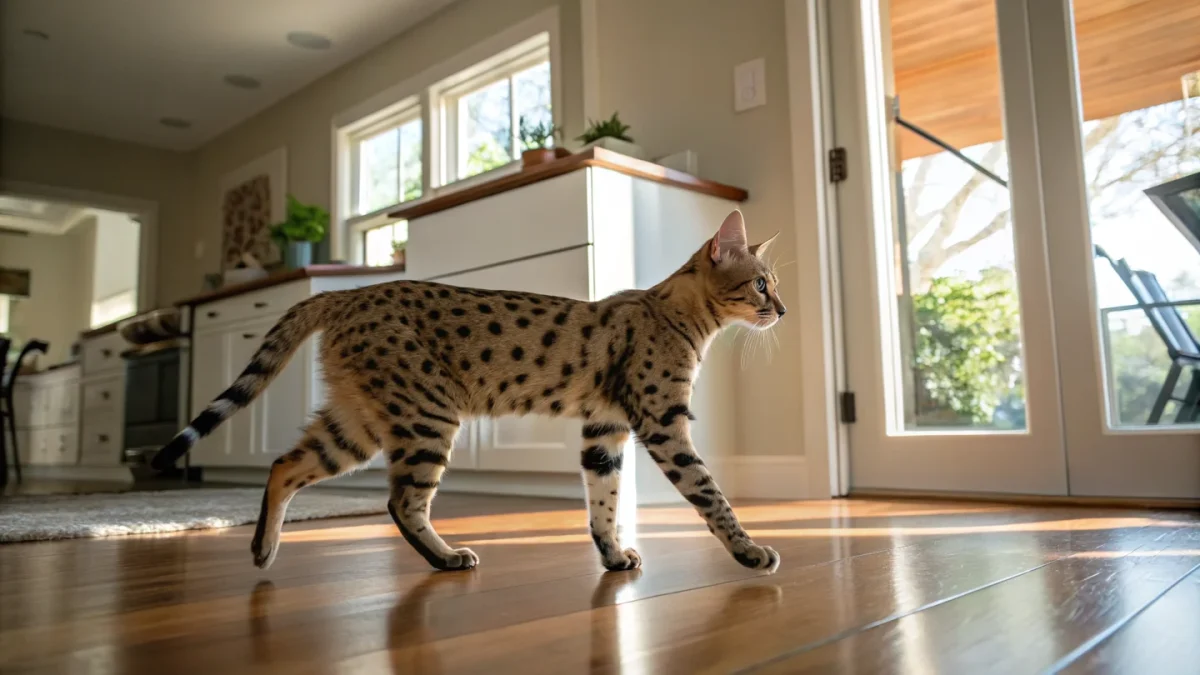
The phrase "part wild, fully devoted" isn't marketing language. It's the closest accurate description of what living with a Savannah cat actually feels like — an animal that came from wild stock and retains wild-edge qualities, but has chosen you, specifically, as its person.
Understanding Savannah temperament means understanding that the breed doesn't come in one variety. A first-generation Savannah is a genuinely different experience from a fifth-generation one. The spotted coat looks the same; the cat inside it does not.
For the full background on the breed's origins and generation system, the full Savannah cat breed guide covers those details.
The Foundation: What the Serval Contributes
The African serval (Leptailurus serval) is an alert, swift, solitary hunter. In the wild, servals are shy around humans and extremely sensitive to their environment. They have enormous ears that detect prey movement in tall grass, and they hunt with patient focus rather than endurance.
These traits don't disappear in Savannah crosses — they dilute slowly across generations. The result is a domestic cat with sharpened instincts: a heightened startle response, keen environmental awareness, stronger prey drive, and an alertness that most domestic breeds simply don't have. Whether that reads as exciting or exhausting depends entirely on the owner.
How Temperament Varies by Generation
F1 and F2 Savannahs tend to be the most complex temperamentally. They bond intensely with their primary household — often a single person or a small family — but can be highly cautious or even reactive with strangers. The wild instincts are present: sudden movements, unfamiliar sounds, and new environments may produce a level of alarm response that surprises owners unfamiliar with hybrid cats.
F1 Savannahs require experienced owners. Not because they're dangerous, but because managing their environment and responding appropriately to their behavioral cues requires a different level of knowledge than most domestic cats demand.
F3 and F4 Savannahs are more reliably social across a broader range of people, though individual variation is significant. Many F3s and F4s settle comfortably into family life with proper socialization, displaying the hallmark Savannah traits — interactiveness, curiosity, dog-like companionship — without the intensity of the earlier generations.
F5 and beyond are where the "dog-like cat" reputation is most consistently earned. These Savannahs are highly social, often greet visitors with curiosity rather than alarm, and maintain the physical beauty of the breed with temperament that experienced cat owners can comfortably manage.
The Dog-Like Qualities: What They Actually Mean
Owners of Savannahs are remarkably consistent in their comparison to dogs, and the comparison has substance. Savannahs:
Follow their people. Not as neurotic behavior — as genuine interest. A Savannah will accompany you from room to room, position itself near where you're working, and orient toward your activity in a way that domestic cats rarely do. It's intentional company, not coincidence.
Respond to leash training. Not all Savannahs take to harness and leash, but many do — and with patience and early introduction, leash walks are a normal part of life for a meaningful number of Savannah owners. This requires proper harness fit and a secure yard or supervised outdoor area.
Learn names and commands. Savannahs learn their own names faster than most cats, respond to recall training more reliably, and can be taught tricks through positive reinforcement. Their intelligence isn't the passive receptiveness of a Persian — it's active and directed toward problem-solving.
Play fetch. A cliché at this point, but it's real. Many Savannahs will retrieve lightweight toys and bring them back. Not every individual, not reliably indefinitely, but the instinct is there.
Water: The Serval Inheritance
Savannahs and water have an unusual relationship. Many Savannahs are fascinated by running water — they play in water bowls, attempt to join showers, and show curiosity about sinks rather than the aversion most cats display. This is widely reported enough to be considered a breed characteristic rather than a quirk of individual personalities.
The likely explanation is the serval's ecology: wild servals hunt extensively in riparian (riverbank and wetland) habitats, and a comfort with water would have adaptive value in that environment.
Practically: keep the lid on the toilet, expect the water bowl to be a play area rather than just a drinking station, and consider a water fountain if standing water is too easily turned into a sport.
The Selective Bonding Reality
One aspect of Savannah temperament that surprises some owners is the depth of selective bonding. These cats tend to identify "their" people and treat them with an extraordinary level of attachment — following, monitoring, and showing obvious distress at extended separation from favored individuals.
The flip side is that this same selective quality means visitors and strangers may receive a much cooler reception, particularly in earlier generations. A Savannah that is a shadow to its owner may sit silently on a high shelf when company arrives, watching with the flat assessment of the serval.
This isn't a flaw or a training failure. It's a temperament characteristic that owners should understand and manage (early, consistent socialization with diverse people matters enormously) rather than expect to disappear.
Energy and Environmental Needs
There is no polite way to say this: Savannahs need stimulation, and they will find it themselves if you don't provide it. Cabinet doors are not deterrents. High shelves are not safe zones. Closed rooms are puzzles.
The minimum for a content Savannah is daily interactive play sessions, access to height (tall cat trees, wall-mounted shelves), puzzle feeders that require engagement to unlock food, and ideally a companion animal — either another active cat or a dog the Savannah has been raised with and trusts.
Savannah owners who try to manage energy through restriction rather than engagement generally end up managing increasingly creative destruction.
Prey Drive and Small Pets
Early-generation Savannahs in particular have notable prey drive. Households with small mammals (rabbits, guinea pigs, rats) or birds need to think carefully about cohabitation. Physical separation with secure enclosures is not overcaution — it's necessary management.
Later-generation Savannahs are typically better in multi-species households, but individual assessment matters. A Savannah raised alongside a small animal from kittenhood is different from one introduced as an adult.
The Right Frame of Mind for Savannah Ownership
Living with a Savannah successfully requires embracing what the breed actually is rather than what you wish it were. These are not cats that appreciate a predictable, quiet routine — they are cats that come alive with engagement and wither with neglect.
The owners who thrive with Savannahs consistently describe the relationship as one of the most rewarding they've had with any animal: an intelligent, loyal companion with a presence that feels genuinely distinct. The owners who struggle with Savannahs are consistently the ones who acquired the breed for the look and were unprepared for the personality.
The look and the personality are inseparable. That's the Savannah. For comparison, the Bengal cat temperament — a spotted hybrid with a different energy profile — is shaped by Asian leopard cat rather than serval ancestry and produces a personality that overlaps in athleticism but diverges in the depth of wild-edge wariness.