

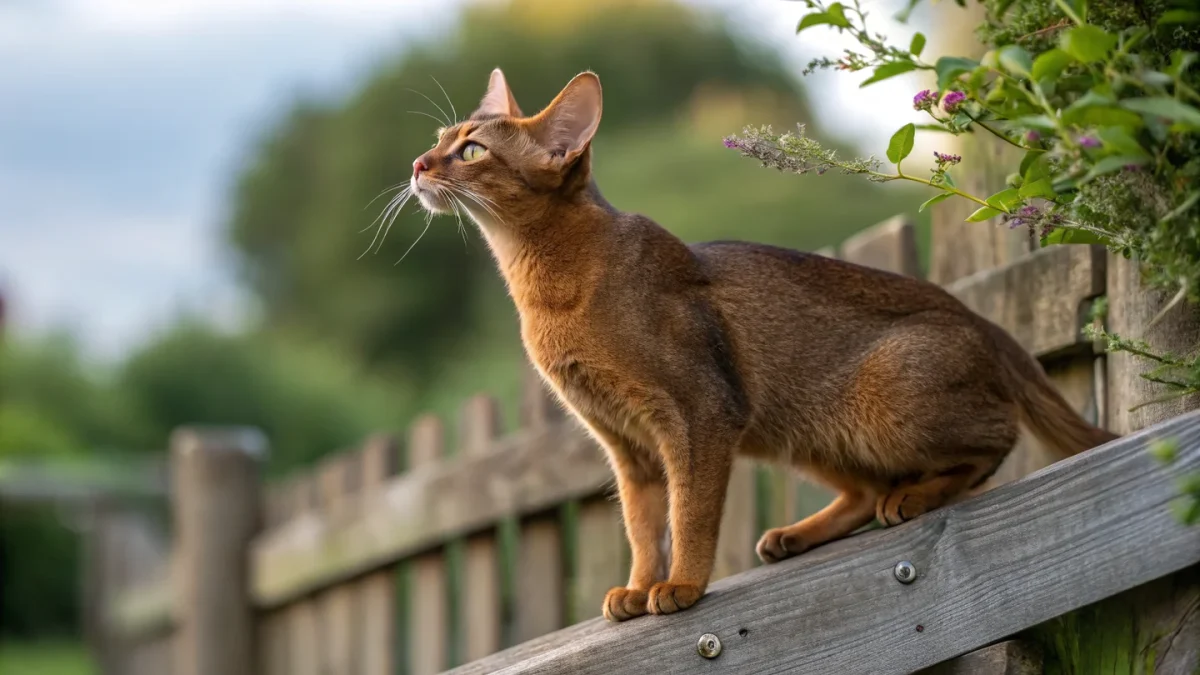
I saw my first Abyssinian at a regional cat show in Portland — not a cat show I'd sought out, but one my Maine Coon breeder friend dragged me to because she had two entries that weekend. I was there for her cats. And then an Abyssinian walked past in someone's arms, and I forgot what I was doing.
It wasn't the color, though the ruddy coat is striking. It was the quality of the cat's attention. Most cats at a show are either resigned or agitated. This one was actively interested in everything — scanning the room the way a hawk scans a field, ears rotating independently, every muscle carrying this low-level readiness. Like the cat had a list of things to understand and was steadily working through it. My breeder friend saw me watching and said, without ceremony, "They're the border collies of the cat world." She wasn't wrong.
The Abyssinian comes with a lot of origin mythology — the Ethiopian campaign, the Victorian Army officer, the founding cat named Zula. Some of it holds up. Some of it doesn't. Modern genetic analysis suggests contemporary Abyssinians trace their ancestry not primarily to Ethiopia but to populations along the Indian Ocean coast, possibly near the Bay of Bengal or Southeast Asia. A 2008 UC Davis study — Lipinski and colleagues, published in Genomics — found Abyssinians carrying genetic markers shared with Southeast Asian cat populations, not African ones. The Ethiopian story appears to be, at best, the story of one founding individual, not the whole breed. Wherever they actually came from, they arrived in Victorian England as something clearly distinctive. And they've been impossible to ignore ever since.
The Abyssinian at a Glance
If the Siamese is the conversationalist of the cat world and the Bengal is the athlete, the Abyssinian is the explorer — a cat that treats every inch of its environment as a territory to be understood, mapped, and regularly reassessed.
They are not still animals. An Abyssinian at rest is planning its next movement. These cats patrol, investigate, and engage with their environment in a way that makes the typical domestic cat look sedentary. Their energy level is genuinely extraordinary — sustained across the day in a way that surprises owners who keep less active breeds.
Size: Medium. Males 3.5–5 kg (8–11 lbs), females 2.5–4 kg (6–9 lbs). The weight doesn't convey the impression — Abyssinians appear larger than they are because of their muscular build and the way they carry themselves.
Coat: Short, fine, and uniquely ticked. Each hair has multiple bands of color, creating a depth and shimmer that photographs incompletely. The ticking is the defining characteristic of the breed and produces a coat unlike any other shorthaired domestic cat.
Lifespan: 12–15 years, with many reaching the mid-teens.
The Ticked Coat: What Makes It Distinctive
The Abyssinian coat pattern is technically called "agouti" or "ticked tabby." It's produced by a gene (the Ta or ticked gene) that suppresses the dark tabby striping pattern while leaving the individual hairs banded in multiple colors. The result: no visible stripes or spots on the body, just a coat where each hair graduates from dark tip to lighter middle to pale base.
In direct light, the coat creates a shimmering, almost iridescent effect — the color shifts subtly as the cat moves because the light hits different bands of each hair. This is particularly striking in the ruddy color, where the ticking runs from dark brown-black tips to orange-red middle tones to a warm apricot base.
The four recognized base colors are:
Ruddy (or "usual" in some registries): Dark brown-black ticking over a warm orange-red base. The most common and visually dramatic.
Blue: Soft blue-gray ticking over a warm blue-beige base. The dilute of ruddy.
Sorrel (or cinnamon): Lighter chocolate-cinnamon ticking over a warm apricot base.
Fawn: The dilute of sorrel — very soft, warm beige ticking over cream. The rarest of the four traditional colors.
Abyssinian Personality: The Perpetual Explorer
The Abyssinian personality is consistent across the breed in a way that makes descriptions reliable: these are curious, active, engaged cats that don't default to passive observation. They investigate. They interact. They move.
This is not the same as destructiveness — an Abyssinian is not typically pulling things off shelves out of frustration. The motivation is curiosity, not restlessness. The distinction matters in practice: you can direct an Abyssinian's energy toward enrichment rather than simply trying to suppress it.
Abyssinians do not typically "lap cat" in the traditional sense. They prefer proximity to contact — they'll sit near you, on the arm of your chair, watching what you're doing, but sustained sitting in one spot isn't their default. The exception is during rest: when an Abyssinian finally decides to stop, it often chooses a close, warm location, and the switch from perpetual motion to complete stillness is one of the more charming things about the breed.
They bond with their families rather than selecting a single person the way Siamese tend to. They're generally sociable with visitors once they've assessed the situation. They do well with other cats and can adapt to dogs, provided the introductions are managed.
Abyssinians do not do well in isolation. The energy and curiosity that make them so engaging also makes solitude stressful. A single Abyssinian left alone all day without company — feline or otherwise — often develops stress behaviors. Two cats in an active household generally fare much better.
What Most People Get Wrong About Abyssinians
The most widespread misconception is that the Abyssinian's activity level makes it difficult or high-maintenance in the sense of requiring constant attention. This misframes the issue.
Abyssinians are self-directed in a way that some high-energy breeds are not. A well-enriched Abyssinian will find its own activities throughout the day — investigating, playing, exploring elevated spaces — without requiring you to actively facilitate every moment. What they need is an environment that supports this: cat trees, climbing infrastructure, puzzle toys, windows with views, and company. They're not asking for constant interaction; they're asking for a rich environment.
The second misconception is about the voice. People expecting a vocal cat based on the energy level are often surprised: Abyssinians are relatively quiet. They're not Siamese. They communicate, and they have a pleasant chirping trill that owners describe as charming, but they don't maintain a running verbal commentary.
Abyssinian Health
The Abyssinian carries some specific hereditary conditions that prospective owners should understand.
Progressive retinal atrophy (rdAc-PRA): A form of hereditary PRA specific to Abyssinians, caused by a mutation in the CEP290 gene. DNA testing is available. Responsible breeders test breeding animals. The condition leads to gradual vision loss but is not painful. The numbers here have moved a lot — a 2010 study in The Veterinary Journal found the mutation had reached roughly 45% of the Swedish Abyssinian population in the early 1980s before targeted screening drove it down to around 4%, while allele frequencies elsewhere run lower (about 7% in North America, closer to 21% in the UK).
Pyruvate kinase deficiency (PK-Def): A hereditary enzyme deficiency causing hemolytic anemia. DNA testing is available and should be part of responsible breeding programs. Affected cats have shorter red blood cell lifespan and may require monitoring and occasionally intervention. A 2012 BMC Veterinary Research study found the mutant allele in roughly 5% of unbiased US Abyssinian samples, climbing to about 15% among cats submitted specifically for PK screening — which makes sense, since the breeders bothering to test are often the ones who already suspect a problem in their line.
Renal amyloidosis: A condition where amyloid protein deposits accumulate in the kidneys, potentially leading to kidney failure. More common in Abyssinians and related breeds (Somali) than in most domestic cat populations — it's been recognized as a distinct familial condition in the breed since researchers first described it in the 1980s, and it's still an active subject of genetic research. Nobody's pinned down an exact breed-wide prevalence number, but it's specific enough to certain lines that responsible breeders treat it as a known risk, not a fluke.
Dental disease: Common across domestic cats; the Abyssinian's lean jaw may predispose to some degree of dental crowding. Regular dental checks and good dental hygiene practice matter.
The lean, muscular build that characterizes Abyssinians also means that illness or weight loss shows up faster and more prominently than in heavier-framed breeds. Regular vet check-ups and familiarity with your cat's normal weight and condition help catch issues early.
Abyssinian Cat Care
Activity and Enrichment
This is the primary commitment with an Abyssinian. Daily interactive play sessions, proper climbing infrastructure, and environmental variety are requirements rather than enhancements. Puzzle feeders, rotating toys, and access to window views meet much of the need between active sessions.
Two interactive sessions daily of 15–20 minutes serve most Abyssinians well. The sessions satisfy the prey drive, provide bonding time, and reduce the probability of the cat finding its own entertainment in ways you'd prefer it didn't.
A tall, stable cat tree is not optional. Abyssinians like height, and they're heavy enough to stress structures that weren't built for an active medium-sized cat.
Grooming
The short, ticked coat is exceptionally easy to maintain. Weekly brushing with a fine-toothed comb or rubber brush removes loose hair and distributes skin oils. Shedding is moderate and manageable. The coat doesn't mat or tangle. Dental care, nail trimming, and ear checks follow the standard routine for all cats.
Nutrition
Abyssinians are lean, active cats with metabolisms that support their activity level. Quality nutrition with adequate protein for the energy expenditure is appropriate. Monitor weight regularly — the lean build means changes are visible, but it's also easy to underestimate weight loss early on.
The Right Owner for an Abyssinian
The Abyssinian thrives in active households where people enjoy watching a cat truly engage with its environment. They're remarkable companions for work-from-home situations where the cat's constant activity becomes pleasant background entertainment rather than an interruption.
They suit families with other animals, children who want an interactive cat, and anyone who finds the idea of a perpetually curious, self-directed companion appealing rather than exhausting.
What they're not suited to is a very quiet, solitary household with long, unchanging routines and little environmental variation. Not because they're difficult — they're genuinely one of the more self-contained of the active breeds — but because their intelligence and curiosity need material to work with.
FAQ
Are Abyssinians good apartment cats?
Yes, with appropriate enrichment. Space matters less than vertical opportunity and stimulation. A well-enriched apartment with climbing infrastructure, puzzle feeders, and window views suits an Abyssinian adequately. A large house with no enrichment suits it worse.
Are Abyssinians vocal?
Not particularly. They have a quiet chirping trill that owners find charming, but they're not continuous vocalizers in the Siamese sense. The energy is expressed through activity, not sound.
Do Abyssinians like other cats?
Generally yes. Abyssinians are social with other cats and often do better with a feline companion, particularly if owners work full days. The energy levels often match well with similarly active breeds.
Are Abyssinians good with children?
Yes, provided children can engage with a cat that doesn't sit still. Abyssinians enjoy active interaction and play, which suits children looking for an engaged cat. They're quick enough to avoid unwanted handling and don't typically respond to stress with aggression.
How active are Abyssinians compared to other breeds?
Among the most active of domestic cat breeds. They are comparable to Bengals in energy level but express it somewhat differently — Bengals have a stronger prey-drive focus, Abyssinians have a broader curiosity-driven exploration behavior. Both require serious enrichment commitment.