

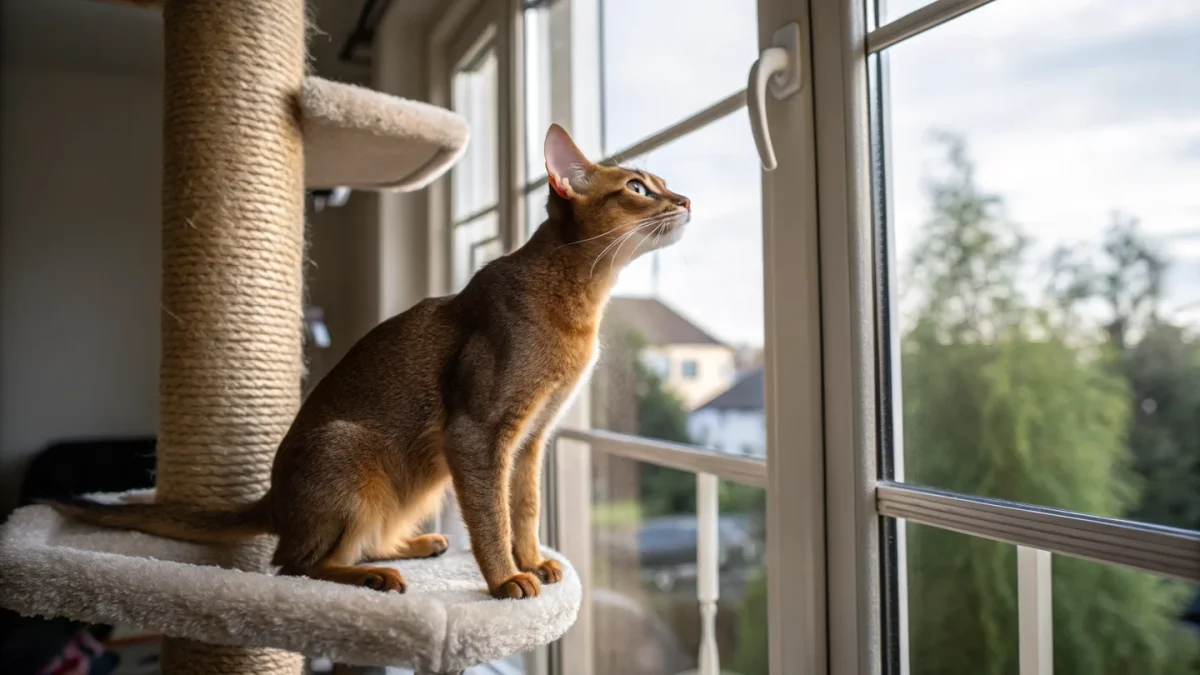
There's a moment in every Abyssinian owner's first week that captures the breed's personality completely: you're sitting in a chair doing something quiet, the cat has just burned through what you thought was an impressive amount of energy, it appears finally about to settle — and then it notices something. A shadow on the wall, a small sound from another room, the specific way the curtain moved. And it's gone again.
The Abyssinian does not drift through life. It investigates it.
Understanding this temperament accurately — not as hyperactivity but as specific, directed curiosity — changes how you manage the relationship. The goal is not to contain the energy. It's to work with it.
What "Active" Actually Means in Practice
The word "active" appears in every Abyssinian description and conveys less than it should. All cats are active sometimes. The Abyssinian characteristic is more specific: these are cats with a very broad and sustained attention to their environment. They notice more things, respond to more stimuli, and follow through on investigation more persistently than most breeds.
This looks like: checking every new person who comes into the house (rather than retreating). Following movement through windows with intense focus. Returning repeatedly to investigate something new in the room. Climbing to new high points and assessing the environment from each. Using their paws to examine objects — touching, moving, exploring — in a way that resembles deliberate investigation.
It doesn't usually look like: frantically bouncing off walls, destructive behavior from frustration, or constant vocalization. Abyssinians in well-enriched environments are busy in a focused way, not a chaotic one.
The sustained nature of the activity is what surprises people used to other cat breeds. A Persian might investigate something for a few seconds and return to resting. An Abyssinian invests more time in its investigations and covers more environmental territory in a day.
Curiosity as the Primary Trait
If the Abyssinian breed were to be summarized in a single characteristic, it would be curiosity — specifically, the functional kind that leads to engagement rather than merely watching.
Abyssinians interact with objects. They bat at things to see what happens. They open or attempt to open things. They watch what their owners do with a focus that reads as genuine interest rather than incidental observation. Owners who work with their hands — drawing, crafting, working with physical objects — frequently report that their Abyssinian is immediately at the table, watching closely.
This curiosity extends to people. Abyssinians are not typically shy with strangers — they assess, briefly maintain some distance if the person's energy is uncertain, and then move in to investigate. The investigation is often physical: sniffing, touching, examining. They want information.
The curiosity is also somewhat task-persistent in a way that distinguishes Abyssinians from less engaged breeds. If they want access to something, they will try multiple approaches. Simple deterrents that work on other cats may require supplementation.
The Affection Question
People sometimes expect either a very cuddly breed or a cold, aloof one from descriptions of the Abyssinian's activity level. The reality is more nuanced.
Abyssinians are affectionate in an active way. They show up where you are. They want to be involved in what you're doing. They're interested in you, which is different from wanting to be physically held. The contact they seek is often parallel — sitting near you rather than on you, adjacent during activity rather than draped and still.
The exception to this is during their genuine rest periods, which do happen. When an Abyssinian finally decides the day's investigation is complete and it's time to stop, it will often seek out a close, warm spot — sometimes including a lap. These moments feel like a reward precisely because they aren't the default state.
The affection also runs directionally. Abyssinians notice when their people leave, seem pleased when they return, and track household routines in a way that suggests genuine investment in the humans rather than mere tolerance of them.
Solitude and Social Needs
Abyssinians need company. This is not a breed that manages alone time well without a companion animal.
A single Abyssinian in an empty household all day has several cubic meters of curiosity and nowhere productive to direct it. The enrichment environment matters — cat trees, puzzle feeders, rotating toys can extend independence for a while. But the social need is real and doesn't fully disappear with physical enrichment.
Two cats, particularly two similarly active cats, work much better. They provide each other stimulation, play opportunity, and company in a way that enrichment objects can't replicate. Many Abyssinian breeders recommend adopting two kittens from the start specifically for this reason.
The alternative is regular social contact from people — a work-from-home owner, a household with multiple people at varying hours. The Abyssinian's definition of adequate company is flexible, but it needs to be met by something.
The Abyssinian Alongside Other Pets
This is one of the more socially adaptable of the active breeds. Abyssinians generally accept other cats reasonably well, with appropriate introductions — the energy levels often create a functional match with other active breeds or younger cats.
Dogs are variable, as always. An Abyssinian that has encountered dogs positively in kittenhood adapts better than one with no prior exposure. Their confidence and lack of the skittish retreat that some breeds show means they often establish themselves with dogs more quickly than expected.
Small animals — rodents, birds — require caution. Not because Abyssinians are aggressive, but because the same investigative drive that makes them so engaging with their environment extends, without distinction, to small cage animals.
What Most People Get Wrong
The main misconception is framing the Abyssinian's activity as a management problem rather than a personality characteristic. Owners who try to suppress or ignore the curiosity and activity tend to have less satisfying experiences than those who work with it.
The right frame is: this cat is interesting, and giving it interesting things to do pays dividends in a relationship that stays engaging for fifteen years. The cat that arrives at the work desk every time you sit down isn't being disruptive — it's interested in you, and in what you're doing. That's a different cat than the one that sleeps on the couch indefinitely. The Somali cat — genetically a longhaired Abyssinian — shares every characteristic of this temperament profile, wrapped in a more dramatic semi-long coat.