

For at least three decades, longhaired kittens appeared in Abyssinian litters and were quietly given away as pets. The Abyssinian breeding community treated them as an embarrassment — an anomaly that suggested questionable ancestry or a stray gene that had crept in somewhere. Breeders didn't talk about them at shows. They certainly didn't breed for them.
Canadian breeder Evelyn Mague changed that in the 1960s when she received one of these "accidental" longhaired Abyssinian kittens and recognized it as beautiful rather than defective. She named him George. George became the foundation of a deliberate effort to establish the longhaired Abyssinian as its own breed. Mague named it the Somali — partly for geography (Somalia borders Ethiopia, the Abyssinian's homeland) and partly because it sounded right.
The Cat Fanciers' Association recognized the Somali in 1979. The Abyssinian breeding community's initial resistance softened once it became clear that longhaired Somalis and shorthaired Abyssinians could be shown separately without controversy, and some breeders today maintain both.
What Is a Somali Cat?
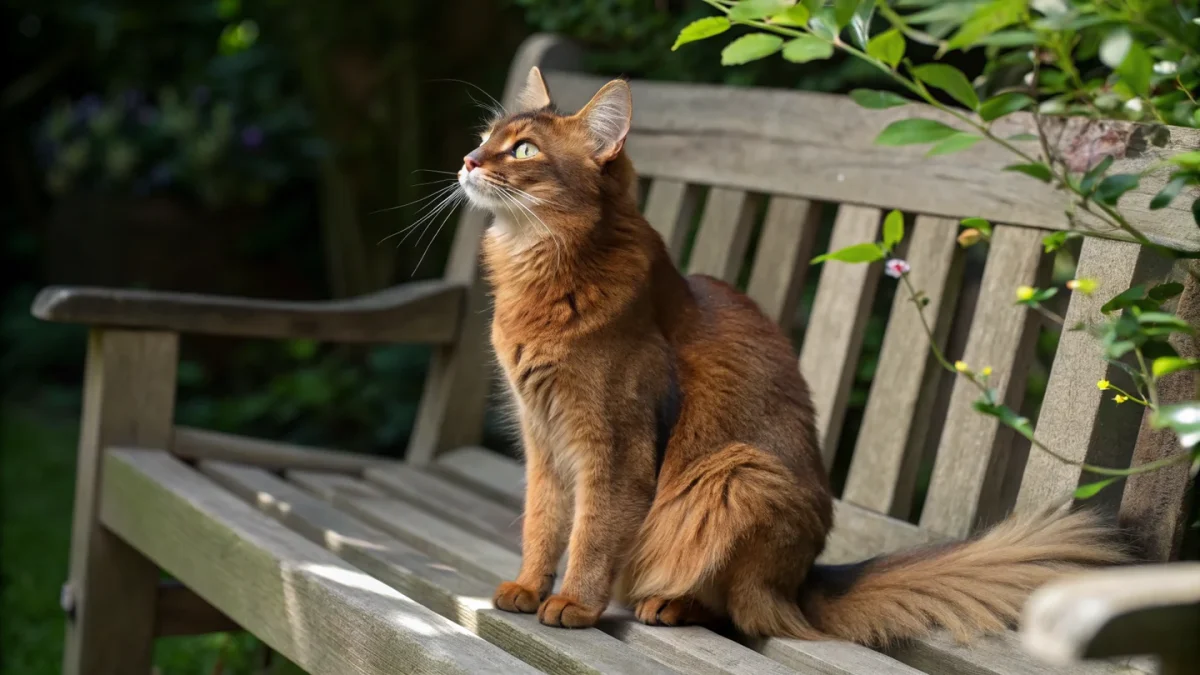
The Somali is the longhaired version of the Abyssinian, sharing identical temperament, structure, and coat pattern but with medium-long fur that creates a dramatically different silhouette. The ticked tabby pattern — each hair banded with alternating dark and light pigment — appears in both breeds, and the warm, wild-looking coloration is the same. What changes with the longer coat is the drama of the presentation: a Somali has a magnificent full tail, a neck ruff that suggests a small lion, and tufted ears that emphasize the already fox-like face.
The two breeds share a genetic relationship that's unusually direct: the longhair gene in Somalis is a recessive mutation, and the Abyssinian — the Somali's short-haired genetic twin — can carry it without expressing it. Breeders who work with both breeds can produce both from the same lines.
Physical Characteristics
The Somali is a medium-sized cat with a foreign (lean, elegant) body type. The structure is athletic and lithe — not as extreme as a Siamese, but distinctly different from a cobby Persian or British Shorthair. The legs are long and slender; the tail is thick at the base and tapers to a point, fully plumed like a fox's brush.
The head is a modified wedge: gently contoured, with a slight dip between forehead and nose but no sharp angles. Large, widely set ears are often tufted. The large almond-shaped eyes are gold, green, or copper, outlined by "mascara" markings — dark pigment that accentuates the eye and contributes to the wild, expressive look.
Coat: Medium-long, silky, and fine. The longhair gene softens the coat rather than dramatically extending it — a Somali doesn't have the extreme length of a Persian or a Maine Coon. The coat lies relatively close to the body except on the tail and ruff.
Colors: The classic Somali colors follow the Abyssinian palette:
- Ruddy (usual): warm brown-orange with black ticking, the most iconic color
- Red (sorrel): warm copper with chocolate ticking
- Blue: warm gray-beige with deeper blue-gray ticking
- Fawn: pale mushroom with deeper fawn ticking
- Additional dilute and silver variations exist and are recognized by some registries
The ticked pattern means there are no stripes or spots on the body — just the warm, almost glowing iridescence of individual hairs banded with alternating dark and light pigment. The effect in natural light is striking: the coat seems to shift and shimmer as the cat moves.
Somali Temperament
If the Ragamuffin is a cat you experience by sitting still, the Somali is a cat you experience in motion. These are intensely active, curious, and playful animals that bring a quality of focused alertness to everything they do.
Energy level: High and sustained. Somalis don't have random bursts of energy followed by long rest periods — they maintain engagement throughout the day. They need play, exploration, and outlets for their physical energy. A cat tree isn't enough; they need interactive play sessions, puzzle feeders, and ideally the company of another active cat.
Intelligence: The breed's intelligence is the kind that finds problems to solve rather than simply observing them. Somalis open doors, learn to operate faucets, and figure out toy mechanisms quickly. They are not willfully destructive, but they do require an environment that can absorb a cat with strong investigative instincts.
Social behavior: Somalis form genuine bonds with their people but are not clingy in the way Ragdolls or Ragamuffins are. They want to be near their humans and involved in household activity, but on their own terms — they join you rather than collapsing on you. They are affectionate without being demanding of physical contact.
Vocalization: Moderate. Somalis have a pleasant, musical voice and use it, but they're not the continuous-commentary cats that Siamese tend toward.
Multi-cat households: Somalis generally do well with other active cats. Pairing a Somali with a sedentary breed is sometimes a mismatch — the Somali's energy level can overwhelm a cat that prefers stillness.
What Most People Get Wrong About Somalis
The most common misconception is treating the Somali as simply "a fluffy Abyssinian" — as if the longer coat is the only meaningful difference. In practical terms, the longer coat does change the grooming requirements, but more significantly, potential owners often underestimate just how active and interactive the Abyssinian temperament is before acquiring a Somali.
Both breeds were shaped by generations of selection for alertness and activity. The coat is different; the personality is essentially identical — and the Abyssinian/Somali temperament is not for everyone. These are not cats that will quietly adapt to a quiet life.
Second: people sometimes expect that the "recessive gene surprise" story means Somalis have uncertain genetics. Modern Somali breeding lines are well-established. When two Somalis are bred together, all kittens will be longhaired. The gene is no longer lurking as a surprise; it's the foundation of a distinct, stable breed.
Third: the ticked coat looks low-maintenance compared to a Persian. It's easier, but Somalis do shed noticeably and the medium-length fur can tangle around the collar area and under the armpits with neglect. Weekly grooming is necessary.
Somali and Abyssinian Genetics
The longhair in Somalis is produced by a recessive variant of the fibroblast growth factor 5 (FGF5) gene — a mutation associated with long coats in multiple domestic cat breeds. A 2007 study in the Journal of Heredity pinned down the specific mutation: a missense change (c.194C>A) found homozygous in long-haired cats across several breeds, Somalis included, alongside Persians, Maine Coons, and Ragdolls.
The ticked pattern is produced by the agouti gene (specifically the ASIP gene pathway), which suppresses the expression of striping and spotting patterns and allows the banded ticking to appear uniformly across the coat. This is the dominant form; non-agouti cats (solid-colored cats) carry two copies of a recessive non-agouti allele that suppresses the ticking pattern. Abyssinians and Somalis are agouti cats — the ticking is their natural expression of the tabby gene.
The wild-looking result is no accident of breeding: the ticked tabby pattern is the "original" domestic cat tabby type, closely resembling the coats of small wild felids throughout Africa and Asia.
Grooming
The Somali coat is easier to maintain than it looks. The semi-long fur has a silky texture that resists matting — it's not the dense undercoat of a Norwegian Forest Cat that requires daily intervention. Weekly brushing or combing is generally sufficient for a pet-quality Somali.
Pay particular attention to the collar area, armpits, and under the tail, where tangles are most likely to develop. The plumed tail is usually self-maintaining and rarely mats if brushed weekly.
Somalis shed year-round with heavier periods in spring and fall. Maintaining a regular brushing schedule reduces shedding around the house substantially.
Health Considerations
Somalis share the Abyssinian's health profile, including some breed-specific concerns.
Pyruvate kinase deficiency (PKD2): This hereditary red blood cell enzyme deficiency causes hemolytic anemia in affected cats. A DNA test is available and responsible breeders screen for it. Different from the PKD (polycystic kidney disease) that affects Persians — this is a separate condition with a different gene. Ask breeders for test results.
Progressive retinal atrophy (rdAc-PRA): A form of progressive blindness has been identified in Abyssinians and Somalis. A DNA test is available. Responsible breeders test their breeding animals.
Renal amyloidosis: Reported in Abyssinians and may occur in Somalis — the veterinary literature treats it as a shared familial condition across both breeds rather than tracking them separately, and honestly, nobody has published a clean prevalence number for either breed on its own. Involves protein deposits in the kidneys.
Dental disease: Somalis can be susceptible to periodontal disease. Regular dental care is important.
Reputable breeders will have documentation of PKD2 and PRA testing for their breeding animals. These tests should be asked about before acquiring a kitten.
Is a Somali Right for You?
The Somali is the right cat for someone who genuinely wants an active, engaging companion — someone who finds a cat's energy level and curiosity delightful rather than exhausting.
They thrive in households with activity, with other cats, with owners who play daily and provide environmental enrichment as a normal part of cat ownership. They are suited to confident cat owners who aren't disturbed by a cat that will figure things out faster than expected.
They are not suited to people wanting a quiet companion, people with very small living spaces and no enrichment setup, or households where the cat would be alone for most of the day without another animal for company.
A Somali kept engaged, given appropriate outlets, and monitored for its specific health concerns can be a companion of extraordinary personality and beauty — the kind of cat that makes people stop mid-sentence at their first encounter with the breed.
Frequently Asked Questions
Are Somalis rare cats?
Somalis are less common than mainstream breeds but not genuinely rare. They are recognized by major registries and bred specifically by dedicated programs worldwide. They may be harder to find than a domestic shorthair or a popular breed like a Maine Coon, and wait lists at reputable breeders are common.
Is a Somali cat the same as an Abyssinian?
They share the same ticked tabby coat pattern, body type, and temperament — the Somali is essentially the longhaired version of the Abyssinian. The key physical difference is the coat length: the Somali's FGF5 gene mutation produces medium-long fur. Behaviorally and temperamentally, the two breeds are nearly identical.
Do Somali cats get along with children?
Somalis' high energy level and playful nature can make them good companions for active older children. With young children who may not know how to interact gently, supervision and early socialization are important. The breed is not aggressive, but it does require appropriate interaction.
Are Somali cats easy to train?
The Somali's intelligence makes it receptive to positive reinforcement training. Many owners successfully leash-train Somalis, teach them to come when called, and even work through basic agility exercises. They enjoy the mental engagement of training. But "trainable" and "obedient" aren't quite the same thing — a Somali will cooperate when it finds the activity worthwhile.
How much do Somali cats shed?
Noticeable but manageable with regular grooming. The medium-length coat sheds throughout the year with heavier periods in spring and autumn. Weekly brushing controls the bulk of it. The coat doesn't produce the carpet-level shed of a fully double-coated breed, but it's more than many shorthaired cats.