

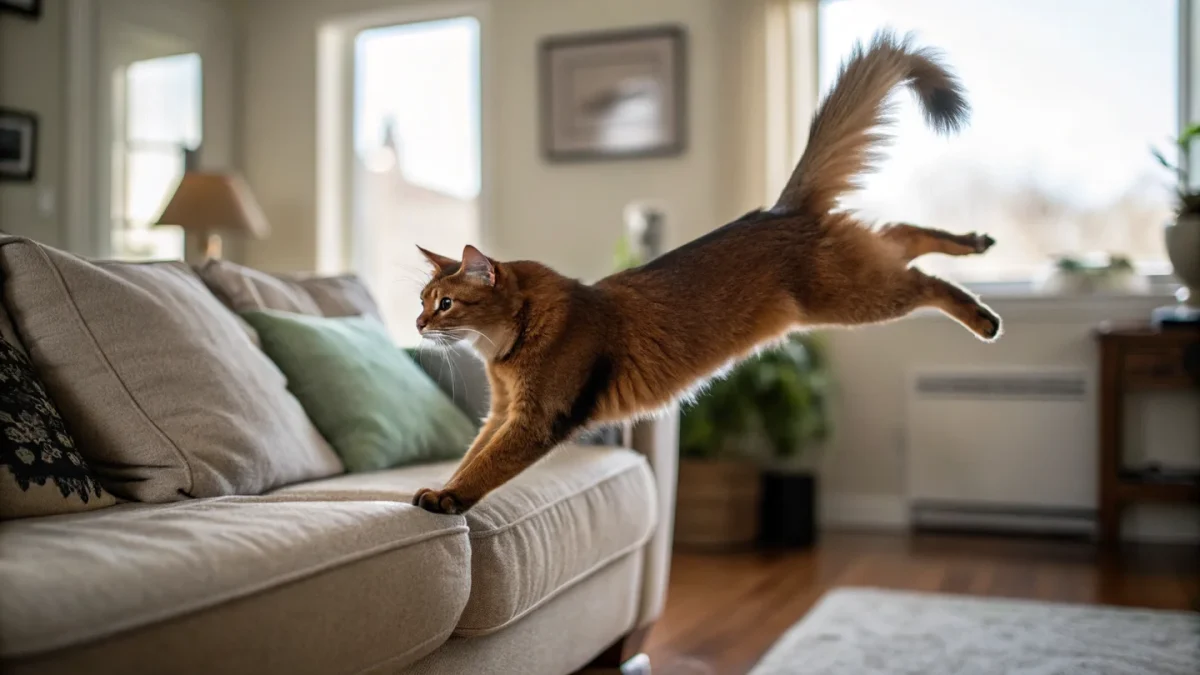
The Somali's nickname in breed circles is "the fox cat." It's an earned description — the triangular face, alert upright ears, ticking pattern, and magnificent plumed tail all contribute to the resemblance. But the nickname goes deeper than appearance. The Somali has a fox's quality of intelligence: watchful, adaptive, problem-solving.
A fox doesn't sit. A fox investigates.
The Somali cat breed guide covers the breed's history and how it developed from Abyssinian lines. What that guide can't fully convey is what the temperament feels like on a Tuesday afternoon when the cat is conducting a systematic audit of every shelf in the room.
The Abyssinian Core
The Somali's personality is essentially the Abyssinian personality with longer fur. This is not a criticism or a reduction — the Abyssinian temperament — the same personality in a short-coated package — is distinctive and specific, and it's worth understanding clearly before acquiring either breed.
Abyssinians were described by early breed chroniclers as "the clowns of the cat world" — a label that captures the playfulness but not the intelligence. These are cats that engage with their environment at a level that most domestic cats don't approach. They watch, they remember, they try things. An Abyssinian or Somali that has observed you operate the kitchen faucet twice will be attempting it independently before the week is out.
The energy level is not sporadic. Somalis don't have the manic half-hour of activity followed by hours of sleep that characterizes many cats. They sustain engagement throughout the day — curious, active, alert. The rest periods exist, but they're shorter and the ratio of active to inactive is different from most breeds.
What "Active" Actually Means
People say "active cat" the way they say "needs a yard" about dogs — as a phrase that sounds manageable. What it means with a Somali is worth spelling out.
A Somali will: investigate the top of every bookcase. Develop techniques for opening certain types of cabinet latches. Turn water bowls into interactive stations. Follow you into every room and watch what you're doing with focused attention. Get bored with toys faster than you can rotate them. Invent games that involve tipping objects off elevated surfaces to observe the result.
None of this is malicious. All of it is exhausting if you aren't someone who finds a cat with the energy of a three-year-old child endearing rather than wearing.
The solution isn't more space — it's more engagement. Puzzle feeders, daily interactive play, tall climbing structures, window perches with outdoor views, and ideally a companion cat who can match the Somali's pace. A Somali that is appropriately enriched is delightful company. A Somali that isn't is a management problem.
The Bond: Near but Not Clingy
Somalis form genuine bonds with their people, but the character of the bond is different from, say, a Ragamuffin's.
A Ragamuffin wants to be on you. A Somali wants to be with you, observing and occasionally participating. The distinction matters. Somalis typically follow their owners through the house, position themselves in the room where activity is happening, and engage when invited — but they don't demand the physical closeness that more lap-oriented breeds do.
This independence can be misread as aloofness. It's not. A Somali that trusts you will initiate contact on its own terms: jumping up for a brief session of headbutts, settling near (not on) you in the evening, showing the specific kind of soft-purring presence that indicates genuine contentment with your company.
The difference from aloof breeds is that the Somali is paying attention. It knows where you are. It knows what you're doing. It's just confident enough in the relationship not to need constant physical reassurance.
Play: Real and Sustained
Somalis play with genuine athletic commitment. Feather wands become targets to be caught with real technique — a Somali in full play mode shows the lateral leaping, the aerial grab, the rapid foot pivot that indicates an animal with serious predatory hardware engaged.
Daily play is not optional for a Somali's wellbeing — it's necessary. A breed with this level of physical and cognitive energy needs outlets for both. Interactive sessions of 20–30 minutes per day, using toys that move unpredictably and require the cat to problem-solve, keep a Somali mentally and physically satisfied.
Many owners find that two Somalis together play with each other in ways that reduce the burden on human participation, though this doesn't eliminate the need for owner-involved sessions — it supplements them.
Vocalization
The Somali's voice is pleasant — neither the persistent volume of a Siamese nor the silence of a Norwegian Forest Cat. They communicate when they have something to say: at meal times, when they want something specific, or occasionally when running commentary seems appropriate.
The characteristic sound is more chirp than meow — a soft, musical utterance that owners find easier to describe as pleasant than demanding.
With Other Cats
Somalis do well with other active cats and particularly well with other Somalis or Abyssinians. The pairing of a high-energy cat with a sedentary one can create tension — not because the Somali is aggressive, but because its desire to engage, play, and initiate interaction can overwhelm a cat that prefers stillness.
If introducing a Somali to a resident cat, consider the resident cat's energy level. A compatible match leads to a genuine feline friendship; a mismatch leads to years of low-level friction.
With Children
Somalis' playfulness and physical confidence makes them good companions for active older children who approach the cat on the cat's terms. The breed isn't reactive or skittish with children, but it also won't simply endure being handled — it will remove itself.
For families with older children who play actively, a Somali can be an extraordinary companion. The interactivity of the breed matches a child's play energy in a way that more sedentary cats don't.
The Right Owner
The Somali's ideal owner is genuinely enthusiastic about an active, curious cat — someone who finds the energy level stimulating rather than draining, who enjoys watching an animal navigate the world with intelligence, and who is committed to providing the enrichment the breed needs.
It's not a breed for someone who wants a cat to coexist with passively. It's a breed for someone who wants a feline companion with real presence — one that makes itself known, participates in household life, and consistently demonstrates that there's more happening behind those amber eyes than is immediately obvious.
That's the Somali. A lot of cat in a moderately sized package, delivered with a fox's face and a temperament that takes some matching.