

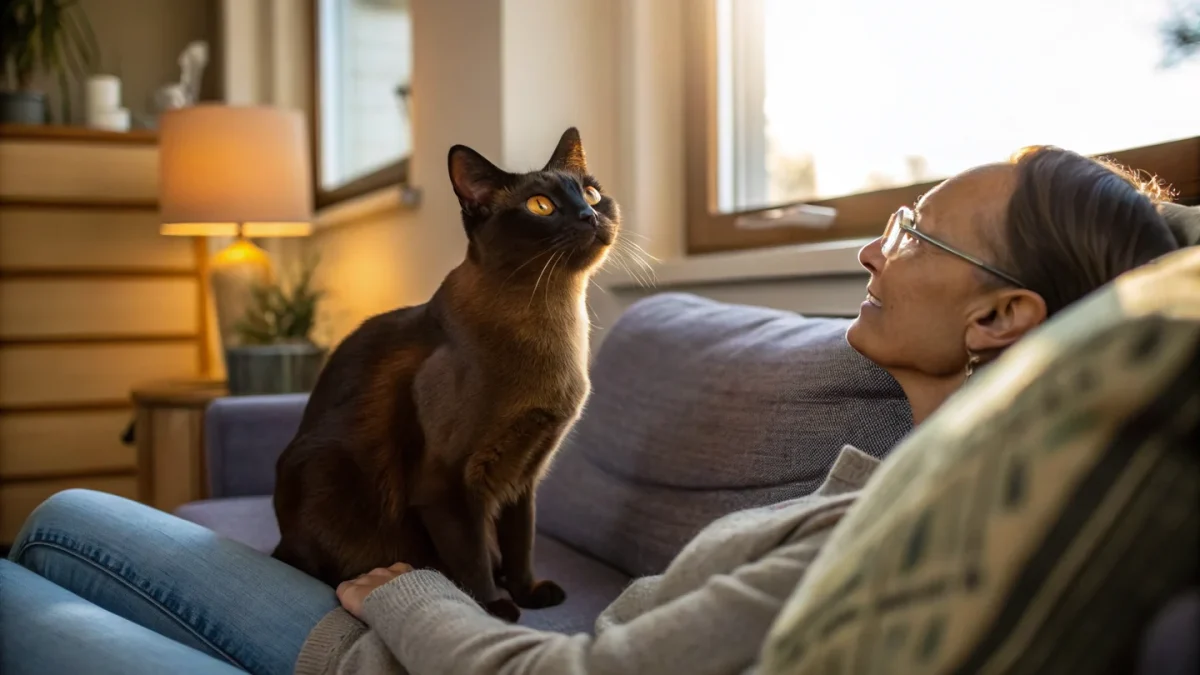
The "velcro cat" nickname arrived so organically and spread so consistently among Burmese owners that it may be the most accurate breed nickname in the cat fancy. The velcro metaphor is exact: the Burmese attaches to you, stays attached, and detaches only when it has decided to re-attach somewhere more convenient.
This is not a metaphor I use lightly. The Burmese genuinely follows. It genuinely waits outside doors. It genuinely settles into the specific crook of your elbow or the particular hollow of your knees at night with the air of an animal that has found its designated location and is confirming the booking.
What Makes the Burmese Different
A lot of cat breeds are described as affectionate. Most of them mean: will accept petting, may seek it occasionally, will tolerate extended holding, will sometimes sleep nearby. These are not small things, but they're different in kind from what the Burmese offers.
The Burmese temperament involves a degree of active participation in your presence that is rare in cats and common in dogs. A Burmese:
- Follows room-to-room with consistency, not occasionally
- Seeks physical contact proactively — paws at you, nudges, positions itself against you
- Demonstrates visible response to emotional tone in its household, often becoming more physically present when its person is distressed or unwell
- Experiences the absence of its person (or absence of sufficient contact with its person) as something that affects its wellbeing measurably
This last point is the one that matters most for prospective owners to understand.
The Intelligence Factor
The Burmese is genuinely intelligent, and this intelligence amplifies both the positive and challenging aspects of the temperament.
On the positive side: Burmese cats train well (in the cat sense of training — they learn household routines, understand cause-and-effect with their people, and can be taught games). Some individuals reliably play fetch. Most learn the difference between acceptable and not-acceptable behaviors when the consequences are applied consistently. The Burmese pays attention to what works.
On the challenging side: the same intelligence that makes the Burmese responsive and trainable also means it learns quickly how to get what it wants. A Burmese that has discovered its vocalization generates contact will use that vocalization. A Burmese that has found that sitting on your keyboard results in attention will sit on your keyboard. The intelligence is not strategically malicious — it's just very efficient.
Vocal Behavior
The Burmese is moderately vocal. The voice is softer and less piercing than a Siamese, but more regularly used than a Russian Blue. They communicate their needs and opinions with a degree of persistence, particularly around mealtimes. The Tonkinese — a Burmese-Siamese cross — occupies a similar vocal middle ground and shares much of the Burmese social drive.
The tone of Burmese vocalization is distinctive — many owners describe it as almost conversational, as if the cat is narrating its experience. "I am following you to the kitchen." "The food bowl situation is unacceptable." "You have been gone for some time and I have feelings about this."
Some individuals become more or less vocal depending on whether vocalization generates the desired response. A Burmese that consistently receives attention when it vocalizes will vocalize more. This can be managed, but it requires consistent response patterns from the owner rather than inconsistent engagement that reinforces persistence.
With Other Animals
The Burmese's social drive extends to other animals in most cases. They tend to do well with other cats, particularly other Burmese or breeds with similarly sociable temperaments. A second Burmese in a household where the cats must be alone for long periods is a genuine welfare consideration rather than just a nice-to-have.
With dogs, the Burmese typically approaches with the same straightforward engagement it applies to everything, which either works well or creates complications depending entirely on the dog's prey drive and temperament.
One note: placing a Burmese with a very independent, territorial, or anxious cat can create problems. The Burmese's lack of caution in social initiation — it approaches directly and with full confidence — does not always land well with cats that prefer to establish boundaries before accepting proximity.
The Social Need: Being Honest About This
The most important thing the Burmese temperament assessment requires is honesty about the social need.
A Burmese that spends 10 hours a day alone in a house without another compatible animal will, over time, show the effects. This might be excessive vocalization when the owner returns. It might be stress-related over-grooming. It might be a flatness to the personality — an absence of the cheerful energy that defines the breed — that reflects genuine unhappiness.
This isn't a flaw in the breed. It's the breed. The Burmese evolved as (or was selected as) a deeply people-attached animal. Meeting that need produces one of the most rewarding companion animals you can have. Consistently failing to meet it produces visible suffering.
The complete Burmese breed guide covers health, history, and grooming, but the temperament is the heart of whether a Burmese belongs in your household. Be honest about your schedule and your willingness to provide genuine company before making the commitment. When that company is provided, the Burmese returns it fully and consistently. There are few cats that make this exchange more explicitly and with less reservation.