

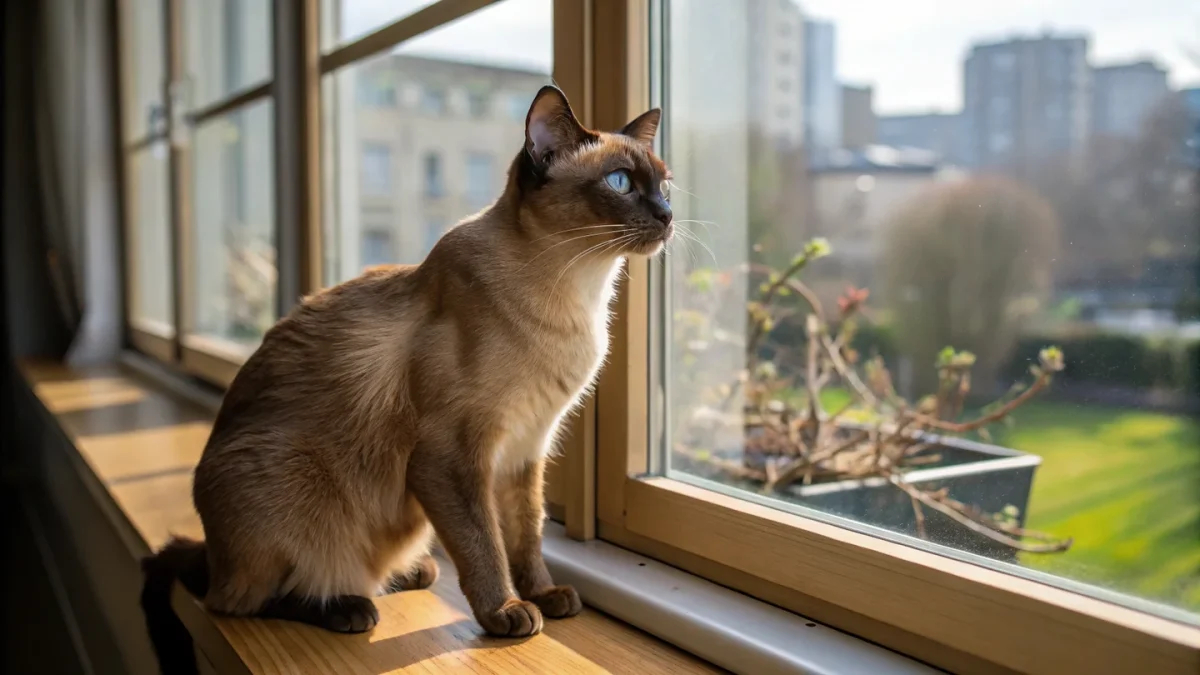
The Tonkinese is the middle note — not the high note, not the low note, but the one that makes the chord resolve. Color-wise, it sits between the pale, sharply contrasted Siamese and the rich, uniform depth of the Burmese. That soft, warm gradient of the mink coat isn't fully one or fully the other; it's its own thing, with those aqua eyes that no other breed reliably produces. Pick one up and you get the Burmese solidity — heavier than the body suggests, muscular and compact. Watch it work a room and you get the Siamese expressiveness, that particular feline intelligence that makes you feel like you're being assessed.
The temperament follows the same logic. A traditional Siamese is a demanding instrument — brilliant, loud, relentless. A Burmese is warmer and steadier, affectionate without the edge. The Tonkinese lands between them: social and engaged, with something to say, but calibrated. You get a cat that wants to be involved without running a constant commentary. For a lot of people, that calibration is exactly what they were looking for — they just didn't know the breed existed.
What Is a Tonkinese Cat?
The Tonkinese is a medium-sized domestic cat produced by crossing the Siamese breed that forms half the Tonkinese's genetic foundation with the Burmese, developed deliberately in Canada and the United States beginning in the 1960s. The breed was recognized by the Canadian Cat Association in the early 1970s and by TICA and CFA in subsequent years.
The Tonkinese occupies a deliberate middle ground between its parent breeds: more sociable and interactive than the average cat (a Siamese inheritance) but less piercing and demanding than a traditional Siamese. More muscular and compact than a Siamese, less cobby than a Burmese. Tonkinese breeders sometimes describe the ideal as "the best of both breeds" — a claim that contains enough truth to have held up for decades.
Physical Characteristics
Tonkinese cats are medium-sized with a surprisingly solid feel for their dimensions — pick one up and you'll find it heavier than expected. The body is muscular and well-proportioned, neither the Oriental's long, lean silhouette nor the Burmese's compact roundness. The head is a modified wedge, slightly rounded, with high cheekbones and a distinct muzzle break.
The eyes are almond-shaped and set at a slight slant — a Siamese characteristic softened by the Burmese influence. Eye color is one of the Tonkinese's most recognizable features: aqua (blue-green) in the mink pattern, blue in pointed, and green-gold in solid. The aqua eyes of a mink Tonkinese are unique among domestic breeds — no other breed reliably produces that particular eye color.
Coat patterns: The Tonkinese produces three patterns, each determined by the combination of the Siamese colorpoint gene (cs) and the Burmese sepia gene (cb):
- Pointed: One copy of the colorpoint gene, with sharply defined darker extremities on a paler body. Blue eyes. Resembles a Siamese in pattern.
- Mink: One copy of each gene (heterozygous). The characteristic Tonkinese pattern — darker than pointed, lighter than solid, with a soft, less sharply defined gradient. Aqua eyes.
- Solid: Two copies of the sepia gene. Uniform body color with very subtle shading. Gold-green eyes. Resembles a Burmese.
When two mink Tonkinese are bred together, the litter will statistically contain all three patterns in roughly a 1:2:1 ratio. Breeding for consistent mink production requires understanding the genetics.
The coat itself is short, fine-textured, and exceptionally silky, with a subtle gloss that makes Tonkinese particularly photogenic.
Tonkinese Temperament
The Tonkinese personality is a study in calibrated sociability. They want to be involved — in your activities, your conversations, your lap — but they're not the cat that will howl at 3am to announce an empty food bowl.
Social orientation: Tonkinese are people cats in the fullest sense. They form strong bonds with their households and are typically welcoming to visitors rather than hiding. Most can be described as extroverted among cats: curious about new people rather than threatened by them.
Intelligence and activity: High on both counts. Tonkinese learn quickly, respond well to clicker training, and invent games when not provided with them. They need mental engagement — puzzle feeders, interactive toys, or a willing play partner — not just physical space. A bored Tonkinese doesn't sulk; it improvises, often in ways the owner finds less than charming.
Vocalization: Present, but in a different register than a traditional Siamese. The Tonkinese voice is softer — it has something to say, but it's not running a constant commentary. Most owners describe them as talkative in a conversational way rather than relentlessly demanding.
With children and other pets: Typically excellent. The Tonkinese's social confidence and interactive nature makes it adaptable to multi-person households. They generally get along well with other cats and with calm dogs.
What Most People Get Wrong About Tonkinese
The most persistent misconception is that Tonkinese are simply "quieter Siamese." They're not a toned-down version of another breed — they're a distinct breed with a character that emerged from generations of intentional selection. The Burmese ancestry contributes a groundedness and warmth that the Siamese doesn't have; the Siamese ancestry contributes a keenness and expressiveness that the Burmese lacks. The result isn't an average — it's a synthesis.
The second mistake is assuming the mink pattern is the "true" Tonkinese while pointed and solid are somehow inferior variants. All three patterns are fully recognized, genetically inevitable when breeding Tonkinese to Tonkinese, and equally valid representatives of the breed. The mink pattern became the most associated with the Tonkinese in public perception simply because it's the most distinctively unique pattern — one that can't be found in a pure Siamese or Burmese.
Third: some people encounter Tonkinese and think they're high-maintenance because of the activity and sociability. These cats do need engagement, but the bar is interaction and play — not specialist care or elaborate management. A Tonkinese that gets daily play and companionship is content.
Coat and Grooming
The short, silky coat is one of the breed's practical pleasures: it's easy to maintain. Weekly brushing is generally sufficient to reduce shedding and keep the coat's characteristic gloss. The Tonkinese sheds less than many longhaired breeds and doesn't require any specialized grooming.
The fine texture does mean that seasonal shedding is noticeable, particularly in spring. More frequent brushing during these periods keeps the coat manageable.
Standard care — dental hygiene, nail trimming, ear cleaning — applies as with any cat. No breed-specific grooming protocols are required.
Health Considerations
Tonkinese are generally robust cats, benefiting from the hybrid vigor that often accompanies cross-breed development. Some considerations:
Respiratory and dental: Tonkinese have an intermediate head shape — not the extreme flat face of a Persian, not the long wedge of a traditional Siamese. This generally means fewer respiratory complications than brachycephalic breeds, but dental crowding can occasionally be a concern given the moderate head width.
Amyloidosis: Siamese and Oriental breeds have a documented susceptibility to amyloidosis — a condition where abnormal protein deposits accumulate in organs, most commonly the liver in these breeds. Because Tonkinese carry the Siamese colorpoint gene as part of their fundamental genetic makeup, they share this predisposition: Tonkinese are explicitly listed alongside Siamese, Burmese, and Oriental Shorthairs in veterinary references on feline amyloidosis. A 2023 study in Genes identified single nucleotide polymorphisms (SNPs) associated with AA-amyloidosis in Siamese and Oriental cats, and the underlying susceptibility appears to reflect a genetically distinct form of serum amyloid A in these lineages that is more prone to forming amyloid fibrils.
General longevity: Tonkinese are typically healthy, long-lived cats. No breed-specific peer-reviewed study exists for Tonkinese longevity, but most veterinary breed sources and registry data place the typical lifespan at 12–16 years, with well-cared-for individuals commonly reaching into their mid-to-late teens. Given that both parent breeds rank among the longest-lived — Burmese leading breed-level data at a mean of 14.4 years in a 2024 RVC study — the Tonkinese's reputation for longevity has a sound genetic basis.
Routine veterinary care, dental cleanings, and appropriate diet are the primary health considerations.
History: From Wong Mau to Breed Recognition
The modern Tonkinese breed is largely the creation of Canadian breeder Margaret Conroy and American breeder Jane Barletta, working in the 1960s. Conroy crossed a Siamese with a sable Burmese and registered the offspring as "Tonkinese" — a reference to the Gulf of Tonkin and a nod to the Asian origin of both parent breeds.
The Cat Fanciers' Association resisted recognition for years, partly because the three-pattern situation complicated the breed standard (pointed kittens looked like Siamese, solid kittens like Burmese — only the mink was distinctively Tonkinese). Full CFA championship status was granted in 1984.
The name itself went through iterations: earlier spellings included "Tonkanese" before "Tonkinese" became standard, an evolution documented in early registry records.
Is a Tonkinese Right for You?
The Tonkinese suits someone who wants genuine daily interaction with their cat — not a cat that exists in the same space but goes its own way. They thrive with owners who enjoy play, conversation (such as it is with a cat), and the occasional supervised adventure.
They are not ideal for people away from home for long stretches without another companion animal present. A Tonkinese paired with another social cat or kept in an active household is happier than a solitary Tonkinese in a quiet apartment.
For people who loved the idea of a Siamese but found traditional Siamese too intense, or who admired Burmese but wanted something slightly livelier, the Tonkinese is a calibration worth considering seriously.
Frequently Asked Questions
Are Tonkinese cats truly a mix of Siamese and Burmese?
Yes, both historically and genetically. Every Tonkinese carries the Siamese colorpoint gene and the Burmese sepia gene in some combination. Modern Tonkinese are bred Tonkinese-to-Tonkinese rather than from fresh Siamese and Burmese crosses, but the genetic heritage is fully present and expressed in the three coat pattern variants.
What makes Tonkinese eyes aqua?
The aqua eye color occurs in the mink pattern because the heterozygous combination of colorpoint and sepia genes produces a different level of pigmentation than either pure Siamese (blue) or pure Burmese (gold-green). This intermediate pigmentation results in the distinctive teal-blue color unique to mink Tonkinese. It's an accidental genetic product of the cross that breeders found attractive enough to preserve.
Do Tonkinese cats get along with dogs?
Generally, yes — the Tonkinese's social confidence and adaptable temperament means proper introductions usually go well. Success depends more on the individual dog's temperament than on the Tonkinese, which typically handles the interaction with curiosity rather than panic.
How long do Tonkinese cats live?
Most veterinary breed sources and registry data place the typical range at 12–16 years, with well-cared-for individuals commonly reaching 16–18 years. No dedicated peer-reviewed study exists specifically for Tonkinese longevity, but the breed's Siamese and Burmese heritage — with the Burmese leading breed-level lifespan data at a mean of 14.4 years in a large 2024 RVC study — supports the reputation for above-average longevity.